Stepping Into an Ink Painting: Suzhou’s Humble Administrator’s Garden
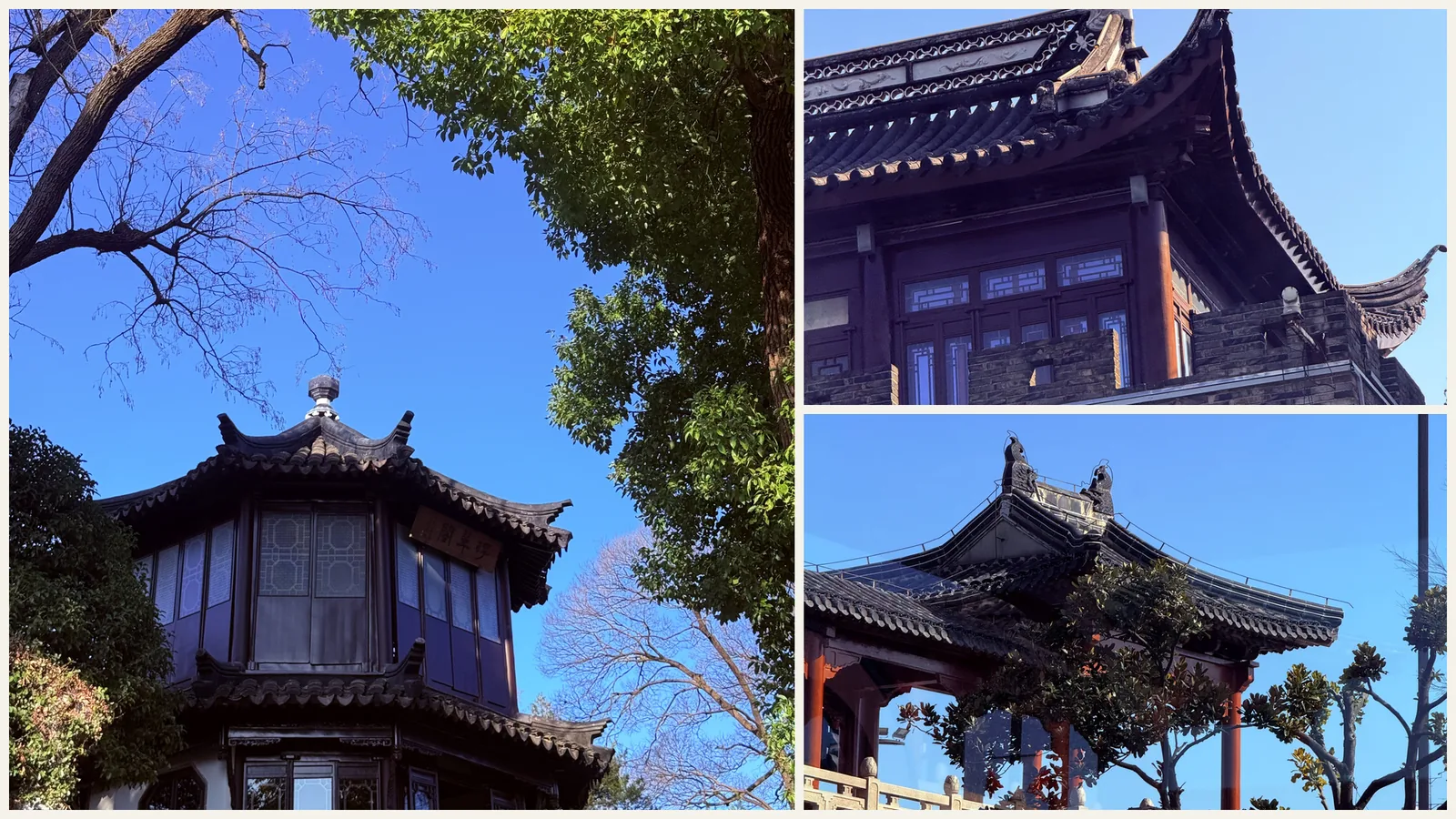
A dark roof lifts into a clear sky. A pavilion appears twice, once above the water and once beneath it. A few steps farther on, a patterned window turns the garden into a picture you could almost hang on a wall.
The Humble Administrator’s Garden, or Zhuozheng Yuan (拙政园), rewards this kind of looking. It is one of the gardens included in UNESCO’s Classical Gardens of Suzhou, a collection celebrated for translating natural landscapes into carefully composed miniature worlds. Its story begins in 1509, when the retired official Wang Xianchen began developing the garden. The grounds have changed through successive owners and restorations; what survives is a layered place, rather than an untouched Ming-dynasty time capsule.
This photo-led guide follows five details worth slowing down for, then brings together the practical information needed to plan a visit. The supplied photographs were taken in February: bare branches and winter light belong to this visit, while summer lotus scenes are a different seasonal experience.
1. First Impressions at the Gate
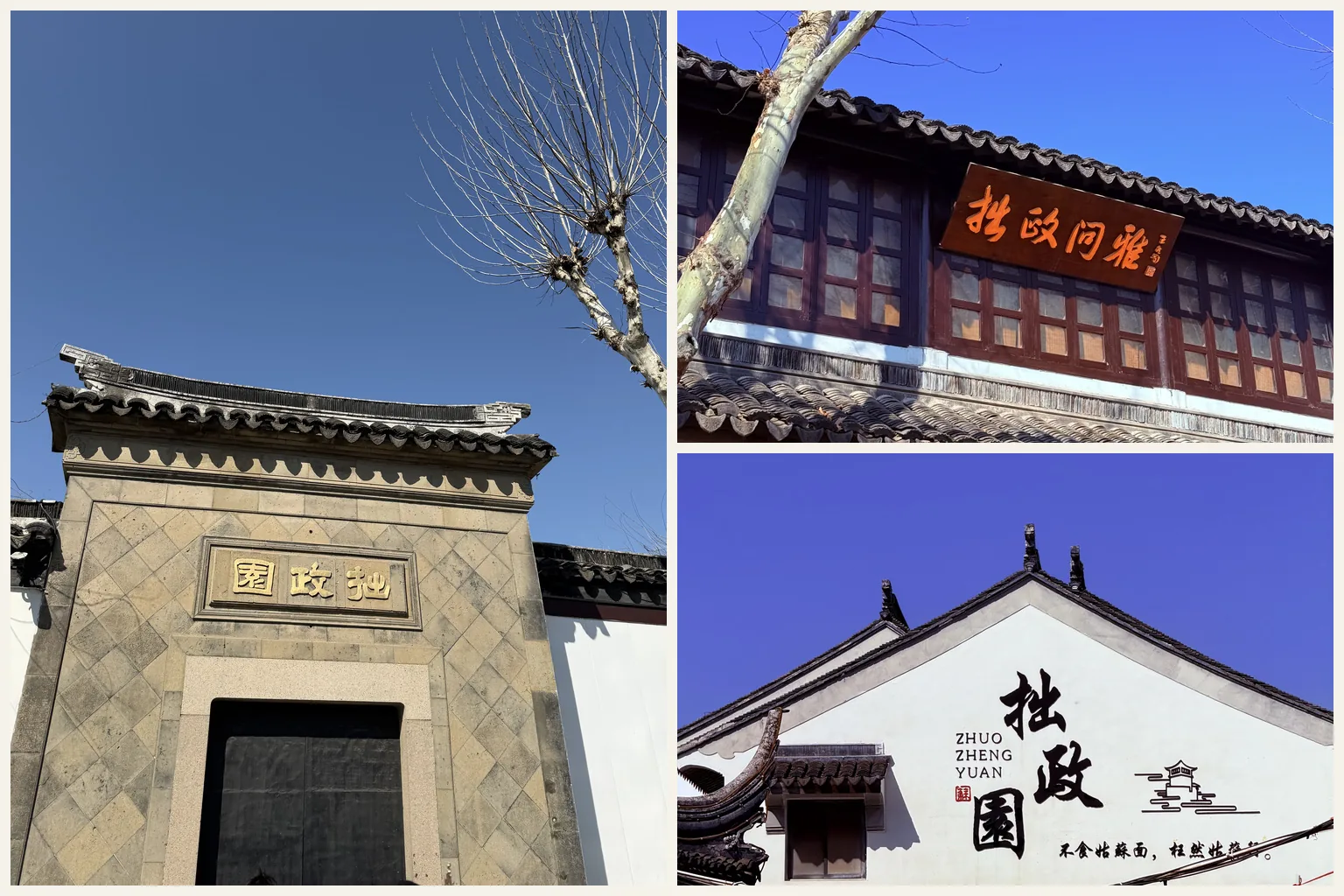
Before the water and pavilions, there is the pleasure of the entrance itself: stonework, dark roof tiles and gold characters against a pale wall. The name appears again in brushwork on a white gable nearby. These are small changes of texture and scale, but they set up a habit that serves you well inside: look at the whole view, then look at its details.
The garden’s name carries a gently self-deprecating reference to a life of cultivation away from official duties. That background gives the place a human scale. Its beauty comes from carefully arranged surroundings in which to walk, read, talk and notice the seasons.
Pause for your entrance photograph, then allow the crowds to move before taking the next frame. This is a popular attraction, and its quieter visual moments can be brief.
2. Bridges, Pavilions and Borrowed Scenery
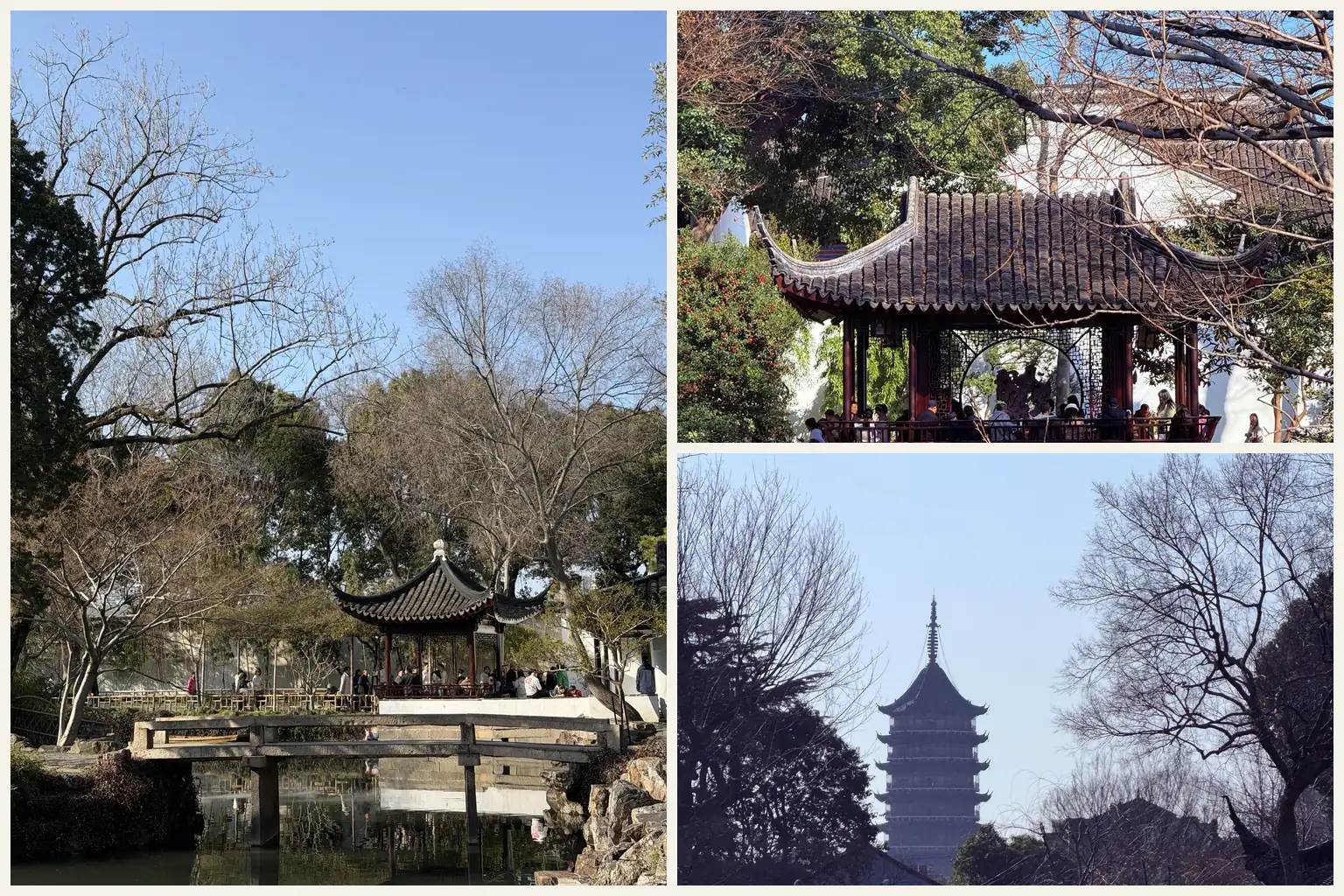
The garden opens through water. A low stone bridge holds a line across the pond; a roof appears between branches; a circular opening in a pavilion frames a smaller scene beyond it. Movement matters here. A view that looks closed from one angle can become unexpectedly deep from another.
One of the best-known examples is the distant Beisi Pagoda, outside the garden walls. The Shanghai landscaping authority describes it as a classic example of jiejing, usually translated as “borrowed scenery”: a landmark beyond the boundary becomes part of the view within. You do not need to know the theory to enjoy it. Look through the layers of water, roofs and trees, then find the tower on the skyline. Its visibility depends on where you stand, the foliage and the light.
The accompanying collage brings together different photographed viewpoints. It is a visual sequence, rather than a map or a claim that all three scenes are visible from one position.
3. Colored Windows and the Pleasure of Framing
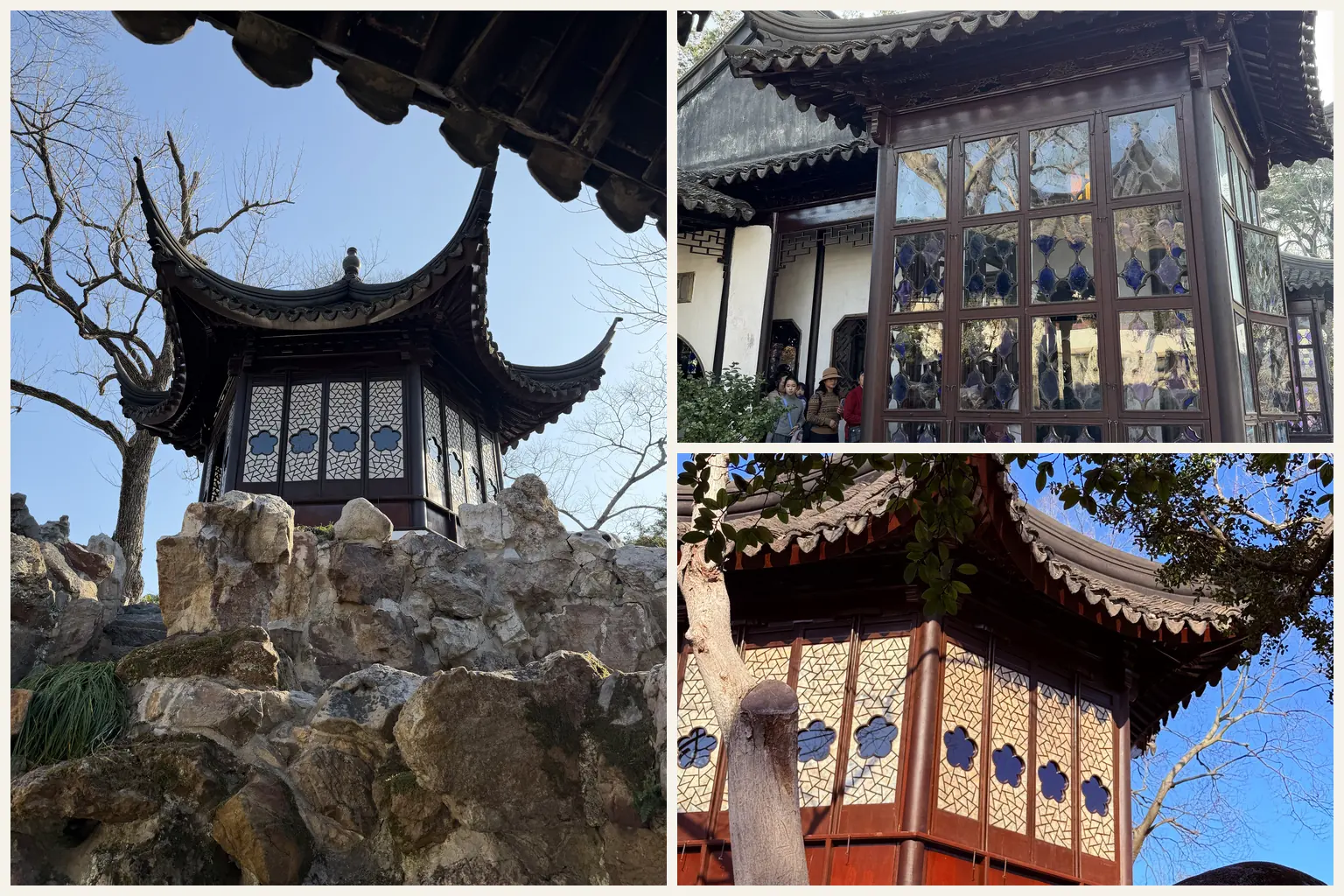
Blue panes catch the eye against dark timber and pale rock. In the photographs, they sit within delicate window patterns, giving even a small pavilion a strong visual presence. Follow the shape of a window first, then notice what changes when you look through it: light, reflections, tree branches and people passing beyond.
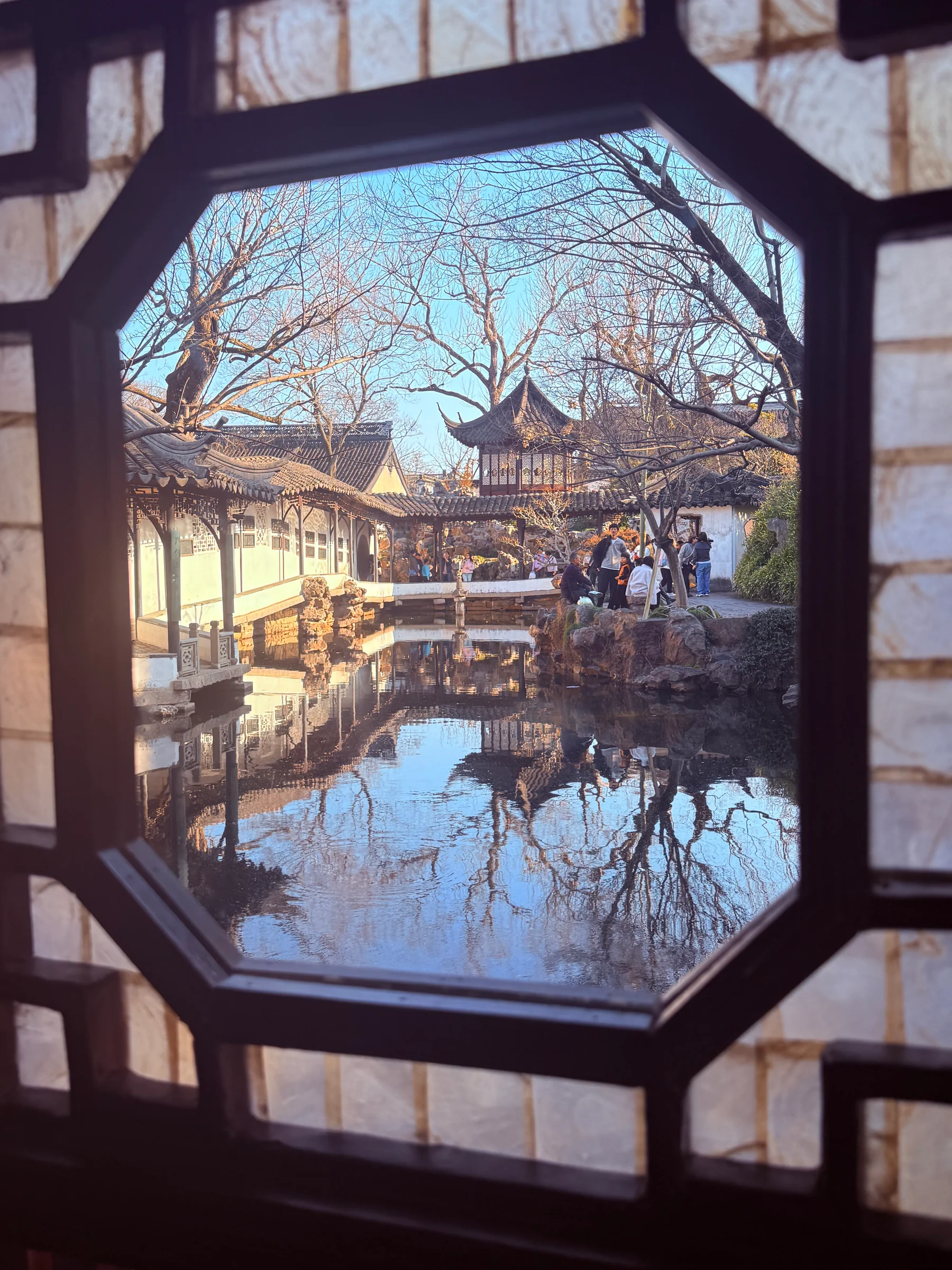
The garden’s windows are worth treating as architecture in their own right. The Suzhou gardens authority documents several traditional materials, including mingwa, translucent shell panels still found at Yiliang Pavilion and elsewhere. Materials and patterns vary across the garden: look for changes in translucency, texture and color as you move between rooms and pavilions.
For photographs, stand slightly to one side and watch how reflections move. A close detail and a wider view often explain the building more clearly together than either image does alone.
4. Rocks and Reflections: A Living Watercolor
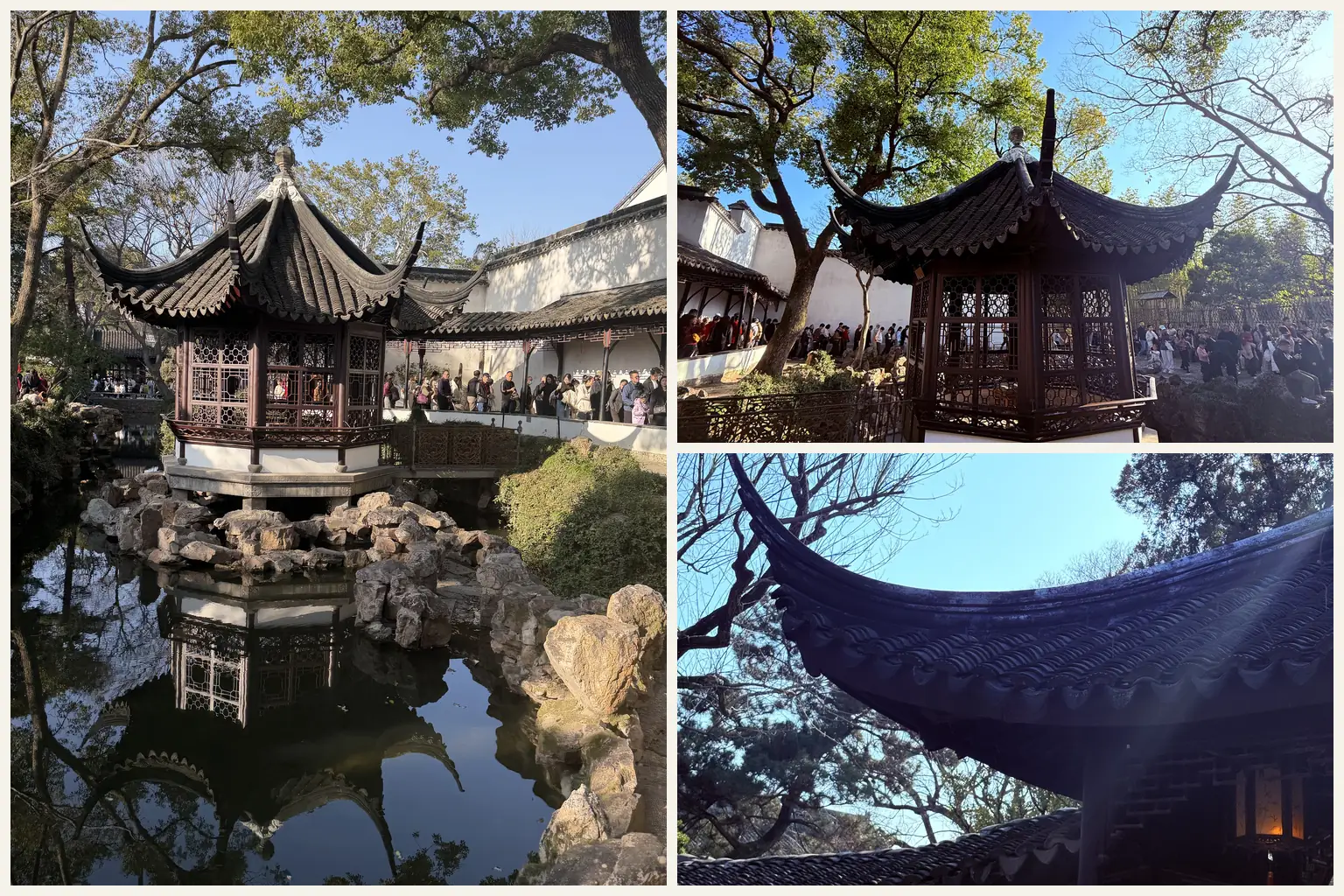
At the pond edge, the dark pavilion in these photographs seems balanced between stone and water. Its roof curves upward; its reflection answers below. Rough rock surfaces provide a counterpoint to the precise timber lattice, while visitors in the background keep the scene firmly in the present.
A small shift in position changes which rocks overlap the pavilion and how much of the reflection remains visible. Wait for the water to settle, then include enough space beneath the roofline for the reflected shape to breathe. On a breezier day, let the broken reflection become part of the picture.
There are many pavilions in the garden, each changing the scale of the view. One appears broad and open from a bridge; another seems almost enclosed among trees. Notice the relationship between the building and its surroundings, then look for the next doorway or bend in the path that rearranges the scene.
5. Quiet Courtyards and Penjing
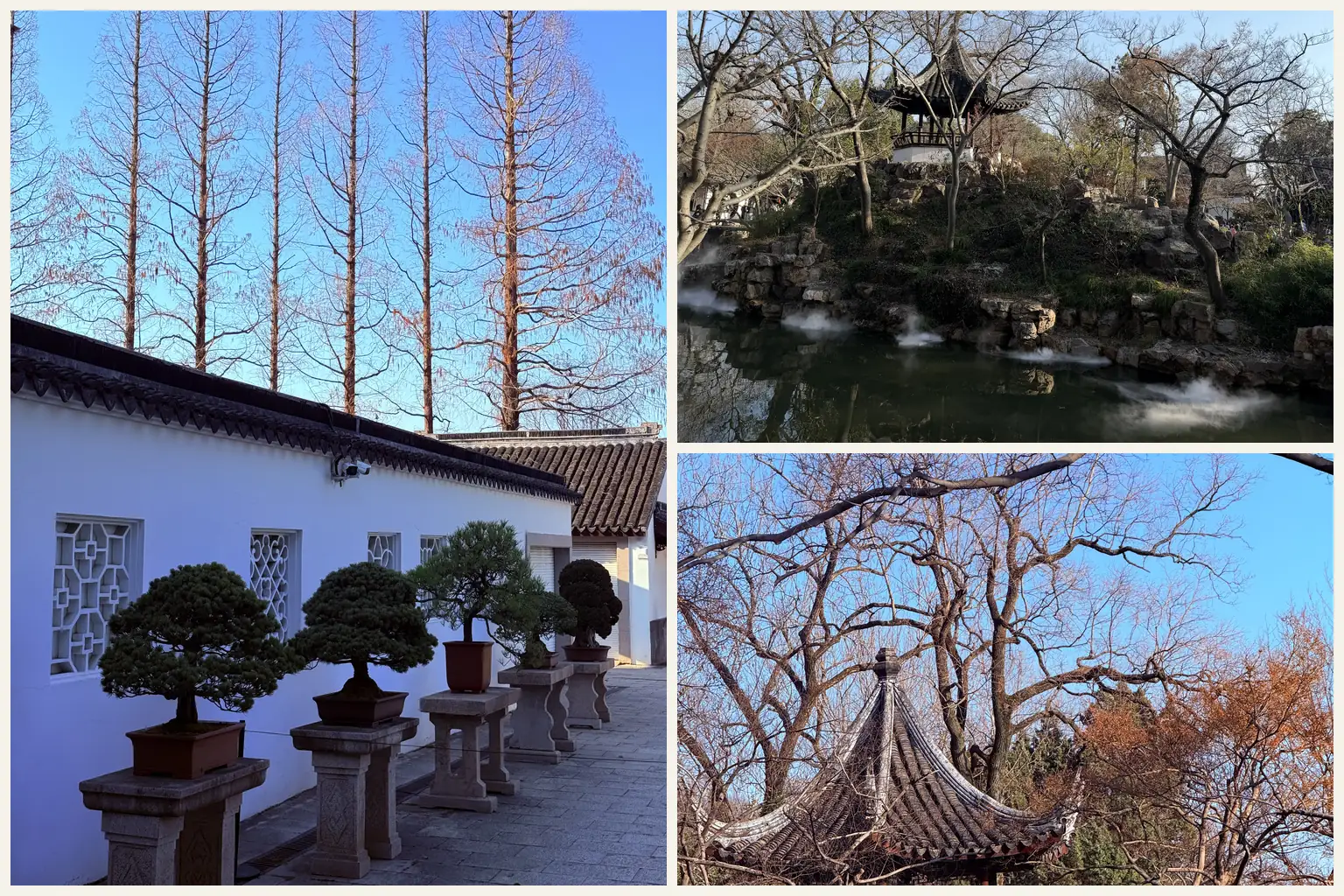
The smaller scenes can stay with you as long as the grand views. Along a white wall, potted trees stand on stone pedestals. Their trunks and branching forms make a procession of miniature landscapes, with patterned windows and tiled eaves providing a restrained backdrop.
Penjing, often compared with bonsai, invites a different pace of looking. Move close enough to notice a tree’s outline and the relationship between its pot and pedestal, while respecting any barriers. A gnarled trunk, an open branch or a carefully chosen pot can hold your attention as readily as a sweeping pond view.
After the busier bridges, leave a little time for the paths and garden edges. A pavilion seen through bare branches, a still pool or a row of small trees can provide a gentle end to the visit. These are moments to seek out, rather than a promise that any particular corner will be empty.
Planning Your Visit
Address: 178 Dongbei Street, Gusu District, Suzhou — 苏州市姑苏区东北街178号.
As an editorial planning suggestion, allow roughly two to three hours for the garden, longer if you enjoy photography or want frequent breaks. The five highlights above are a visual guide, not a compulsory walking route. Use the garden’s current visitor map and any on-site access notices to decide your way around.
Opening hours
The gardens authority publishes the following standard daytime schedule:
| Period | Opening hours | Last admission |
|---|---|---|
| March–October | 7:30 a.m.–5:30 p.m. | 5:00 p.m. |
| November–February | 7:30 a.m.–5:00 p.m. | 4:30 p.m. |
Special notices can override this schedule. For example, the garden opened at 6:45 a.m. from 19 June to 7 October 2026; that was a dated seasonal arrangement, not a year-round opening time. Check the official opening-hours page and your booking confirmation before travelling. Night visits are a separate product with their own arrangements.
Tickets, booking and passports
The published standard adult daytime prices are RMB 80 in April, May and July–October, and RMB 70 in January–March, June, November and December. Check the final price for your selected date and ticket type before payment.
Book ahead. A June 2026 municipal notice specifies real-name, timed reservations one to seven days in advance. Foreign visitors should choose a booking channel that accepts their passport details and bring the same physical passport used for the reservation, together with the booking confirmation. The city has documented passport purchases and staffed assistance for overseas visitors; this should not be read as a guarantee of same-day availability or an identical check-in method on every platform.
If a booking form does not accept your document, contact the official service channel or staffed visitor-service window. Do not assume that a passport alone replaces a confirmed reservation.
How to Get There
From Shanghai
Search China Railway’s official 12306 service for trains from Shanghai Railway Station or Shanghai Hongqiao to Suzhou Railway Station (苏州站). Compare the actual departure station and journey time for your travel date. Suzhou Railway Station and Suzhou North are different stations, with different onward journeys; make sure you book the one you intend.
Treat the train ride as only one part of the trip. Allow time for station security, finding the correct exit and reaching the garden. Journey times vary by service, and the onward transfer adds to them; check the full journey rather than treating the rail time as a door-to-door estimate.
By metro in Suzhou
Line 6: Use Zhuozhengyuan Subo / Humble Administrator’s Garden–Suzhou Museum station (拙政园苏博站). Follow current station signs toward the garden and Dongbei Street. The city’s published station-opening information lists Exits 1 and 3. Check the current exit map for the walking route and any temporary closures; the walk depends on the exit and the entrance in use.
Line 4: Beisita station (北寺塔站) is another option for approaching the old-town area. Use a current local map for the remaining walk to Dongbei Street, rather than relying on a fixed ten-minute estimate.
By taxi or DiDi
Use the garden’s Chinese name and street address: 拙政园,东北街178号. Confirm the permitted drop-off point with your driver. Traffic restrictions, queues and fares vary, especially around holiday periods, so check the live estimate rather than budgeting around a guaranteed fifteen-minute ride.
Make a Day of the Old Town
The Suzhou Museum main building is a natural companion visit on Dongbei Street. Select 本馆, the main site, when checking the museum’s official visitor information; other branches are in different locations. The museum has its own reservation process and opening calendar, separate from the garden ticket.
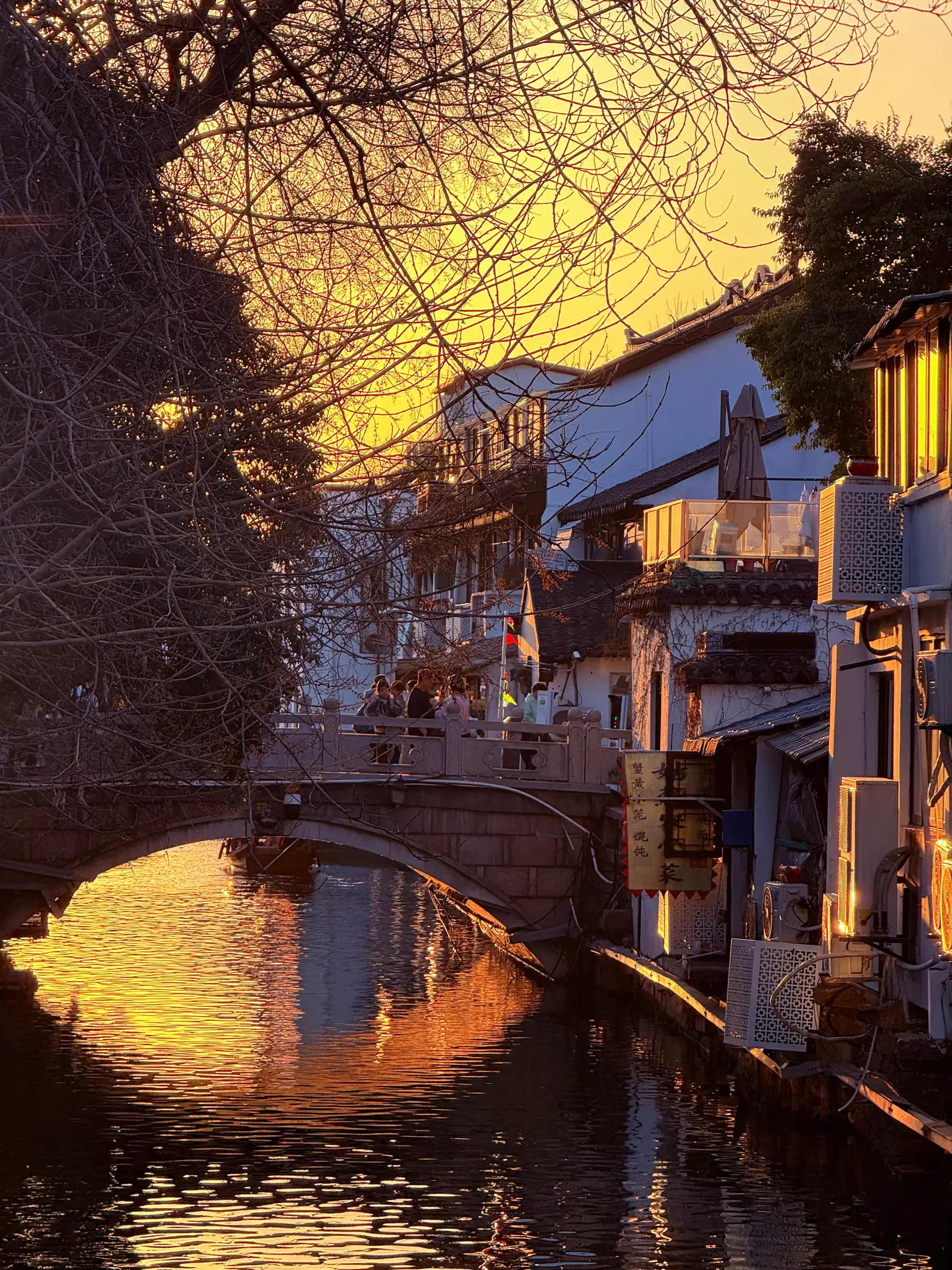
Continue toward the Pingjiang Road historic district if you would like canal-side walking afterward. Its streets and canals make a leisurely extension to the day. Choose a comfortable section on a map and leave room for a tea break.
For the garden itself, the most useful advice is simple: give the views time to change. Step away from the first obvious photo spot, look back through a doorway, and let water, timber and stone find a new arrangement in the frame.
Sources and Photo Notes
Practical information checked on 17 November 2026. Recheck operating notices and booking conditions for your own travel date.
- Suzhou gardens authority: garden history, layout and address.
- Suzhou municipal notice: 2026 seasonal opening and advance booking.
- Suzhou municipal report: overseas visitors and passport ticketing.
- Suzhou municipal Line 6 station and exit information.
- Shanghai landscaping authority: borrowed scenery and Beisi Pagoda.
- Suzhou gardens authority: traditional window craftsmanship.
The editorial collages combine the author-supplied photographs from this garden visit. They preserve separate viewpoints and are not continuous panoramas.