Category: Living

Practical expat lifestyle blueprints and asset protection strategies. Insights into daily life, cost of living, relocation logistics, and property risk management across global expat hubs.

  • Bangkok Expat Life Local Perspective: Living Like a Resident, Not a Visitor

    Bangkok Expat Life Local Perspective: Living Like a Resident, Not a Visitor

    Most guides to Bangkok expat life read like extended hotel brochures. They tell you where to find the best rooftop bars, which malls carry imported cheese, and how to navigate the BTS with a smile. But long-term relocation demands something grittier and more honest: an understanding of how the city actually functions when the novelty wears off and the daily grind sets in. This article offers a Bangkok expat life local perspective grounded in sustained observation rather than vacation enthusiasm. I write as someone who has spent considerable time in the city, built routines there, and learned to distinguish tourist Bangkok from resident Bangkok. I do not claim to speak for Thai people or possess some authentic insider knowledge unavailable to other foreigners. What follows is one informed observer’s account of what it means to truly live in this layered, contradictory metropolis.

    What ‘Local Perspective’ Actually Means in Bangkok’s Layered Society

    Bangkok resists simple categories. The city contains multiple social strata operating in parallel: old-money Thai families, rural migrants who built the metropolis, Chinese-Thai business networks, diplomatic communities, digital nomads, retirees, and the vast invisible labor force that keeps everything running. Many Thais you encounter daily are themselves migrants from Isaan or the south, not born Bangkokians.

    This matters because “local perspective” is not monolithic. In my observation, many long-term foreign residents make the mistake of assuming their Thai neighbors, colleagues, or partners represent some unified “local view.” They do not. A shopkeeper in On Nut whose family came from Ubon Ratchathani twenty years ago experiences Bangkok differently than a fifth-generation Sino-Thai professional in Sathorn. Both are “local” in ways a fresh arrival is not.

    The honest position for any foreign writer is humility. I can describe patterns I have observed, routines I have adopted, and mistakes I have made. I cannot tell you what Thai people “really think” about foreigners because there is no single Thai people and no single foreigner category. The retiree on a marriage visa, the engineer on a work permit, and the undocumented migrant worker occupy radically different positions in Bangkok’s social architecture.

    Neighborhoods Where Residents Actually Live, Not Just Where Expats Congregate

    Sukhumvit between Nana and Thong Lor, Silom, and Riverside remain expat-heavy zones where English suffices and international amenities cluster. There is nothing wrong with starting there. But many foreigners who stay beyond two years find themselves drifting east or north, drawn by lower rents, less performative lifestyles, and the gradual accumulation of Thai-language competence that makes more neighborhoods viable.

    Phra Khanong and On Nut, once considered peripheral, have developed genuine mixed communities. You will find Japanese families, young Thai professionals, and middle-income foreigners in the same condominium buildings, sharing the same street food vendors. The area along Sukhumvit Road still carries expat infrastructure, but venture one soi east and you encounter wet markets, motorcycle repair shops, and temple fairs that operate entirely in Thai.

    Further out, Bang Na and Srinakarin offer lower costs and more space, though commute times to central business districts test patience. Ari and its northern extension along Phahon Yothin Road attract a younger, creative-leaning crowd both Thai and foreign, with less of the packaged “hipness” that can feel manufactured in Thong Lor.

    What distinguishes resident neighborhoods from expat bubbles is not absence of foreigners but proportion and function. In a genuine residential area, foreigners are present but not dominant. The restaurants do not primarily serve Instagram aesthetics. The markets existed before you arrived and will continue after you leave. These areas require some Thai language or at least willingness to communicate through gesture and patience.

    Readers considering property arrangements in any Bangkok neighborhood should review current leasing regulations carefully. Our related coverage on property leasing risks for foreigners in Thailand examines common contractual pitfalls that affect long-term residents more than short-term visitors.

    Daily Rhythms: How Bangkok’s Physical and Social Infrastructure Shapes Your Routine

    Bangkok operates on distinct temporal patterns that reshape your body and habits within months. The morning cool between six and eight o’clock becomes precious real estate for exercise, market shopping, or simply sitting outside before the heat builds. By mid-morning, the city shifts indoors. Air conditioning ceases being luxury and becomes survival infrastructure.

    The afternoon lull, roughly two to four, sees many small businesses slow dramatically. This is when naps happen, when motorcycle taxi drivers doze on their seats, when the city conserves energy for evening resurgence. Dinner service often runs later than Western schedules, with many families eating at eight or nine. Night markets and street food stalls peak after dark, when temperatures drop to merely oppressive.

    Water defines domestic life more than most foreigners anticipate. The need for constant hydration, the frequency of showers, the management of laundry in humidity that prevents proper drying without mechanical assistance. Your relationship with your air conditioner becomes almost marital. Electricity bills reflect this dependency, and as of early 2024, typical monthly costs for a one-bedroom apartment running AC regularly ranged from 1,000 to 1,500 THB depending on usage patterns and unit efficiency. These figures fluctuate with energy prices and individual habits.

    The soi system itself shapes movement. Major roads are arteries, often jammed, but the real circulation happens through these smaller residential lanes. Learning your neighborhood’s soi network reveals shortcuts, hidden vendors, and the particular social ecology of your immediate area. Each soi develops its own character, its own gossip network, its own unspoken rules about parking, noise, and trash disposal.

    The Unspoken Etiquette of Sharing Space in a Dense, Hierarchical City

    Bangkok’s population density demands negotiated coexistence. In my observation, many Thais manage this through practiced indirectness that foreigners often misread as passivity or avoidance. The smile that seems friendly may also be a social lubricant preventing confrontation. The refusal to directly say “no” preserves face for both parties but requires foreigners to develop radar for soft rejection.

    Hierarchical awareness permeates daily interaction. Age, status, and perceived social position shape language registers, physical positioning, and deference patterns. Many foreigners blunder through these dynamics unconsciously, neither offending catastrophically nor integrating smoothly. The goal is not perfect performance but sufficient sensitivity to avoid repeated friction.

    Queue behavior, noise levels in shared housing, and motorcycle parking all carry location-specific norms that you learn through observation and occasional correction. The auntie who gestures at your improperly parked bike is doing you a favor. The security guard who ignores your greeting may be indicating you have not yet earned acknowledgment. These small negotiations accumulate into a sense of belonging or its absence.

    Food Culture Beyond the Instagram Spots: Markets, Street Stalls, and Domestic Eating

    Bangkok’s food reputation is deserved but often misunderstood by newcomers who gravitate toward curated experiences. The Michelin-recognized street stalls and trendy cafes represent a fraction of actual eating patterns. Most Bangkok residents, Thai and foreign alike, sustain themselves through an ecosystem of unglamorous, hyper-practical food provision.

    The fresh market, not the supermarket, remains the backbone of daily cooking for many households. Morning markets offer produce, proteins, and prepared ingredients that assume home cooking knowledge. The learning curve is steep. You must recognize vegetables, understand cuts of meat displayed differently than Western butchery, and communicate quantities in a system that may use traditional Thai measurements.

    Street stalls operate on specialization. One cart does one dish, perfected over years, served rapidly to known customers. Regulars develop relationships with vendors who remember preferences without asking. This is not tourism performance but subsistence infrastructure. A reliable rice-and-curry stall becomes a pillar of your weekly routine, your emergency meal when cooking feels impossible.

    Home cooking in Bangkok requires adaptation. Kitchens in older apartments are often small, ventilation limited, and Western oven-centric recipes impractical. Many long-term residents develop hybrid approaches: Thai-style stir-fries and soups supplemented with occasional elaborate cooking projects. The tropical heat discourages lengthy food preparation. The abundance of cheap, good prepared food reduces incentive.

    Getting Around: Why Transportation Choices Define Your Bangkok Experience

    Your mobility decisions fundamentally shape your relationship with the city. The BTS and MRT systems, expanded significantly in recent years with new lines and station openings, offer reliability that surface transport cannot match. However, coverage remains incomplete, and the “last mile” problem persists. As of 2024, construction continues on several extensions, and riders should verify current routes with the Bangkok Mass Transit Authority or official transit updates rather than relying on older maps.

    Motorbike taxis serve as the connective tissue between transit stations and final destinations. The experience intimidates many newcomers: negotiating price, clinging to a stranger, weaving through traffic that seems actively hostile. Yet they become indispensable, especially during monsoon season when walking even short distances becomes unpleasant.

    Grab and Bolt provide alternatives that many foreigners default to, but costs accumulate. A resident learns when these services justify expense and when public options suffice. The motorcycle taxi queue at your local station, the bus route that runs against traffic direction, the ferry crossing that avoids bridge congestion: these knowledge pieces separate residents from visitors.

    Car ownership presents its own calculus. Traffic congestion in central Bangkok remains severe, parking expensive and scarce, and the psychological toll of navigation significant. Yet for families or those living in less transit-served areas, it becomes necessary. The foreigner’s license process, insurance requirements, and accident liability frameworks all demand careful attention to current regulations.

    The Language Reality: Thai Proficiency and Its Impact on Daily Life

    English sufficiency varies enormously by context. Central business districts, international hospitals, and tourist-oriented services operate comfortably in English. Government offices, local contractors, fresh markets, and emergency situations often do not. The gap between these worlds defines much of the foreign resident experience.

    Basic Thai transforms daily life more than most anticipate. Numbers, food vocabulary, and polite particles open doors that remain closed to monolingual foreigners. The effort itself, however fumbling, often generates goodwill that pure English dependence does not. Many Thais appreciate the attempt even when execution is poor.

    Reading Thai script, not merely speaking, provides independence. Menus without English translations, official documents, medication instructions, and neighborhood signage all become accessible. The investment is substantial: Thai is a tonal language with its own script, and progress feels slow. Yet long-term residents consistently identify literacy as a turning point in their comfort and capability.

    Language schools abound, quality varies, and self-study resources have improved dramatically. The critical factor is consistent application in real situations rather than classroom perfection. The foreigner who stumbles through market negotiations daily progresses faster than the one who completes advanced courses but fears embarrassment.

    Weather, Health, and the Physical Adaptation to Tropical Urban Living

    Bangkok’s climate demands respect. The hot season, roughly March through June, pushes temperatures above 35°C with humidity that renders air conditioning essential rather than optional. The rainy season brings sudden, intense downpours that flood streets and test drainage infrastructure. The cool season, November through February, offers relative relief that residents anticipate with almost religious intensity.

    Physical adaptation happens gradually and incompletely. Some foreigners never adjust to the perpetual sweat, the need for multiple daily showers, the way clothing deteriorates faster in humidity. Others find their bodies recalibrating, their heat tolerance expanding, their preference for cold climates permanently altered.

    Healthcare access in Bangkok is generally good, with international-standard hospitals in central areas and more affordable local clinics for routine needs. However, navigating the system requires understanding: which hospitals accept which insurance, when to use emergency services versus scheduled appointments, how to communicate symptoms across language barriers. Tropical diseases, while not omnipresent, require awareness. Dengue fever, in particular, poses genuine risk and demands preventive measures against mosquito exposure.

    Air quality has emerged as a growing concern, with seasonal pollution from agricultural burning and perennial vehicle emissions combining to produce hazardous levels. Long-term residents increasingly invest in air purifiers, monitor AQI readings, and plan outdoor activities around pollution forecasts. This represents a significant change from even a decade ago, when such concerns received less attention.

    Building Genuine Connections: Beyond the Expat-Local Divide

    The expat bubble is real and seductive. English-speaking social circles, international schools, and shared complaint sessions about Thai inefficiency provide comfort and community. They also limit integration and, in my observation, often breed cynicism that becomes self-fulfilling.

    Genuine connection across cultural and linguistic boundaries requires sustained effort and mutual vulnerability. It does not happen through one temple visit or charitable gesture. It develops through repeated, low-stakes interactions: the daily exchange with your security guard, the gradual conversation with your regular food vendor, the neighbor who initially ignored you and eventually nodded recognition.

    Many Thai-foreigner friendships form around shared practical activities rather than explicit cultural exchange. Exercise groups, craft workshops, language exchange partnerships, and professional collaborations all provide natural contexts. The foreigner who shows up consistently, contributes reliably, and demonstrates patience with imperfect communication builds trust over time.

    Romantic relationships accelerate integration for some and create complications for others. The visibility of foreigner-Thai couples in Bangkok masks varied dynamics: genuine partnerships, transactional arrangements, and everything between. Generalization is impossible and inappropriate. What matters is individual integrity and honest assessment of mutual expectations.

    When Bangkok Stops Being ‘An Experience’ and Becomes Simply Home

    There is a tipping point that long-term residents recognize but rarely articulate. The temple you once photographed obsessively becomes background. The street food you raved about to friends back home becomes Tuesday dinner. The traffic jam that once seemed exotic chaos becomes simply annoying. This normalization is not failure or jadedness. It is the necessary transformation from tourist to resident.

    The city reveals itself differently at this stage. You notice infrastructure changes, new construction, neighborhood shifts that short-term visitors miss. You develop opinions about urban planning, transit policy, political developments that affect daily life. You mourn places that close, celebrate improvements that arrive, feel proprietary about your particular corner of the metropolis.

    This is also when the hard questions emerge. Visa stability, long-term financial planning, aging in a foreign country, political risk, family obligations elsewhere. Bangkok as home requires confronting these realities rather than deferring them. Many foreigners cycle through repeated one-year plans that accumulate into decades without deliberate choice. Others make explicit decisions to build permanent lives, with all the complexity that entails.

    For professionals evaluating whether long-term international living aligns with broader life goals, our overview of Southeast Asia residency comparison: Thailand vs Philippines offers context for regional decision-making. Those considering eventual relocation to the United States through employment-based pathways may find value in understanding the EW3 visa pathway for skilled workers seeking U.S. permanent residency, which we examine in separate coverage.

    Common Risks or Mistakes

    Long-term Bangkok living presents predictable pitfalls that observation and experience can help avoid.

    Over-reliance on expat infrastructure limits both cost control and integration. The foreigner who shops only at supermarkets, eats only at English-menu restaurants, and socializes only with other foreigners pays premium prices for constrained experience.

    Visa complacency endangers stability. Thai immigration regulations have tightened in recent years, with more scrutiny of visa runs, retirement visa financial requirements, and work permit compliance. Rules change, enforcement patterns shift, and assumptions based on past practice become hazardous. Current regulations should be verified with official sources or qualified legal professionals, not expat forum anecdotes.

    Financial underestimation affects many who assume Bangkok living remains cheap indefinitely. While costs can be modest by Western standards, lifestyle inflation, unexpected medical needs, currency fluctuation, and the desire for periodic home-country travel accumulate. Budgeting should include contingency reserves and awareness that exchange rates between Thai baht and major currencies shift over time.

    Cultural performance without substance fools no one. The foreigner who masters wai positioning but remains fundamentally inconsiderate, who speaks some Thai but listens poorly, who demands integration on their own terms, generates friction that fluent language cannot resolve.

    Isolation in crisis represents perhaps the deepest risk. The apparent ease of Bangkok living can delay development of genuine support networks. When serious illness, relationship breakdown, or legal trouble strikes, the foreigner without local connections faces disproportionate difficulty.

    Key Takeaways

    • Bangkok’s “local perspective” is plural, not singular: multiple Thai communities coexist with distinct experiences of the city
    • Long-term comfort typically requires moving beyond expat-concentrated neighborhoods into genuinely mixed residential areas
    • Daily rhythms shaped by heat, humidity, and infrastructure differ substantially from Western urban patterns and demand physical adaptation
    • Thai language proficiency, especially literacy, transforms practical capability and social possibility more than most foreigners initially invest
    • Transportation knowledge—soi networks, transit combinations, timing strategies—separates functional residents from dependent visitors
    • Food culture operates on practical subsistence logic beneath its celebrated surface; market integration and vendor relationships build genuine connection
    • The transition from “Bangkok as experience” to “Bangkok as home” brings new challenges that require explicit life planning rather than passive continuation
    • Visa, financial, and legal compliance require ongoing attention to current regulations, not reliance on outdated assumptions or informal advice

    Frequently Asked Questions

    How long does it typically take to feel genuinely comfortable living in Bangkok?

    Most long-term residents report a progression: initial excitement lasting weeks to months, followed by a difficult adjustment period of six to eighteen months when novelty fades but competence remains incomplete. Genuine comfort, defined as navigating daily life without constant conscious effort, typically emerges after two to three years of sustained residence. This varies enormously with prior international experience, Thai language acquisition, employment situation, and social network development. Some foreigners never reach this stage and either leave or remain in perpetual tourist mode.

    Which Bangkok neighborhoods offer the best balance of local atmosphere and foreigner-friendly infrastructure?

    Phra Khanong and On Nut currently attract many mid-career foreigners seeking this balance, offering transit access, mixed demographics, and ungentrified local commerce alongside sufficient international amenities. Ari and northern Phahon Yothin appeal to younger residents valuing creative community over polished expat services. Further east, Bang Na provides lower costs with increasing convenience as transit expands. The optimal choice depends on individual priorities: commute tolerance, space needs, budget constraints, and willingness to use Thai language in daily transactions. Neighborhood character evolves rapidly, and recent verification with current residents is advisable before committing.

    Is it necessary to learn Thai to live well in Bangkok long-term?

    Survival without Thai is possible in central, expat-oriented areas. Living well—defined as genuine independence, cost efficiency, social breadth, and emergency capability—requires at least functional spoken Thai and ideally basic literacy. The threshold for meaningful improvement in daily life is lower than many assume: numbers, food vocabulary, direction-giving, and polite particles address most routine needs. Reading Thai script unlocks deeper layers: menu comprehension, official document navigation, and neighborhood exploration. The investment is substantial but the return compounds over years of residence.

    What are the biggest mistakes foreigners make when trying to integrate into Bangkok life?

    Common errors include: treating Thai indirectness as weakness or dishonesty rather than social protocol; expecting integration to happen through consumption (temple visits, cooking classes) rather than sustained participation; failing to develop patience with processes that differ from home-country efficiency assumptions; romanticizing or exoticizing Thai culture rather than engaging its practical realities; and maintaining purely transactional relationships with service providers who could become genuine connections. Perhaps most damaging is the assumption that money substitutes for respect, or that spending more earns deeper acceptance.

    How has Bangkok changed for long-term foreign residents in recent years?

    Several trends are observable: increasing digitization of government services and financial transactions, reducing some bureaucratic friction but creating new barriers for the less technologically adept; gradual tightening of visa enforcement and retirement financial requirements; rising awareness of air quality issues affecting daily health decisions; continued transit expansion altering neighborhood accessibility and desirability; and a subtle shift in Thai attitudes toward some foreign resident categories, with more scrutiny of digital nomads and less automatic hospitality extended to all. These patterns continue evolving, and residents must monitor current developments rather than relying on established routines.

    Considering Long-Term Options Beyond Thailand?

    Bangkok offers remarkable possibilities for those who commit to genuine engagement rather than surface-level consumption. Yet long-term international living raises broader questions about stability, citizenship pathways, and eventual goals. Some professionals ultimately seek permanent residency options elsewhere, including employment-based immigration to the United States.

    For skilled workers exploring U.S. permanent residency through employment channels, the EW3 visa pathway represents one potential avenue, though processing times, visa bulletin movements, and individual eligibility vary considerably. Current government procedures and timelines should be verified through official U.S. government sources, as these change periodically.

    SerialExpat.com assists professionals and families in evaluating international living strategies with realistic assessment of pathways, timelines, and practical requirements. If you are weighing Bangkok long-term residence against other regional or global options, or exploring how current living experience might connect to future immigration planning, we invite consultation to discuss your specific situation.

    Disclaimer

    This article is for general informational purposes only and does not constitute legal, tax, immigration, financial, or property investment advice. Laws, government procedures, visa bulletin dates, processing times, tax rules, and local regulations may change. Readers should verify information with official sources or consult a qualified professional.

  • Manila Condo Risk: Flair Towers Walkout Case Study


    Introduction: A “Building Problem” That Exposes a “System Problem”

    In June 2026, residents and owners of Flair Towers in Mandaluyong, Metro Manila reported a scenario that should make any overseas buyer pause: a serious dispute between the condo corporation (homeowners/condo association structure) and the developer-linked property management company escalated to the point where the management team allegedly withdrew abruptly, leaving day-to-day operations in a state of confusion.

    People described practical consequences that sound small until they happen to your asset:

    • official communication channels disrupted
    • maintenance and repair workflows slowed or inaccessible
    • operational coordination and security routines thrown into uncertainty

    If you live in the building, you can show up, ask questions, attend meetings, and push for action.
    If you are an overseas owner, you often learn about it late—and you have fewer ways to respond quickly.

    I’ve spent years living and working across countries with a “risk controller” mindset. My conclusion is simple:

    Flair Towers is not just a one-off “property drama.” It’s a case study in how Philippines condo ownership can become a cross-border governance problem—especially for absentee investors.

    If you’re considering buying (or already own) a condo in Manila, this article breaks down three system-level risks that marketing brochures rarely explain.


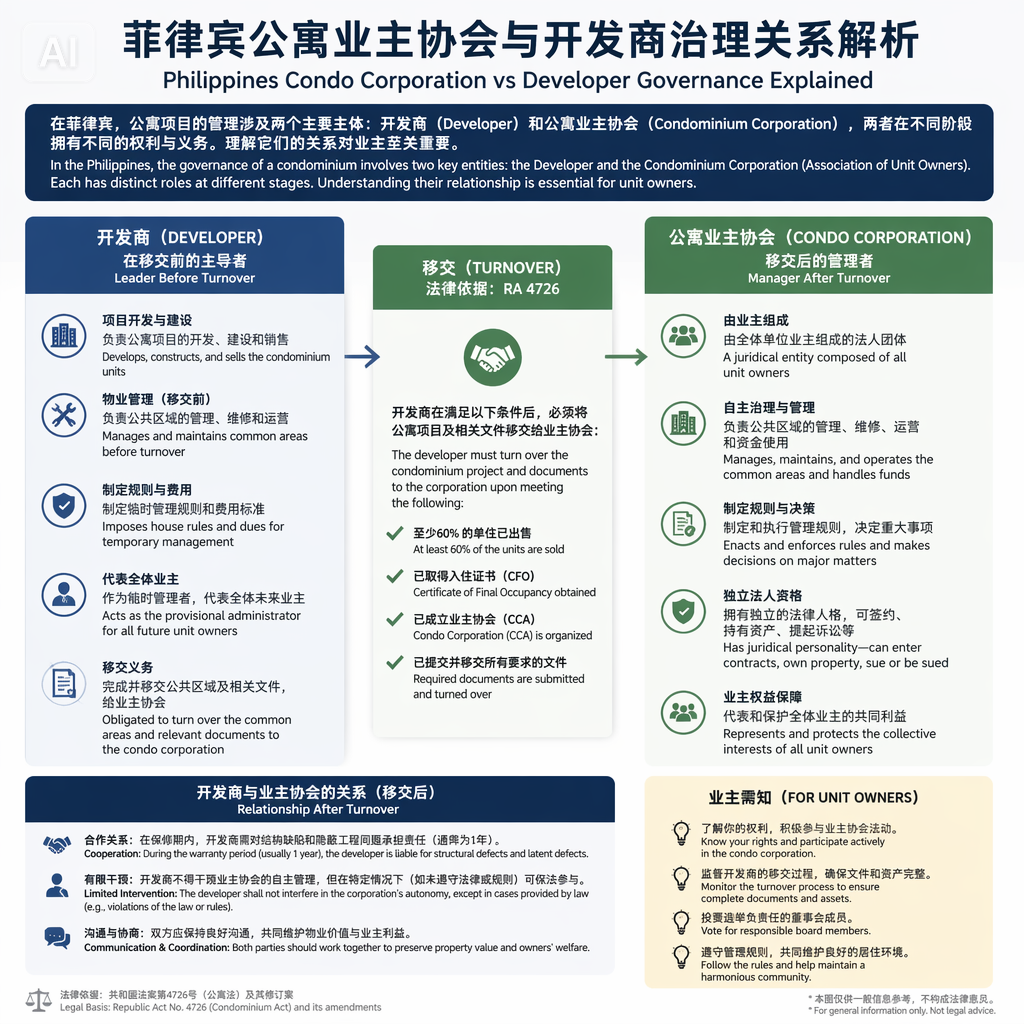
    Risk #1 — The Hidden Power Shift: Developer vs. Condo Corporation Governance

    Many foreign buyers focus on the developer brand: DMCI, Megaworld, SMDC, and others. The assumption is understandable: “Big developer = safer investment.”

    But Philippines condo ownership has a governance structure that surprises overseas investors.

    In many condo setups, once a building reaches a certain stage of turnover/occupancy, a condo corporation / homeowners association (the collective ownership body) becomes the key governing entity for building operations. That creates a structural tension:

    • The developer (or its affiliated company) often wants a management structure that supports predictable fees and vendor control.
    • Unit owners (through the condo corporation) increasingly demand transparency, accountability, and tighter cost oversight.

    When both sides cooperate, things look smooth.

    When they don’t—especially during disputes involving budgets, billing, contracts, or governance—building operations can become the battlefield. And when that conflict escalates, the people caught in the middle are usually:

    • tenants (who just want repairs and stable services)
    • on-site residents (who experience daily disruption)
    • overseas owners (who lose visibility and reaction speed)

    The hard truth: you may think you bought a passive “rental asset,” but you also bought into a local governance system that can change direction quickly.


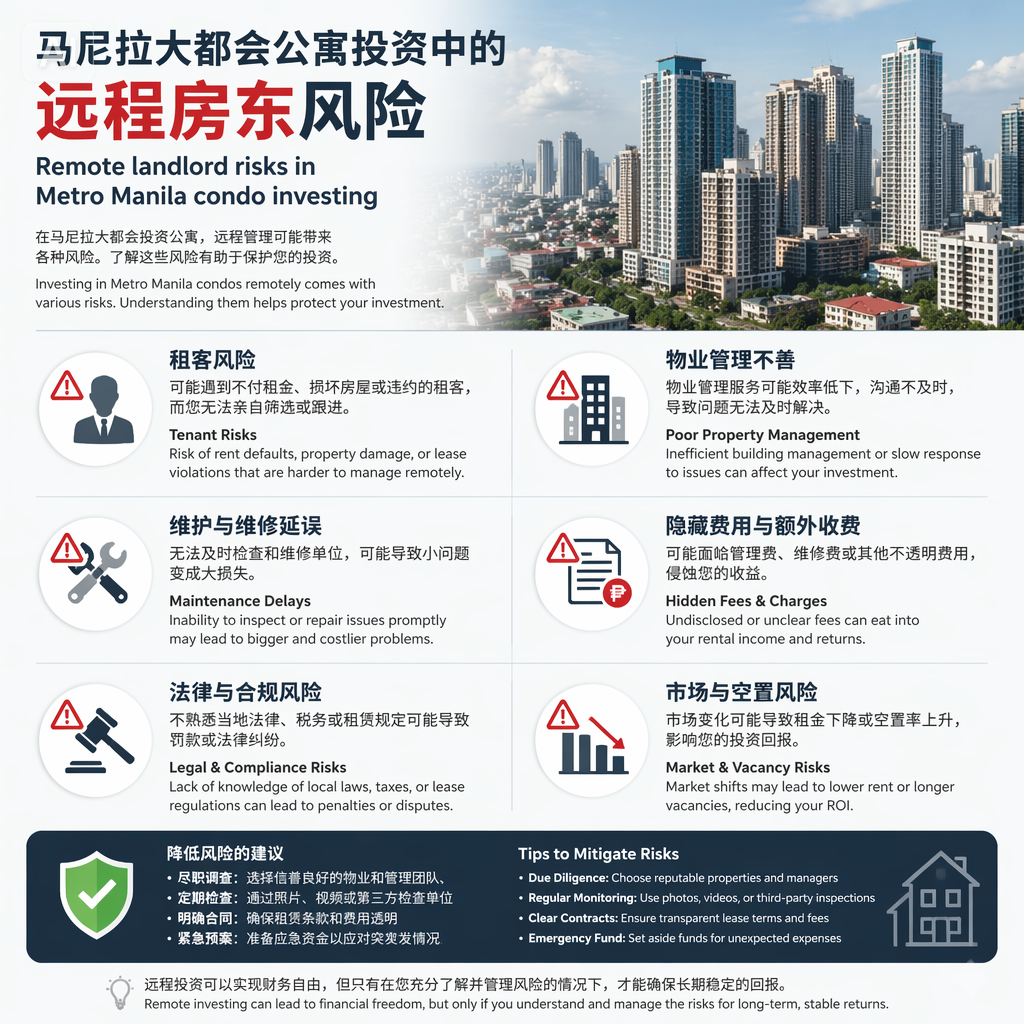
    Risk #2 — “App-Based Management” Can Collapse Into a Physical Blind Spot

    A popular sales narrative for overseas buyers goes like this:

    “Don’t worry. Everything is managed. You can collect rent and handle issues from your phone.”

    That can be true—when the system runs normally.

    But cross-border property management has a fragile dependency: your visibility is only as good as the local workflows. If digital channels (apps, portals, official email systems, ticketing tools) become unreliable during management transitions or disputes, overseas ownership can feel like managing a property through fog.

    What does that look like in real life?

    • Repairs slow down → tenants lose patience
      Manila’s climate (heat, humidity, typhoons) turns “minor maintenance” into fast deterioration. If leaks, mold, AC issues, or plumbing problems aren’t handled quickly, tenants don’t wait politely. They negotiate hard, withhold rent, or move out.
    • Deferred maintenance compounds
      In tropical conditions, an empty unit doesn’t “pause.” Paint, ceilings, walls, and fixtures degrade faster without consistent upkeep.
    • Cross-border coordination cost spikes
      The moment you can’t rely on stable building processes, your “remote ownership” turns into coordination work—calls, vendor sourcing, follow-ups, and sometimes costly in-person trips.

    This is why I treat “one-tap property management” as a best-case scenario, not a guaranteed baseline.


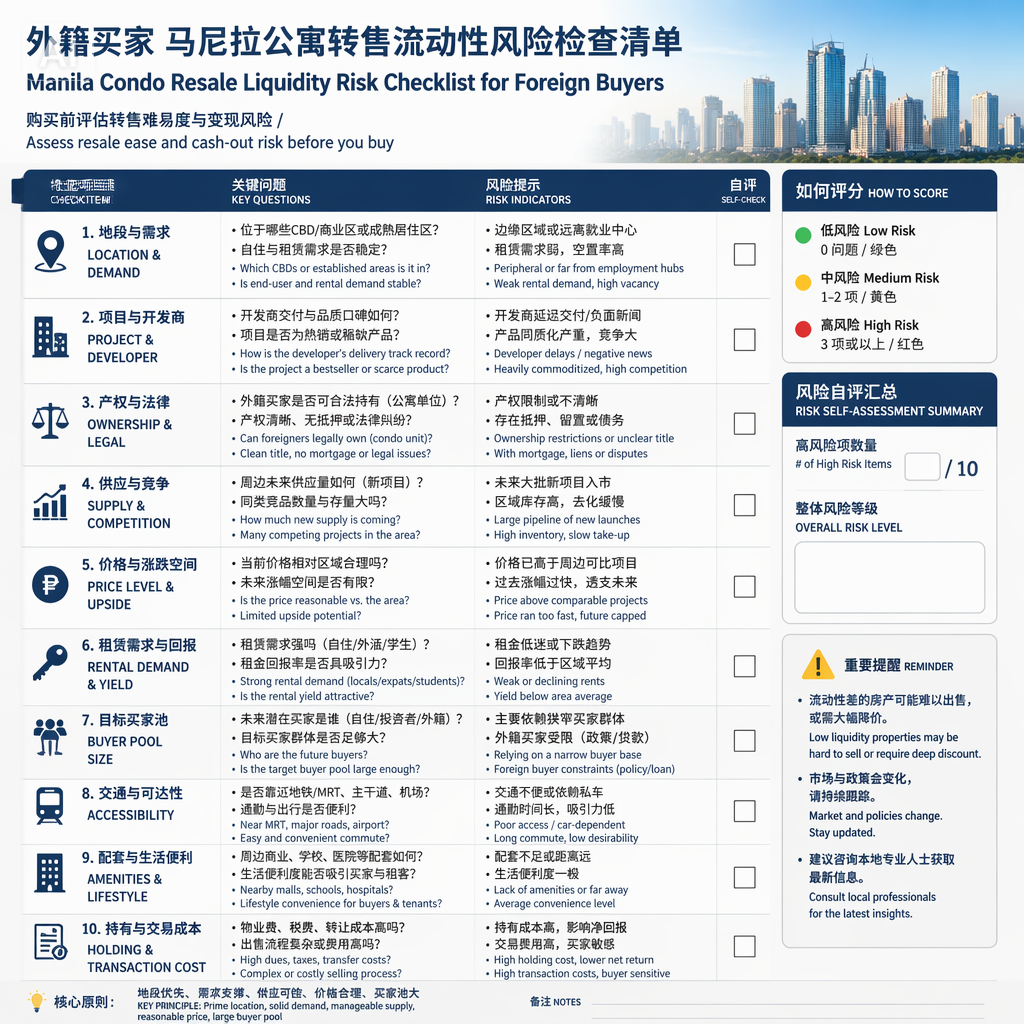
    Risk #3 — The Secondary Market Can Lock Up Faster Than People Expect

    When a building faces a reputation shock—whether it’s operational disruption, governance conflict, or public controversy—many investors think:

    “Fine. I’ll sell. Even at a discount.”

    This is where Manila can surprise you.

    Compared to more centralized, highly standardized resale markets, Manila’s condo resale ecosystem can feel fragmented:

    • pricing discovery varies widely
    • buyer pools can be narrow for certain segments
    • transaction processes can be slower and more document-intensive than many first-time foreign buyers assume

    And even if you find a buyer, the math can still hurt.

    The “paper profit” problem

    Developers can continue marketing new units at higher headline prices, while resale demand stays thin. This can create a psychological trap: your unit looks valuable on paper, but liquidity is limited when you urgently need an exit.

    Transaction friction and holding costs

    Selling can involve meaningful costs (taxes, fees, transfer-related expenses, agent commissions), while ongoing holding costs continue in the background (condo dues/association fees, repairs, vacancy months).

    Demand mismatch risk

    In prime areas (Makati, BGC, Mandaluyong), pricing can drift toward “international city” levels. But local income levels may not support premium rents at scale. That can leave the market relying heavily on:

    • expats with shifting demand cycles
    • specific industries (which can boom and fade)
    • foreign buyers’ sentiment (which can change quickly)

    When the marginal buyer disappears, liquidity can disappear with them.


    A Risk Controller’s Checklist: How to Approach Philippines Condos Without Losing Control

    I don’t believe in “never buy in the Philippines.” I believe in buying only when the decision can survive worst-case scenarios.

    If you want practical guardrails, here are three:

    1) Treat the foreign ownership limit as a hard boundary (not a workaround game)

    Philippines condo foreign ownership is commonly discussed around the 40% foreign ownership cap at the project/building level. Before committing funds, verify eligibility and compliance through proper documentation and professional review.

    If your “solution” depends on informal workarounds, your risk profile is no longer “real estate.” It becomes “legal and enforceability uncertainty.”

    2) Don’t buy purely for yield unless you can personally use the asset

    If the only reason you’re buying is a promised rental return, you’re exposed to too many variables you don’t control: vacancy, tenant quality, maintenance, governance conflicts, and resale liquidity.

    A stronger approach is practical utility:

    • Can you use the unit as a personal base?
    • Can it support your cross-border work/life needs?
    • Would you still be comfortable holding it if rent drops or vacancy lasts 6–12 months?

    If the answer is no, the “investment” is fragile.

    3) Stress-test your cash flow model (assume higher holding cost + longer vacancy)

    A conservative model is not pessimism; it’s how you stay solvent.

    Before you buy, run scenarios like:

    • higher maintenance frequency than expected
    • longer vacancy periods
    • slower repairs and higher coordination costs
    • additional selling friction and longer time-to-exit

    If your finances still hold under stress, you’re buying from strength—not hope.


    The Bottom Line

    Flair Towers—whether you view it as a management dispute, a governance conflict, or a cautionary headline—highlights a deeper issue:

    Overseas property ownership is not only about purchase price and rent. It’s about governance, visibility, and liquidity under pressure.

    If you’re buying in Manila, the question is not “Is this building modern?” or “Is the developer famous?”

    The question is:

    Can I defend this decision if the worst-case operational scenario happens—and I’m not physically there?

    That is what “cross-border risk control” really means.

  • The 3-Filter Move Abroad Framework: Visa, Money, and Lifestyle Risk

    The 3-Filter Move Abroad Framework: Visa, Money, and Lifestyle Risk

    What this site is (and isn’t) The Serial Expat is a practical guide for people planning a serious move abroad—especially into Southeast Asia—without relying on sales-driven agencies. You’ll find clear explanations of immigration pathways, real-world living considerations, and a compliance-first way to think about risk. This isn’t a “dream life” blog. It’s decision support: how to reduce uncertainty before you commit time, money, and identity to a new country. The 3 filters that prevent expensive mistakes Most relocation advice skips the hard part: tradeoffs. A move works when three filters align—visa reality, money mechanics, and lifestyle risk. If one filter fails, the whole plan becomes fragile. 1) Visa reality: what is actually controllable? Start with what you can control versus what you can’t. Programs have timelines, eligibility constraints, and failure modes (audits, RFEs, document gaps, shifting policy). Your job is to map the pathway, identify the choke points, and decide whether your tolerance for uncertainty matches the process.
    • Timeline tolerance: How long can you wait without your plan collapsing?
    • Evidence burden: What documents will be required, and where are the weak links?
    • Single-point failures: What happens if a key step is delayed or denied?
    2) Money mechanics: the part most people don’t model A move abroad isn’t just “cost of living.” It’s cash flow timing, currency exposure, and the legal structure of assets. The goal is to avoid being forced into bad decisions because you ran out of runway.
    • Runway: How many months can you operate if income drops or delays hit?
    • Currency risk: What happens if FX moves 10–20% against you?
    • Asset structure: Are you buying, renting, or testing first—and what’s reversible?
    3) Lifestyle risk: safety, stability, and the “friction tax” Even with a perfect visa and budget, lifestyle friction can quietly erode the plan: healthcare access, local bureaucracy, neighborhood safety, air quality, and cultural fit. This is where “I can handle anything” optimism often breaks.
    • Healthcare reality: Where do you go when it’s not routine?
    • Local stability: What changes could impact residency, property, or day-to-day life?
    • Support systems: Who do you call when something goes wrong?
    How to use The Serial Expat If you’re early-stage, start by reading the pathway and country guides that match your shortlist. If you’re already in motion, use the content to pressure-test assumptions—timelines, documentation, and the hidden risks behind “easy” solutions.

    The goal isn’t to move fast. It’s to move with a plan that survives contact with reality.

    Want a neutral risk assessment? If you want a second set of eyes on your plan—visa pathway, Southeast Asia living fit, or property/residency risk—book a 45-minute consultation. You’ll leave with a clearer feasibility view and a practical next-step plan.