Category: Pathways

Explore global residency and immigration pathways. Featuring deep dives into US EB-3/EW3, Thailand LTR/DTV, and Philippines SRRV visas, offering policy analysis, timelines, and real-world expat legal frameworks.

  • EW3 Visa Waitlist: Why Career Planning Matters More

    The EW3 visa waitlist is one of the longest employment-based immigration backlogs in the United States, with priority dates that can stretch across many years depending on your country of chargeability. While most beneficiaries fixate on monthly Visa Bulletin movements, the smarter play is to treat your career as the variable you actually control. This article explains why skill-building, income diversification, and geographic flexibility during the wait period often matter more than watching priority date advances—and how to protect your underlying petition while doing it.

    The EW3 Visa Waitlist Is a Policy Timeline, Not a Life Plan

    The Employment-Based Third Preference “Other Workers” category—commonly called EW3 or EB-3 unskilled—covers positions requiring less than two years of training or experience. Because annual visa numbers are capped and demand from certain countries dramatically exceeds supply, the waitlist operates on a fixed priority date system that responds to statutory limits, not individual merit.

    What this means practically: your place in line is determined by when your employer’s PERM labor certification was filed (or when the I-140 petition was submitted if PERM was not required). The State Department’s Visa Bulletin publishes cutoff dates monthly, but movement is unpredictable and varies significantly by country. You cannot study harder, earn more, or work longer to make your date come faster.

    Yet many beneficiaries spend years in a passive holding pattern—staying in jobs below their potential, delaying education, or putting family plans on indefinite hold. The priority date is fixed by policy, but your earning power, professional network, and personal resilience are not. Reframing the wait from passive endurance to active career architecture is the central shift this article proposes.

    What Actually Happens to Your Career During a Multi-Year EW3 Wait

    Extended waits create real professional costs that compound over time. Skills atrophy. Industry knowledge becomes dated. Peer groups advance into senior roles while you remain tethered to a specific position. Family financial pressure mounts. Geographic constraints limit opportunities. These effects are especially acute for EW3 beneficiaries, who are often in entry-level or manual positions that offer limited upward mobility within the sponsoring employer.

    The psychological toll matters too. Anxiety about priority date movement can dominate decision-making, leading to short-term choices that undermine long-term prospects. Some beneficiaries decline promotions or training opportunities fearing they might “disrupt” their petition. Others remain in deteriorating work conditions because they believe any change risks everything.

    Understanding your actual legal constraints—rather than assumed ones—frees you to make better career decisions. The waitlist controls your immigration timeline; it should not control your entire professional trajectory.

    Skill-Building Strategies That Don’t Depend on Your Priority Date

    Building transferable skills is the highest-return investment during the EW3 wait period. Focus on capabilities that increase your value regardless of where you eventually work or live.

    Technical certifications and credentials. Obtain industry-recognized certifications in your current field or adjacent areas. Healthcare workers might pursue CNA-to-LPN pathways or specialized equipment certifications. Construction or manufacturing workers might add OSHA safety credentials, welding certifications, or equipment operation licenses. These credentials travel with you and often qualify you for higher wages immediately.

    Language and communication skills. For non-native English speakers, advancing from functional to professional fluency opens management and customer-facing roles. Consider structured programs with measurable outcomes rather than informal practice alone.

    Digital literacy and remote-work capabilities. Proficiency in project management software, data entry systems, basic coding, or digital marketing tools expands your employment geography dramatically. These skills enable location-independent income that can supplement or replace local wages.

    Entrepreneurial and financial literacy. Understanding small business basics, bookkeeping, tax compliance, and investment fundamentals prepares you for eventual self-employment or property investment—common paths for immigrants who build wealth.

    Importantly, education and training pursued during the wait period generally do not jeopardize your EW3 petition, provided you maintain your underlying employment relationship and do not violate the terms of any current nonimmigrant status. However, if you are in the U.S. in a specific visa category, verify that study is permissible under your current status.

    Income and Geographic Flexibility: Protecting Family Stability

    Single-income households tied to one employer in one location face concentrated risk. Diversification applies to immigration waiting periods just as it does to investment portfolios.

    Remote work for non-U.S. employers. If you are outside the U.S. during the wait, working remotely for companies in third countries can provide income in stronger currencies, build international experience, and establish professional networks beyond your eventual U.S. destination. Some EW3 beneficiaries establish bases in lower-cost jurisdictions—Southeast Asia, Eastern Europe, Latin America—where remote income stretches further and family quality of life improves.

    Geographic arbitrage considerations. For those already in the U.S., the same logic applies in reverse: some beneficiaries maintain their sponsoring employment while family members live in lower-cost areas, or they negotiate remote arrangements that reduce commuting and housing costs. For those abroad, establishing residency in a favorable tax or cost-of-living jurisdiction during the wait can preserve capital.

    Multiple income streams. Side businesses, freelance work, rental properties, or investment income reduce dependence on the sponsoring employer. Each stream must be evaluated for compliance with local tax laws and any applicable work authorization restrictions.

    Family resilience also includes contingency planning for derivative beneficiaries. Children approaching age 21 face potential “aging out” risks under the Child Status Protection Act calculations. While this is a complex legal topic beyond career planning per se, maintaining financial flexibility to pursue alternative immigration pathways if needed is a prudent parallel consideration.

    Employer Relationships and the Limits of EW3 Portability

    The EW3 category’s employer-sponsored nature creates genuine constraints that career planning must accommodate. Understanding these limits prevents costly mistakes.

    Under standard rules, your I-140 petition is tied to the specific employer and specific job described in the PERM labor certification. If that employer withdraws the petition or goes out of business before your priority date becomes current and you complete adjustment of status, the petition typically terminates. This is fundamentally different from categories where self-petitioning is possible.

    The American Competitiveness in the Twenty-First Century Act (AC21) provides limited portability provisions for certain employment-based immigrants, but applicability to EW3 cases involves specific requirements. Generally, to port to a new employer under AC21, you must have an approved I-140, your adjustment of status application (I-485) must have been pending for 180 days or more, and the new position must be in the “same or similar occupational classification.” Whether a particular job change qualifies is fact-specific and requires case-by-case legal analysis.

    What this means practically: early in the process, before I-485 filing, your ability to change employers without losing your priority date is severely constrained. After I-485 has been pending sufficiently, more flexibility may exist, but it is not automatic and carries risk. Any contemplated employer change should be reviewed with a qualified immigration attorney before action.

    Building a strong relationship with your sponsoring employer—demonstrating value, communicating your commitment, and understanding their business stability—can be as important as external skill-building. Some beneficiaries negotiate training opportunities, schedule flexibility, or gradual role evolution within the same employer, preserving the petition while advancing professionally.

    Building Your Parallel Plan: When the Waitlist Moves Slowly or Stalls

    The Visa Bulletin can stall for months or even years. Country-specific backlogs for EW3 have historically seen little or no movement for extended periods. Relying solely on this single pathway is a concentration risk that smart beneficiaries mitigate.

    Alternative immigration pathways. Depending on your circumstances, you may become eligible for other categories during the wait—marriage to a U.S. citizen, employer sponsorship in a higher preference category, or qualification for a national interest waiver. Maintaining the credentials and clean immigration record that would support alternative applications preserves optionality.

    Non-U.S. residency and citizenship options. Some beneficiaries pursue permanent residency or citizenship in intermediate countries, creating additional bases for work, travel, and eventual retirement. Current Visa Bulletin dates should be checked against your personal timeline to assess whether parallel pathways warrant investment.

    Return-to-origin planning. If the wait extends beyond what your family can sustain, having built transferable skills and savings enables a dignified return to your home country or relocation elsewhere—not as failure, but as a deliberate choice supported by improved human capital.

    The parallel plan is not pessimism; it is risk management. The most stressed beneficiaries are those with no alternative. The most resilient are those who could walk away if needed, even if they hope not to.

    Common Risks or Mistakes

    Several recurring errors undermine EW3 beneficiaries during the wait period:

    Assuming any job change is automatically permitted. AC21 portability has specific prerequisites and does not apply to all cases. Acting on general advice without individual legal review can terminate a petition years in the making.

    Neglecting current status maintenance. If you are in the U.S. on a nonimmigrant visa, letting it lapse or violating its terms can create inadmissibility issues that complicate eventual adjustment. Career moves must not jeopardize lawful presence.

    Over-investing in location-specific assets. Buying property, starting immovable businesses, or enrolling children in expensive programs tied to one location creates exit costs if priority dates stall or personal circumstances change.

    Ignoring tax and reporting obligations. International remote work, foreign accounts, and multiple income streams trigger complex tax filing requirements. Non-compliance can create immigration and financial problems later.

    Waiting passively for the “real life” to begin. The years in the EW3 queue are real years of career development, family formation, and wealth accumulation. Treating them as merely preparatory wastes irrecoverable time.

    Key Takeaways

    • The EW3 visa waitlist timeline is determined by statutory caps and country demand, not by individual effort—you cannot accelerate it through career achievement alone.
    • Transferable skills, remote income capability, and geographic flexibility are variables you control and should prioritize during the wait period.
    • Employer changes before I-485 filing or during early processing stages carry substantial risk and require individualized legal analysis before action.
    • Building a parallel plan—including alternative immigration pathways, third-country residency options, or return planning—reduces psychological and financial stress.
    • Any specific career move that might affect PERM or I-140 validity should be reviewed with a qualified immigration attorney before implementation.

    Frequently Asked Questions

    How long is the EW3 visa waitlist currently?

    Wait times vary dramatically by country of chargeability and change monthly based on the State Department Visa Bulletin. Some countries face backlogs of many years, while others may see more movement. You should verify the current Visa Bulletin for your specific country and note the month and year of the data, as dates shift regularly. Projections beyond official publications are speculative.

    Can I change jobs while my EW3 petition is pending?

    It depends on your case stage. Before I-140 approval, changing employers typically requires a new PERM and I-140 filing with a new priority date. After I-140 approval and with an I-485 pending for 180+ days, AC21 portability may allow a move to a “same or similar” position, but this determination is fact-specific and requires legal review. Do not change employers based on general information without consulting your attorney.

    Can I work remotely for a non-U.S. employer during the EW3 wait?

    If you are outside the U.S., remote work for non-U.S. employers is generally not restricted by your pending EW3 petition, though you must comply with local tax and work authorization laws in your country of residence. If you are inside the U.S. on a specific nonimmigrant status, your work authorization is tied to that status, not the pending EW3 petition. Unauthorized work in the U.S. can create serious immigration consequences.

    What happens to my EW3 priority date if my employer goes out of business?

    If the employer withdraws the I-140 or ceases operations before your priority date becomes current and you complete adjustment, the petition generally terminates. In some circumstances, you may retain the priority date for a subsequent petition, but this depends on whether the I-140 was approved and other factors. This is a high-risk scenario that underscores why monitoring employer stability and building parallel plans matters.

    Should I pursue additional education while waiting for my EW3 visa?

    Generally yes, with caveats. Education that builds transferable skills and does not require full-time study that conflicts with current employment or visa status is beneficial. However, if you are in the U.S., verify that your current status permits study. If education leads to a substantially different career path, consider whether it might affect “same or similar occupational classification” determinations for future portability. Discuss significant educational investments with your immigration attorney.

    Related Reading on SerialExpat

    Disclaimer

    This article is for general informational purposes only and does not constitute legal, tax, immigration, financial, or property investment advice. Laws, government procedures, visa bulletin dates, processing times, and regulations change frequently. Readers should verify all information with official sources such as USCIS and the Department of State, and consult a qualified immigration attorney before making any career or legal decisions that could affect a pending petition. Individual circumstances vary significantly by priority date, country of chargeability, and petition stage.

  • Why More People Over 35 Are Considering EW3

    Planning desk for a long-term EW3 immigration decision

    Why more people over 35 are considering EW3 is not difficult to understand when you look beyond the surface of immigration marketing. For many overseas Chinese, digital nomads, globally mobile families, and people already waiting on another immigration path, the question is no longer only “Which country can I move to?” It becomes “Where can I build a more stable long-term life, and what risks am I willing to accept along the way?” EW3 is not a shortcut, and it should not be treated as one. It is better understood as a slow, employer-based immigration option that requires patience, documentation, financial planning, and a realistic view of work and family life.

    What EW3 Actually Means

    EW3 is commonly used to refer to the EB-3 “Other Workers” immigrant visa category. The broader EB-3 category includes skilled workers, professionals, and other workers. The U.S. Department of State explains employment-based immigrant visa categories on its Employment-Based Immigrant Visas page. In practical terms, the EW3 discussion usually focuses on jobs that require less than two years of training or experience and are not temporary or seasonal.

    This matters because EW3 is not an investment visa, a self-petition path, or a remote-work residency program. It depends on a real U.S. employer, a real job offer, labor certification in most cases, an immigrant petition, and the availability of an immigrant visa number. If any part of that chain is weak, the entire plan becomes fragile.

    Why the EW3 Question Becomes More Serious After 35

    Life and financial planning for people over 35 considering EW3

    Stability Starts to Matter More Than Optionality

    In your twenties or early thirties, it is easier to optimize for income growth, flexibility, travel, and career experimentation. After 35, many people start measuring life differently. A stable immigration path, children’s education, healthcare access, family security, and long-term residence rights may become more important than the freedom to keep moving every six months.

    For overseas Chinese and cross-border families, visa uncertainty can become emotionally expensive. Renewals, employer dependence, changing local rules, school transitions, and aging parents all create pressure. EW3 attracts attention because it points toward U.S. permanent residence, not because the process is easy.

    People Over 35 Often Understand Slow Decisions Better

    EW3 is a slow decision. The U.S. Department of State publishes the monthly Visa Bulletin, and employment-based categories can be affected by annual limits, priority dates, and country-specific demand. Waiting is not a side issue. It is part of the plan.

    At 35 or older, time is not just a number on a processing chart. It affects children’s school years, family finances, career continuity, mental health, and whether a spouse can realistically support the same plan. That is why EW3 should be evaluated as a life-planning decision, not just an immigration product.

    The Real EW3 Decision Is About Risk Control

    Employer Authenticity Is the First Risk

    EW3 is employer-based. In most cases, before an employer can file an immigrant petition with USCIS, the employer must first complete the PERM labor certification process. The U.S. Department of Labor explains the Permanent Labor Certification Program as a process designed to determine whether there are sufficient able, willing, qualified, and available U.S. workers for the job and whether hiring a foreign worker would adversely affect wages and working conditions of similarly employed U.S. workers.

    This is the core reality that many people miss. EW3 is not supposed to be a purchased slot. The job, wage, recruitment process, employer operations, and supporting documents must make sense. If the employer is weak, fake, underfunded, or poorly documented, the applicant carries meaningful risk.

    Priority Date Risk Can Change the Family Timeline

    Many applicants focus on whether they can start the case. A better question is whether they can live with the waiting period. Priority dates may advance, slow down, or retrogress. A family that can tolerate three years may not be able to tolerate seven. A child’s age, a spouse’s career, or a parent’s health can change the decision completely.

    For this reason, EW3 should not be the only plan. It may be one layer in a broader mobility strategy that also includes current legal status, income continuity, tax planning, housing decisions, education planning, and emergency liquidity.

    Cost Should Be Separated From Promises

    EW3 may involve legal fees, government filing fees, document preparation, translations, medical exams, relocation costs, and years of opportunity cost. Any claim that sounds like “guaranteed approval,” “no risk,” or “fast green card” should be treated carefully. A serious provider or attorney should be able to discuss failure scenarios, not only success stories.

    How to Think About Life Planning Before Choosing EW3

    Cash Flow Matters More Than the Initial Price

    Because EW3 can take years, applicants need to think beyond the initial cost. The more useful question is whether the family can maintain financial stability during the waiting period. That means separating the immigration budget from living reserves, emergency funds, and money that should not be touched.

    A family that uses all available liquidity to start an immigration case may become vulnerable if processing slows, a job changes, a parent becomes ill, or a child’s education cost rises. Risk control begins with not overextending the household.

    The Job Itself Must Be Emotionally Acceptable

    EW3 “Other Workers” roles are often practical, service-based, or physically demanding. Depending on the employer and job market, they may involve hospitality, food service, caregiving support, cleaning, manufacturing, warehouse work, or other essential roles. For some applicants, the bigger challenge is not eligibility. It is whether they and their family can accept the lifestyle adjustment.

    This is especially important after 35. A person may already have professional experience, social status, or a certain lifestyle in another country. Moving into a lower-status or more physically demanding job for the sake of a long-term immigration path is a serious trade-off, not a small detail.

    Who Should Consider EW3 More Seriously?

    People With a Long-Term U.S. Settlement Goal

    EW3 is more suitable for people who already have a serious long-term reason to consider the United States: children’s education, family relocation, a stable residence plan, or a long-term career reset. If the goal is only short-term travel or lifestyle flexibility, EW3 may be too heavy and too slow.

    People Who Can Tolerate Uncertainty

    EW3 requires patience. The employer may change, the labor market may change, visa availability may change, and personal circumstances may change. Applicants who need a fast solution to urgent immigration anxiety may find the process stressful.

    People Willing to Do Due Diligence

    The right questions are not only “How much does it cost?” and “How long will it take?” Better questions include: Who is the employer? What is the role? What wage is offered? How is recruitment handled? Who is the attorney? What happens if the employer withdraws? What happens if the case is delayed? What does the contract say about refunds and responsibilities?

    Common Mistakes When Evaluating EW3

    Mistake 1: Thinking a Lower Entry Threshold Means Lower Risk

    EW3 may have a lower education or experience threshold than some other employment-based categories, but that does not mean it is low-risk. Employer quality, documentation, labor certification, waiting time, and family readiness all matter.

    Mistake 2: Looking Only at Success Stories

    Success stories rarely show the full process: delays, anxiety, job adjustment, document issues, family disagreement, or financial pressure. A mature decision should include both best-case and worst-case scenarios.

    Mistake 3: Ignoring the Life Stage Factor

    After 35, immigration is rarely an individual decision. It often affects a spouse’s career, children’s schooling, elderly parents, asset allocation, and healthcare planning. If these questions are not discussed early, they tend to become harder later.

    Key Takeaways

    • Why more people over 35 are considering EW3 has less to do with hype and more to do with long-term stability.
    • EW3 is not a shortcut. It depends on a real employer, a real job, and a compliant immigration process.
    • The main risks include employer quality, priority date movement, family cash flow, job acceptance, and unrealistic promises.
    • EW3 works better as one part of a broader life plan, not as the only backup option.
    • Applicants should verify official sources, review contracts carefully, and consult qualified immigration counsel before making decisions.

    Frequently Asked Questions

    Is EW3 suitable for people over 35?

    It can be, but age alone does not determine suitability. The more important questions are whether the applicant can tolerate a long process, accept the job reality, maintain family cash flow, and handle uncertainty.

    Is EW3 easier than EB-1 or EB-2?

    EW3 may have a lower education or experience threshold, but it is not necessarily easier overall. It still depends on a real employer, labor certification in most cases, visa availability, and proper documentation.

    Can I apply for EW3 by myself?

    EW3 is generally employer-based. It is not usually a self-petition category. A U.S. employer normally plays a central role in the process.

    What should I watch most carefully during the waiting period?

    Pay attention to legal status, priority dates, employer stability, family finances, document accuracy, and whether the plan still fits your life as circumstances change.

    How can I judge whether an EW3 opportunity is reliable?

    Start with employer verification, job details, wage logic, attorney credentials, contract terms, refund conditions, and whether the provider clearly explains risk instead of only selling the upside.

    Related Reading on SerialExpat

    • Pathways – immigration, visa, and long-term residency planning.
    • Living – practical expat life, housing, healthcare, and family setup.
    • Legal – compliance, documentation, and legal risk basics for cross-border life.

    Disclaimer

    This article is for general informational purposes only and does not constitute legal, immigration, tax, financial, or employment advice. U.S. immigration rules, visa bulletin dates, government fees, processing times, and agency procedures may change. Readers should verify information with official sources and consult a qualified immigration attorney before making decisions.

  • EW3 Processing Is Slowing Down: How Ordinary Applicants Should Plan the Next Two Years

    EW3 applicants planning the next two years

    EW3 processing is slowing down, and ordinary applicants need to plan the next two years with more discipline than optimism. For many overseas Chinese families, digital nomads, cross-border workers, and people already waiting on another immigration path, EW3 can still be part of a serious long-term plan. But it should not be treated as a fast solution to immigration anxiety. The next two years are less about waiting passively and more about managing cash flow, keeping career options alive, choosing a livable base, and reducing the risk of making irreversible decisions too early.

    First, Understand What Is Actually Slowing Down

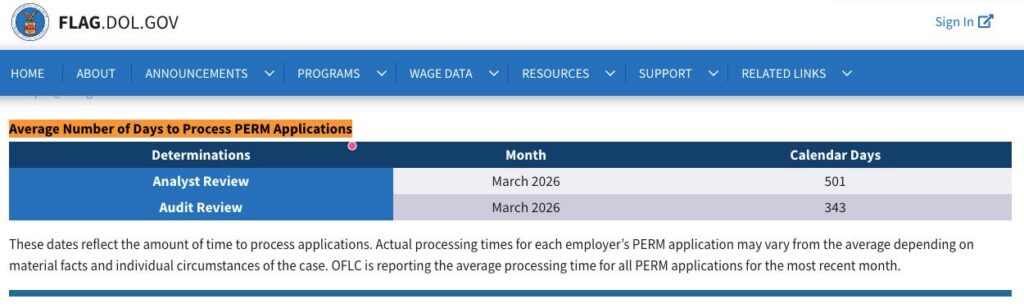
    When people say “EW3 is getting slower,” they are usually mixing several different timelines into one feeling: PERM labor certification, I-140 petition review, visa bulletin movement, National Visa Center processing, consular appointments, and family relocation. These are not the same thing. A delay in one stage does not always mean every stage has stopped, but the applicant experiences the combined result as a longer and more uncertain wait.

    EW3 generally refers to the EB-3 “Other Workers” category. The U.S. Department of State’s July 2026 Visa Bulletin lists the employment third preference and separates “Other Workers” from the broader EB-3 skilled workers and professionals line. It also shows that “Other Workers” has its own cut-off dates across chargeability areas, which is why applicants should track the correct line rather than simply asking whether “EB-3 is current.”

    Processing Time: Build a Two-Year Operating Plan, Not a Countdown

    Do Not Plan Around the Best-Case Timeline

    A common mistake is to use the fastest story as the family baseline. Someone hears about a case that moved quickly and then builds rent, schooling, resignation, or asset-sale decisions around that optimistic scenario. That is risky. Employment-based immigration is affected by annual numerical limits, priority dates, document readiness, government workload, and case-specific issues.

    The Department of State explains in the Visa Bulletin that final action dates and filing dates determine when applicants may move forward, and that oversubscribed categories are handled according to priority dates. In plain language: your personal readiness is only one part of the equation. The system also has to have a visa number available for your category and chargeability area.

    Use Three Time Horizons

    For the next two years, applicants should separate planning into three horizons:

    • 0-6 months: document audit, employer verification, contract review, and cash-flow stabilization.
    • 6-18 months: career continuity, family location strategy, savings discipline, and backup visa or residence options.
    • 18-24 months: re-evaluation of priority date movement, family readiness, school timing, work transition, and whether the EW3 plan still fits reality.

    This structure is more useful than asking every month whether the case is “almost done.” It gives the family a way to make decisions without being emotionally controlled by every update.

    Cash Flow: The Most Important Risk Control Tool

    Do Not Spend Like Approval Is Already Certain

    EW3 applicants often underestimate the cost of waiting. The visible costs may include legal fees, government filing fees, translations, document preparation, medical exams, travel, and relocation. The less visible costs include lost job opportunities, lower liquidity, school transitions, temporary housing, and emotional pressure from uncertainty.

    A safer approach is to divide money into three buckets. The first bucket is the immigration budget: fees and case-related costs that are expected. The second is the living reserve: at least 12 months of basic family expenses if possible. The third is the no-touch reserve: money that should not be used unless the plan fails or a genuine emergency happens.

    Keep Your Current Income Engine Running

    For ordinary applicants, the next two years should not be treated as a suspended life. If you are employed, protect your current role. If you are self-employed or a digital nomad, stabilize revenue rather than chasing aggressive expansion. If your spouse works, discuss whether one income can support the family if the other person needs to prepare for relocation or job transition later.

    The worst version of an EW3 plan is one where the family spends heavily, reduces income, sells assets too early, and then faces a slower-than-expected timeline. Immigration planning should improve optionality, not remove it.

    Career Planning: Prepare for Both the Job and the Wait

    Career planning while waiting for EW3 processing

    Understand the Job Reality Behind EW3

    EW3 is not a prestige category. “Other Workers” roles may involve practical, service-based, or physically demanding work. Applicants need to think honestly about whether they can perform the sponsored role, whether the employer is real, and whether the job is compatible with family expectations.

    The U.S. Department of Labor’s PERM labor certification page explains that, in most cases, the employer must obtain a certified labor certification before submitting an immigration petition to USCIS. The DOL must certify that there are not sufficient able, willing, qualified, and available U.S. workers for the job and that hiring the foreign worker will not adversely affect wages and working conditions of similarly employed U.S. workers. This is why the job cannot be treated as a decorative formality.

    Build Skills That Keep You Employable Either Way

    Over the next two years, applicants should improve skills that are useful whether EW3 succeeds, slows further, or changes direction. English communication, basic U.S. workplace expectations, driving ability, digital documentation habits, financial literacy, and health management are more practical than chasing certificates that do not fit the likely work environment.

    If the applicant has professional experience outside the United States, it is also worth maintaining that career track in parallel. A slower EW3 timeline should not erase the person’s existing earning power.

    Location Selection: Choose a Base That Can Survive Waiting

    Your Waiting Location Matters

    Many applicants focus only on the eventual U.S. destination. But the place where the family waits may be just as important. A good waiting base should have manageable rent, reliable healthcare, stable internet, accessible schools if children are involved, and a visa or residence arrangement that does not create constant stress.

    For digital nomads and overseas Chinese families, the best waiting location is not always the most exciting city. It may be the city where monthly burn rate is low, daily life is predictable, and documents can be handled efficiently. If your family is already stretched emotionally, do not choose a base that makes ordinary life harder.

    Do Not Move Too Early Unless There Is a Clear Reason

    Some families relocate closer to the United States or change countries too early because they feel progress should be visible. That can be expensive and disruptive. Unless a move improves income, legal status, children’s schooling, health access, or document readiness, it may simply add another layer of risk.

    A two-year EW3 plan should ask: Where can we live with the least financial pressure while keeping the most future options open?

    Risk Control: What Ordinary Applicants Should Check

    Employer and Contract Risk

    Before committing more money or making family decisions, applicants should understand who the employer is, what the job is, where the work is located, what wage is offered, whether the business is operating, and who is responsible for each step. If an intermediary cannot clearly explain the employer, role, timeline, contract terms, refund conditions, and failure scenarios, that is a warning sign.

    Priority Date and Category Risk

    Applicants should track the correct Visa Bulletin category every month. For EW3, that usually means the “Other Workers” line, not only the broader EB-3 line. Families from different chargeability areas may see different cut-off dates, so generic online commentary can be misleading.

    Status and Documentation Risk

    If the applicant is already in the United States, maintaining lawful status is a separate question from having an immigration case in process. If the applicant is outside the United States, document readiness, civil records, police certificates, passport validity, family documents, and consistency of personal history all matter. A slow process gives families time to prepare, but only if they use that time well.

    A Practical Two-Year Plan for EW3 Applicants

    Months 1-3: Audit the Case

    Confirm the category, employer, job title, work location, attorney or representative, contract terms, payment schedule, and current stage. Save all documents in a clean digital folder. Write down the priority date, if already assigned, and the exact Visa Bulletin line you need to monitor.

    Months 4-9: Stabilize Money and Work

    Reduce unnecessary spending. Build a living reserve. Avoid major irreversible expenses unless they improve your long-term resilience. Keep income active, and do not resign from a stable role simply because the immigration case has started.

    Months 10-18: Prepare for Mobility Without Forcing It

    Improve English, driving readiness, health routines, document organization, and family communication. If children are involved, map school-year timing but avoid committing to a relocation date before the immigration timeline supports it.

    Months 19-24: Reassess the Whole Plan

    Review whether the case is moving, whether the employer remains credible, whether the family can continue waiting, and whether alternative residence or immigration options should be added. A mature EW3 strategy includes review points, not blind persistence.

    Key Takeaways

    • EW3 processing is slowing down, so applicants should plan around uncertainty instead of best-case timelines.
    • The next two years should be managed as an operating plan covering cash flow, career, location, documentation, and risk control.
    • The “Other Workers” line in the Visa Bulletin matters; applicants should not rely on vague EB-3 commentary.
    • Cash reserves and income continuity are often more important than aggressive relocation preparation.
    • EW3 should be one part of a broader life plan, not the only option holding the family together.

    Frequently Asked Questions

    Is EW3 still worth considering if processing is slower?

    It can still be worth considering for applicants with a long-term U.S. settlement goal, but it should be evaluated as a slow, risk-managed path rather than a quick immigration solution.

    How much money should an ordinary applicant reserve?

    There is no universal number, but a practical target is to separate case-related costs from at least several months of living expenses. Families with children, unstable income, or international relocation needs should be more conservative.

    Should I change jobs while waiting for EW3?

    Be careful. Career changes should improve income stability or long-term resilience. Do not weaken your current financial position simply because an immigration case is pending.

    Should my family move to another country while waiting?

    Only if the move improves legal status, cost of living, income, schooling, healthcare, or document readiness. Moving just to feel closer to the plan can create unnecessary risk.

    What should I check every month?

    Check the Visa Bulletin, case communication from your attorney or employer, family cash flow, document readiness, and whether your current location remains sustainable.

    Related Reading on SerialExpat

    • Pathways – immigration, visa, and long-term residency planning.
    • Living – practical expat life, housing, healthcare, and family setup.
    • Legal – compliance, documentation, and legal risk basics for cross-border life.

    Disclaimer

    This article is for general informational purposes only and does not constitute legal, immigration, tax, financial, employment, or relocation advice. U.S. immigration rules, visa bulletin dates, government processing times, filing fees, and agency procedures may change. Readers should verify information with official sources and consult a qualified immigration attorney before making decisions.

  • Best Place to Wait for US EW3 Visa: Thailand DTV vs SRRV vs SE Asia

    wait for US EW3 visa

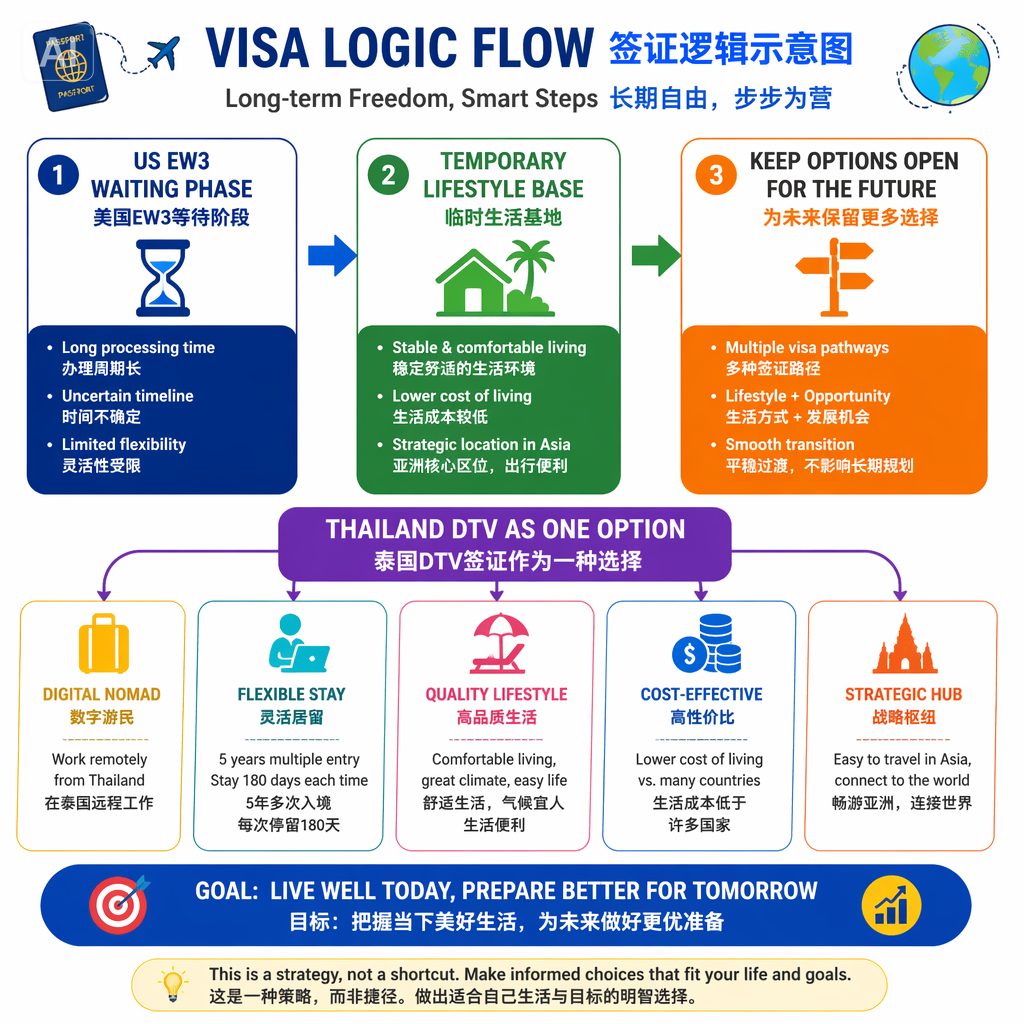
    If you need to wait for US EW3 visa processing outside your home country, choosing the right base in Southeast Asia can shape your finances, family stability, and mental health across a multi-year timeline. Most EB-3 unskilled applicants from the Philippines, India, and other oversubscribed countries face priority date waits stretching from three to ten years or more. This article breaks down five realistic locations—Thailand under the Destination Thailand Visa, the Philippines through the Special Resident Retiree’s Visa, Bali via Indonesia’s long-stay frameworks, Ho Chi Minh City on Vietnamese business or temporary residence pathways, and Malaysia through its post-2021 residency programs—by life stage and budget rather than crowning a single winner. Your circumstances, not a generic ranking, should drive the decision.

    How Long Is the EW3 Wait, Really? Why Your Base Location Matters

    The EB-3 Other Workers category, commonly called EW3, remains heavily backlogged for applicants born outside Mexico. Priority dates for many countries lag several years behind the current processing month, and the visa bulletin advances unpredictably. Some applicants see their dates stall for years, then jump months in a single bulletin; others watch gradual creep that still leaves them half a decade from interview scheduling.

    This volatility creates a practical problem. You cannot put your life on hold indefinitely. Maintaining a job, educating children, preserving savings, and staying healthy all require geographic stability. Yet committing to a location with the wrong cost structure, visa restrictions, or tax profile can drain resources you will need for the final immigration steps—medical exams, visa fees, travel to the U.S. consulate, and initial settlement costs.

    The base you choose also affects your compliance posture. U.S. immigration authorities do not require you to remain in your home country during I-140 processing or priority date waiting. However, your conduct abroad—tax filings, visa status in the host country, any hint of unauthorized work—becomes part of your record. A clean, documented residency history in a stable jurisdiction helps; a patchy visa status or tax ambiguity can complicate your eventual consular processing.

    The Five Contenders: At-a-Glance Comparison Table

    The table below summarizes core dimensions for each location. Specific financial requirements, fees, and program rules change frequently. Verify current terms directly with official government sources before making any decisions.

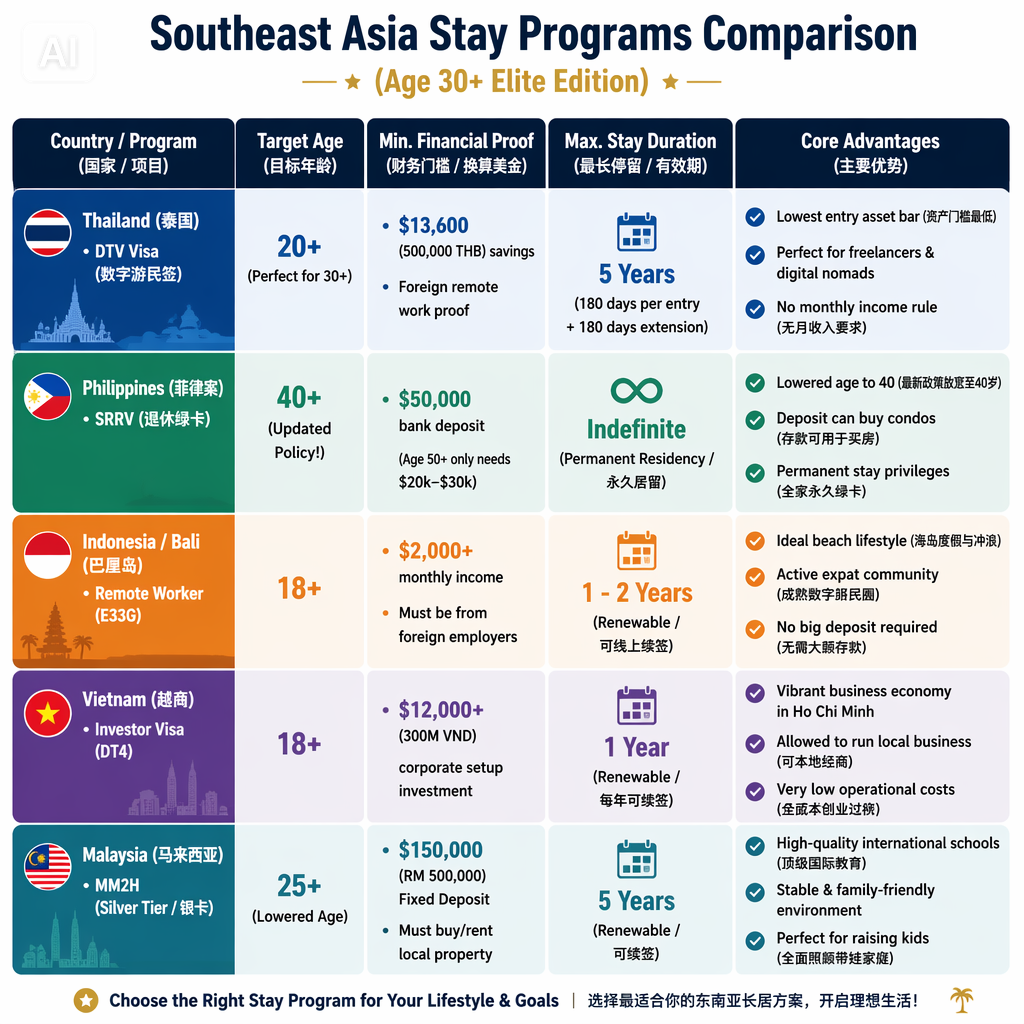
    Dimension Thailand (DTV) Philippines (SRRV) Bali/Indonesia Ho Chi Minh City/Vietnam Malaysia
    Primary visa pathway Destination Thailand Visa (DTV) Special Resident Retiree’s Visa (SRRV) Second Home Visa or B211A business visa Business visa (DN) → Temporary Residence Card Malaysia My Second Home (MM2H) or Premium Visa Programme
    Typical initial stay Up to 180 days per entry, extendable Indefinite with annual renewal 1–5 years depending on visa type 1–2 years, renewable 5 years, renewable
    Financial threshold Proof of remote/digital income or savings; no fixed deposit Deposit varies by age and visa type; lower brackets for retirees Second Home requires proof of funds; B211A lower barrier Business registration or employer sponsorship typically required Fixed deposit plus proof of monthly offshore income; requirements tightened post-2021
    Work authorization DTV permits certain digital/remote activities; traditional employment prohibited No local work permitted; passive income only Work permit required for local employment; remote work legally gray Work permit required; business visa alone does not authorize employment MM2H does not permit local work without separate pass; Premium Visa has different rules
    Property ownership Foreigners cannot own freehold land; condominium quota purchase possible Can purchase condominium; land ownership restricted Hak Pakai (Right to Use) or Hak Guna Bangunan for structures; not freehold equivalent 50-year leasehold typical for foreigners; complex ownership structures Freehold possible in certain categories; generally more foreign-friendly
    Tax residency trigger 180+ days may trigger tax residency; 2024 reforms affect worldwide income reporting Non-citizen residents taxed on Philippine-sourced income only 183+ days triggers tax residency; complex compliance 183+ days typical threshold; worldwide income exposure possible 182-day physical presence test; territorial tax system for many income types
    Healthcare quality Good private hospitals in Bangkok, Chiang Mai; insurance essential Variable by city; Manila and Cebu have adequate private care; many expats self-insure or use local plans Bali limited for serious conditions; Jakarta better; medical evacuation insurance common Rapidly improving in HCMC; international hospitals available; insurance recommended Strong private healthcare in KL and Penang; medical tourism hub
    Monthly budget (modest lifestyle) $1,200–$2,500 $1,000–$2,000 $1,200–$2,200 $800–$1,800 $1,200–$2,500
    English prevalence Tourist areas and medical settings; limited otherwise High relative to region; widespread in business and services Tourist zones only; Bahasa Indonesia required for legal matters Growing in business districts; Vietnamese dominant Very high; primary business language
    Schooling for children International schools in major cities; $8,000–$25,000/year International schools in Manila, Cebu, Davao; $6,000–$18,000/year Limited in Bali; Jakarta better; $8,000–$20,000/year Expanding international school sector; $6,000–$15,000/year Excellent international schools in KL; $8,000–$22,000/year
    Family inclusion Spouse and children can accompany; dependent rules apply Spouse and dependents includable; additional fees Spouse and children on dependent KITAS; additional documentation Family members need separate visa basis or sponsorship Spouse, children under 21, and parents may be included depending on program tier

    Segment 1: The Solo Applicant on a Tight Budget (Under $1,500/Month)

    If you are single, under 35, and funding your wait through savings or modest remote work, your priorities are low burn rate and visa flexibility. Two locations stand out, with important caveats.

    Ho Chi Minh City offers the lowest coherent cost of living among the five. A disciplined single person can live comfortably on $800–$1,200 monthly, with excellent street food, affordable motorbike transport, and reasonable apartment rents in District 2 or Binh Thanh. The challenge is legal status. Vietnam does not offer a straightforward long-stay visa for passive waiters. Most applicants cycle business visas (DN category) or pursue temporary residence cards through nominal company sponsorship. This creates compliance risk and periodic renewal friction. You must verify current requirements with the Vietnam Immigration Department, as 2023–2024 e-visa expansions changed tourist entry but not long-stay frameworks.

    The Philippines (SRRV) becomes viable if you qualify for a lower deposit bracket, typically available to applicants meeting age thresholds. The SRRV Smile or Classic categories historically required differentiated deposits by age, with reduced amounts for retirees. However, the program was temporarily suspended in 2020 and eligibility rules shifted upon reopening. Confirm current deposit requirements and active program status with the Philippine Retirement Authority before proceeding. English fluency reduces daily friction dramatically.

    Avoid: Malaysia post-2021 program restructuring, which raised financial barriers; Bali, where visa runs and limited infrastructure inflate hidden costs; and Thailand DTV if your remote income falls below demonstrable thresholds.

    Segment 2: The Working Couple Who Needs Legal Income Options

    Couples where both partners want legitimate income face the sharpest constraints. Most Southeast Asian visas explicitly prohibit local employment without separate work authorization.

    Thailand’s DTV permits certain digital activities—freelancing, remote work for non-Thai employers, digital content creation—within defined boundaries. It does not authorize traditional employment with a Thai company or all employment structures. Verify permitted activities directly with the Royal Thai Embassy or official Thailand Pass system. For couples where one partner qualifies for DTV and the other can structure legitimate remote work, Thailand offers reasonable infrastructure, coworking spaces, and quality of life in Chiang Mai or Bangkok. The non-working partner typically holds a dependent extension.

    Malaysia presents a split picture. The restructured MM2H program after 2021–2022 generally does not permit local work without a separate employment pass. However, Malaysia’s broader visa ecosystem includes pathways for skilled workers and entrepreneurs that some couples navigate. The Premium Visa Programme, launched as a parallel offering, has different rules regarding economic activity. Confirm current terms with the Malaysia My Second Home Centre. English prevalence and business infrastructure are superior to most alternatives.

    Vietnam and Indonesia both require work permits for local employment, and enforcement has tightened. Nominal “business visa” arrangements that mask actual work create deportation risk and future immigration complications. For couples needing dual income, these are generally poor fits unless one partner secures legitimate corporate sponsorship.

    Segment 3: Families with School-Age Children: Education and Stability First

    Children need continuity. Switching schools mid-stream, coping with visa uncertainty, or facing medical emergencies without reliable care creates disproportionate stress during an already uncertain immigration wait.

    Malaysia leads for education quality and stability. Kuala Lumpur and Penang host established international schools with recognized curricula (IB, British, Australian), and the MM2H or Premium Visa structures provide multi-year certainty. Healthcare is excellent and affordable. The tradeoff is higher financial requirements and, for MM2H, restrictions on local employment.

    Thailand ranks second, particularly Bangkok and Chiang Mai, with strong international schools and good private hospitals. The DTV’s renewal structure requires attention—ensure you can demonstrate continued eligibility for extensions without disrupting children’s enrollment.

    The Philippines offers the most affordable international schooling and English-native instruction, reducing language transition trauma. Manila and Cebu have adequate though uneven healthcare. The SRRV’s indefinite nature provides stability if you qualify and maintain the deposit. Verify whether your children’s ages affect dependent inclusion rules.

    Avoid: Bali, where quality international schooling is limited and serious medical conditions require evacuation; and Ho Chi Minh City, where the international school sector, while growing, lacks the depth of established alternatives and visa instability disrupts planning.

    Segment 4: Capital-Ready Applicants Who Can Park Funds for Residency

    If you have liquid assets and can commit a fixed deposit for residency rights, your calculus shifts toward program stability, tax efficiency, and lifestyle quality rather than minimal cost.

    Malaysia has historically attracted this segment with its property ownership allowances, territorial tax system, and developed infrastructure. Post-2021 MM2H changes increased financial requirements and added complexity, but the program remains operational with further 2024 modifications. The fixed deposit structure, combined with proof of monthly offshore income, suits applicants with investment income or retained earnings. Malaysia’s tax residency trigger at 182 days and territorial approach to many income types can be advantageous, though cross-border tax planning requires professional guidance.

    The Philippines SRRV offers lower capital requirements for older applicants and indefinite stay rights. The deposit is recoverable upon program exit, though timing and conditions vary by visa category. Classic, Smile, and Courtesy visas carry different deposit schedules and ancillary benefits. This suits pre-retirement applicants with conservative risk tolerance who prioritize English fluency and cultural familiarity.

    Thailand DTV does not require a fixed deposit, which paradoxically makes it less suitable for capital-ready applicants seeking structural stability. The income-demonstration model creates ongoing documentation burden.

    Indonesia’s Second Home Visa, launched in 2022, targets this segment with multi-year validity and property-linked stay rights. However, foreign ownership structures (Hak Pakai, Hak Guna Bangunan) differ materially from freehold, and tax residency at 183+ days exposes worldwide income. Verify current validity periods with the Indonesian Directorate General of Immigration.

    The Hidden Costs Nobody Tabulates: Tax, Compliance, and Exit Risk

    Beyond visible rent and school fees, four hidden cost categories distort apparent affordability.

    Tax residency exposure. Thailand’s 2024 tax reforms brought worldwide income into reporting scope for tax residents, defined broadly by physical presence. The Philippines taxes non-citizen residents only on local income, which favors passive foreign-income holders. Malaysia’s territorial system and 182-day threshold are more predictable. Vietnam and Indonesia both present worldwide income risk at 183+ days. These rules change; consult a cross-border tax professional rather than relying on generalized summaries.

    Visa renewal friction. The DTV, B211A, and Vietnamese business visas require periodic renewal with documentation, fees, and occasional policy shifts. Each renewal carries rejection risk. Indefinite programs like SRRV and multi-year programs like MM2H reduce this friction but impose capital lockup.

    Property ownership illusions. Foreigners cannot own freehold land in Thailand; condominium purchase is possible within quota limits. Indonesia’s title structures are not freehold equivalents. Malaysia offers more straightforward foreign ownership in certain categories. Misunderstanding these structures creates exit losses when you finally depart for the U.S.

    Unauthorized work consequences. Working remotely for a U.S. employer while on a tourist or non-work visa constitutes visa violation in Thailand, Indonesia, and Vietnam. The DTV’s permitted activities have boundaries; “digital nomad” is not a universal work authorization. Enforcement varies, but a violation record can jeopardize future U.S. immigration processing.

    What Happens If Your Priority Date Moves Faster—or Stalls Completely?

    Your base choice must accommodate both scenarios.

    If the visa bulletin accelerates unexpectedly, you need geographic flexibility to reach your designated U.S. consulate quickly. Locations with strong air connectivity to the U.S.—Bangkok, Manila, Kuala Lumpur—outperform those requiring multi-leg journeys. You also need liquid funds not trapped in property or fixed deposits with withdrawal penalties.

    If your priority date stalls for years beyond projection, you need sustainable visa status without accumulating renewal risk. This favors indefinite programs (SRRV) or multi-year structures (MM2H, Second Home Visa) over repeated short-term renewals.

    The worst position: committed to a location through property purchase or non-refundable deposits, then facing a sudden priority date advance that requires immediate relocation, or conversely, a decade-long stall that exhausts your visa pathway. Structure your base with explicit exit options.

    Decision Framework: Picking Your Base Without Regret

    Use this sequential filter rather than comparing locations in isolation.

    First, constrain by legal viability. Can you realistically obtain and maintain the required visa given your age, capital, and employment structure? Eliminate options where your profile does not match program requirements.

    Second, constrain by family needs. Do you have school-age children? Does your spouse need work authorization? These typically eliminate one or two locations immediately.

    Third, optimize for timeline compatibility. Match visa duration to your realistic priority date range. A five-year MM2H visa suits a five-year projected wait better than annual renewals.

    Fourth, stress-test for downside scenarios. Can you sustain the location if your priority date stalls two years beyond estimate? Can you exit cleanly if it advances suddenly?

    Fifth, verify current rules with official sources. All programs discussed have undergone recent changes. Malaysia MM2H was suspended and restructured in 2021–2022. Philippines SRRV saw temporary suspension and rule shifts. Indonesia’s Second Home Visa launched in 2022 with evolving implementation. Thailand DTV is relatively new with developing extension practice. Vietnam’s long-stay frameworks continue to adjust. Do not rely on expat forum posts or outdated articles for current requirements.

    When to Start Your Southeast Asia Setup Relative to Your Priority Date

    Timing matters for both financial and psychological reasons.

    Relocating immediately after I-140 approval, when your priority date is years from current, risks visa status expiration or excessive capital commitment before you have clarity. Conversely, waiting until your priority date is months from current leaves insufficient time to establish residency, open banking relationships, enroll children in school, and adapt culturally.

    A pragmatic middle path: begin detailed location research and preliminary financial preparation when your priority date is approximately three to four years from the current visa bulletin date. Initiate actual relocation when the gap narrows to two years, assuming your I-140 remains valid and your petition has not encountered administrative issues. This preserves optionality while allowing genuine settlement.

    For applicants with approved I-140, be mindful that consular processing requires you to attend interview at your designated post. If you establish residency abroad, you may request transfer to that consulate, but processing capacity and wait times vary. Some applicants maintain home country ties specifically to preserve consular options.

    Common Risks or Mistakes

    EW3 applicants frequently misstep in predictable ways when establishing Southeast Asian bases.

    Assuming “digital nomad” status is universally legal. No Southeast Asian country offers blanket remote work authorization. Each visa has specific permitted activities, and enforcement is tightening. A visa violation can generate a record that complicates U.S. immigration.

    Conflating property possession with ownership. Leasehold, Hak Pakai, and nominee structures create usable possession without secure ownership. Understand what you are actually acquiring and how you will exit.

    Ignoring tax residency triggers. Days count. Crossing 180 or 183 days can shift your tax obligations dramatically, particularly under Thailand’s 2024 reforms. Track your presence and seek professional advice.

    Underestimating school transition costs. International school deposits, withdrawal penalties, and curriculum mismatches create real losses if you must depart suddenly for visa interview.

    Overcommitting to a single location. The EW3 timeline is uncertain by design. Structure your base with explicit reversibility.

    Key Takeaways

    • No single location is best for all EW3 waiters; match your life stage, budget, and family structure to the right program.
    • Ho Chi Minh City offers lowest cost but highest visa friction; Malaysia offers most stability but highest financial requirements.
    • Thailand DTV suits remote workers with demonstrable digital income but does not authorize all employment structures.
    • Philippines SRRV provides indefinite stay and English fluency at moderate cost for those meeting age and deposit criteria.
    • Malaysia leads for families prioritizing education and healthcare; Bali trails for families due to limited schooling and medical infrastructure.
    • Tax residency rules vary sharply by jurisdiction and change frequently; professional guidance is essential, not optional.
    • All programs discussed have undergone recent policy changes; verify current requirements directly with official government sources before acting.
    • Structure your base for both sudden priority date advancement and indefinite delay.
    • Maintain clean compliance records throughout your wait; visa violations abroad can affect U.S. immigration outcomes.

    Frequently Asked Questions

    Can I apply for the EW3 visa while living outside my home country?

    Yes. U.S. immigration law does not require you to remain in your country of birth or last residence during I-140 processing or priority date waiting. You may file from abroad, and when your priority date becomes current, you can pursue consular processing at a U.S. embassy or consulate in your country of residence, subject to that post’s capacity and any transfer procedures. Maintain legal status in your host country throughout the process.

    Does Thailand DTV allow me to work remotely for a US employer legally?

    The DTV permits certain digital and remote activities, including freelance work and employment with non-Thai entities, within defined boundaries. It does not constitute blanket work authorization for all employment structures. Traditional employment with a Thai company requires a separate work permit. The precise scope of permitted activities should be verified with the Royal Thai Embassy, as implementation continues to evolve. Working outside permitted activities constitutes visa violation.

    What happens to my Philippines SRRV deposit if I leave before getting my green card?

    SRRV deposits are generally recoverable upon program exit, subject to the specific visa category’s terms and any applicable holding periods. Classic, Smile, and Courtesy categories have different deposit schedules and conditions. The Philippine Retirement Authority administers these deposits. Request current withdrawal procedures and timelines directly from the PRA, and ensure you understand any currency conversion or fee deductions that may apply.

    Is Malaysia MM2H still accepting applicants after the 2021 program changes?

    Yes, though with significantly modified requirements. The program was suspended in 2021 and restructured with higher financial thresholds, including increased fixed deposit amounts and proof of monthly offshore income. Further modifications occurred in 2024. The Malaysia My Second Home Centre oversees current applications. Premium Visa Programme offers a parallel pathway with different terms. Verify current eligibility, financial requirements, and processing status directly with official Malaysian sources before applying.

    Can my spouse work in Vietnam while we wait for my EW3 priority date to become current?

    Generally no. A business visa (DN) or dependent status based on your visa does not authorize employment. Your spouse would need an independent work permit, typically requiring a sponsoring employer and meeting Vietnamese labor market tests. Some multinational companies navigate this through internal transfers, but casual or remote work arrangements do not satisfy legal requirements. Unauthorized work carries deportation risk and potential future immigration consequences.

    Related Reading on SerialExpat

    Disclaimer

    This article is for general informational purposes only and does not constitute legal, tax, immigration, financial, or property investment advice. Laws, government procedures, visa bulletin dates, processing times, tax rules, and local regulations may change. Readers should verify information with official sources or consult a qualified professional. Specific visa requirements, fees, deposit amounts, and program statuses must be confirmed directly with the relevant government authorities: Royal Thai Embassy, Philippine Retirement Authority, Indonesian Directorate General of Immigration, Vietnam Immigration Department, and Malaysia My Second Home Centre. Cross-border tax matters should be reviewed with a qualified tax professional familiar with both your home country and destination jurisdiction.

  • Philippines SRRV Visa 2026: Smile vs Classic Program Costs and Risks

    Philippines SRRV Visa 2026: Smile vs Classic Program Costs and Risks

    If you are planning your foreign retirement, staying informed about the Philippines SRRV visa 2026 updates is crucial, as the Philippine Retirement Authority (PRA) has officially implemented its new policy and fee structure.

    While the minimum entry age remains at 40 years old, the required visa deposit amounts across major retirement programs have been significantly revised upward. Below is the complete guide to navigating these mandatory updates.

    New Deposit Structure for the Philippines SRRV Visa 2026

    The Classic program allows the visa deposit to be converted into active investments (such as purchasing a condominium). The updated tiered deposit rates are structured below.

    Updated Philippines SRRV Deposit Requirements (2026 Edition)

    The Philippine Retirement Authority (PRA) has officially implemented its new fee and policy structure. The minimum entry age remains at 40 years old, but the required visa deposit amounts across major programs have been revised upward.


    1. SRRV Classic Option (Most Popular)

    The Classic program allows the visa deposit to be converted into active investments (such as purchasing a condominium). The updated tiered deposit rates are structured below:

    Applicants Aged 40 to 49

    • Without Pension: A fixed deposit of $50,000 USD.
    • With Pension: A deposit of $25,000 USD.
      • Requirement: Must prove a guaranteed monthly pension vertical of at least $800 USD for individuals or $1,000 USD for couples.

    Applicants Aged 50 and Above

    • Without Pension: A deposit of $30,000 USD (Increased from the previous $20,000 USD).
    • With Pension: A deposit of $15,000 USD (Increased from the previous $10,000 USD).
      • Requirement: Must meet the identical monthly pension minimums ($800 USD single / $1,000 USD couple).

    2. SRRV Courtesy Option

    Designed for select individuals (former Filipino citizens, retired diplomats, or foreign nationals who served international organizations in the Philippines):

    • Aged 40 and Above: A flat deposit of $1,500 USD.

    3. Essential Rules & Policy Shifts

    Dependents & Surplus Fees

    • The baseline deposit covers a maximum of three (3) family members (the Principal Applicant + 2 qualified dependents, who must be a legal spouse or unmarried children under 21 years old).
    • For each additional dependent beyond the first two, an extra $10,000 USD must be deposited.

    Real Estate Conversion (Investment Mechanism)

    • Under the Classic scheme, funds can still be moved from the term deposit into real estate.
    • New Threshold: The total value of the condominium unit being purchased must be worth at least $50,000 USD.
    • Note: Applicants aged 50+ who initially deposited $30,000 USD must self-fund and inject the remaining $20,000 USD difference out-of-pocket to clear the property investment criteria.

    Strict Compliance and Exit Realities

    • The PRA has eliminated informal “Letter of Introduction” routes. All funds must bypass local intermediaries and be transferred directly via formal inward foreign remittances into authorized banks (like BDO).
    • Should you choose to cancel your visa, expect a longer administrative lead time for visa downgrading and deposit refunds, which currently averages 2 to 8 weeks due to heightened verification.

    The Special Resident Retiree’s Visa, commonly called the SRRV, is one of Southeast Asia’s longest-running retirement residency programs. Administered by the Philippine Retirement Authority, it offers multiple entry privileges, exemption from certain immigration requirements, and a relatively straightforward deposit-based structure that has attracted American and European retirees for decades. Yet the program’s marketing rarely matches its operational reality. Between the SRRV Smile and SRRV Classic designations, applicants face different deposit mechanics, hold periods, and conditions that can significantly alter the total cost and liquidity of their commitment. This guide examines what the PRA actually offers, what it costs, and where the real risks sit for prospective applicants in 2026.

    What the SRRV Actually Is (And What It Is Not)

    The SRRV is a non-immigrant visa that grants indefinite stay to qualified retirees who place a deposit with a PRA-accredited financial institution. It is not permanent residency in the Philippine immigration law sense. It does not create a pathway to citizenship. It does not automatically confer work authorization. These distinctions matter because many applicants conflate the SRRV’s convenience with legal status it does not provide.

    The program operates as a privilege arrangement: you provide a time deposit or qualifying investment, the PRA issues an identification card and visa endorsement, and you receive multiple-entry rights plus certain duty exemptions. The Philippine government can modify, suspend, or terminate program terms with limited notice, as demonstrated by historical policy shifts. Applicants should verify current program status directly with PRA before making financial commitments.

    SRRV Smile vs Classic: Structural Differences Beyond Marketing Names

    The Smile and Classic labels suggest a simple choice between two service tiers, but the practical difference centers on deposit instrument requirements and applicant profile matching. Both programs typically require the principal applicant to meet age thresholds and place deposits in accredited Philippine banks, yet the specific deposit amounts, hold periods, and permitted uses of deposited funds have varied over time.

    Historical program data suggests that Smile program deposits were traditionally oriented toward applicants who maintained their funds in time deposit instruments without concurrent real estate purchase, while Classic program structures allowed deposit integration with property acquisition under specific conditions. However, PRA has revised these frameworks multiple times, including age requirement adjustments in 2011 and program suspensions during 2020. Any comparison based on pre-2024 terms may not reflect 2026 operational reality.

    Applicants should obtain the current program memoranda directly from PRA to confirm which tier applies to their situation. Third-party agents frequently conflate historical and current terms when marketing program benefits.

    The Deposit Mechanics: What You Lock Up and How You Get It Back

    The deposit requirement represents the core financial commitment of any SRRV application. Funds must typically be placed with a PRA-accredited banking institution in an acceptable currency and instrument type. The deposit remains encumbered for the duration of SRRV participation, meaning it cannot be freely withdrawn or repurposed without program exit consequences.

    Refund procedures upon program withdrawal have historically involved processing periods and documentation requirements that extended well beyond initial expectations. Applicants should not assume same-day or same-week liquidity. The PRA may require evidence of cleared immigration status, returned identification cards, and completion of specific exit protocols before authorizing deposit release.

    Currency risk also deserves attention. Deposits held in Philippine peso instruments expose holders to exchange rate fluctuation against dollar or euro assets. Historical PRA practice has accepted USD-denominated deposits at certain accredited institutions, but the available banking partners and currency options change. Verify directly with both PRA and your intended deposit institution before transfer.

    Annual and Hidden Costs Agents Rarely Itemize

    Beyond the principal deposit, SRRV participation involves recurring fees that accumulate meaningfully over a typical retirement horizon. These typically include annual membership fees, identification card renewal charges, and processing fees for dependent additions or program modifications. Agents quoting only the headline deposit amount present an incomplete financial picture.

    Additional costs that applicants frequently overlook include: medical examination fees for initial application and periodic renewal; document authentication and notarization for foreign-issued records; travel costs to Philippine diplomatic posts or PRA offices for biometrics and interview requirements; and potential legal or advisory fees if application complications arise.

    Dependent coverage also carries incremental costs. Spouses and qualified children typically require separate documentation and fee payments, and their continued eligibility may depend on the principal applicant’s maintained status. The PRA fee schedule in effect at time of application governs these amounts, which may differ from figures quoted in promotional materials.

    Program Risks: PRA History, Policy Instability, and Forfeiture Scenarios

    The most significant risk in any SRRV commitment is not market fluctuation but administrative discontinuity. The Philippine Retirement Authority has demonstrated willingness to alter program fundamentals with limited transition periods. The 2020 suspension of SRRV processing for extended periods left existing holders in uncertain status and blocked new applications entirely. Similar disruptions could recur.

    Forfeiture conditions represent another underexamined exposure. While deposits are nominally refundable upon program exit, specific violations of PRA terms may trigger partial or complete forfeiture. These conditions have historically included failure to maintain required deposit balances, unauthorized withdrawal or encumbrance of deposited funds, and criminal conviction or deportation orders. The precise forfeiture triggers and appeal mechanisms should be reviewed in current PRA program agreements, not agent summaries.

    Accredited bank risk adds a further layer. The list of PRA-recognized deposit institutions has changed as bank licensing and financial health evolved. Depositing with an institution that later loses accreditation could complicate program compliance. Cross-reference any bank recommendation against current BSP and PRA accreditation lists.

    Who Each Program Actually Suits (Without the Sales Pitch)

    The appropriate SRRV tier depends less on marketing labels than on individual liquidity needs, property intentions, and mobility patterns. Applicants with no interest in Philippine real estate acquisition and strong preference for capital preservation in simple deposit instruments have historically aligned with Smile-structured arrangements. Those intending property purchase and comfortable with longer capital commitment periods may find Classic-integrated options more efficient, assuming current rules still permit such integration.

    Neither program suits applicants requiring rapid capital access, those uncomfortable with Philippine administrative processes, or individuals seeking true permanent residency with political rights. The SRRV is fundamentally a convenience product for retirees with established financial capacity and limited need for employment or civic participation.

    For Americans comparing regional options, Thailand’s retirement visa structure offers lower deposit requirements but more frequent renewal obligations, while Malaysia’s MM2H program has undergone its own restrictive revisions. Each jurisdiction presents different trade-offs between upfront cost, ongoing compliance burden, and program stability.

    Application Reality: Timelines, Medical Checks, and Banking Hurdles

    The SRRV application process involves sequential steps that resist acceleration. Initial document preparation, including police clearance, medical examination, and financial verification, typically requires weeks even with efficient coordination. PRA processing adds additional duration, and deposit placement with accredited institutions may involve its own compliance and account-opening procedures.

    Medical requirements deserve particular attention. Post-2020 program adjustments have included evolving health clearance standards, and some applicants report additional scrutiny for certain conditions. The specific examination protocols and acceptable medical providers should be confirmed with PRA before scheduling appointments, as requirements may differ by applicant age or nationality.

    Banking logistics create practical friction for American applicants subject to FATCA reporting requirements. Philippine banks maintain varying appetites for U.S. person accounts, and deposit account opening may require extensive documentation beyond standard SRRV application materials. Early engagement with prospective deposit institutions prevents last-minute complications.

    How SRRV Compares to Thailand and Regional Alternatives

    Southeast Asian retirement visas share superficial similarities but diverge in critical mechanics. Thailand’s O-A and O-X retirement visas require periodic renewal and proof of health insurance coverage, with lower capital thresholds but more frequent administrative contact. Malaysia’s MM2H program, after substantial 2021-2022 revisions, now demands higher monthly income or deposit commitments with stricter withdrawal conditions. Indonesia’s retirement visa remains less developed as a mainstream option for Western applicants.

    The Philippines SRRV historically distinguished itself through indefinite validity without renewal travel and relatively simple dependent inclusion. Whether these advantages persist in 2026 depends on PRA policy choices that applicants cannot predict. Readers evaluating Thailand alternatives may find our separate analysis of Thai Elite Visa versus standard retirement visa structures useful for direct comparison.

    For those considering whether Southeast Asian residency aligns with longer-term U.S. immigration planning, our coverage of the EW3 visa pathway for unskilled workers examines an entirely different mobility strategy with its own risk and timeline profile.

    Before You Apply: A Verification Checklist

    Given program volatility and the absence of reliable third-party data, prospective applicants should complete direct verification across multiple channels before transferring funds or signing engagement letters with facilitators.

    First, obtain current program descriptions and fee schedules directly from pra.gov.ph or verified PRA offices, not agent websites. Second, confirm accredited deposit institution status with both PRA and Bangko Sentral ng Pilipinas to ensure your intended bank maintains current authorization. Third, request written confirmation of refund procedures and timeline, including any conditions that would delay or reduce deposit return. Fourth, verify medical examination requirements and acceptable provider networks for your specific location and nationality. Fifth, review Bureau of Immigration circulars governing SRRV holder rights and restrictions to confirm no unadvertised limitations apply.

    Cross-reference any agent-quoted figures, timelines, or success probabilities against these official sources. Commission-driven facilitators have structural incentive to minimize disclosed risk and processing complexity.

    Common Risks or Mistakes

    Applicants routinely encounter several predictable pitfalls. Treating the deposit as a liquid investment rather than a locked commitment leads to cash flow problems when unexpected needs arise. Relying on agent representations without PRA written confirmation creates vulnerability to term changes or fee disputes. Failing to plan for dependent status maintenance generates family immigration complications if the principal applicant predeceases or divorces. Neglecting Philippine tax compliance obligations despite SRRV marketing claims of tax privilege results in Bureau of Internal Revenue penalties. Finally, assuming program continuity based on decades of operation ignores the demonstrated pattern of abrupt suspension and revision.

    Property purchases connected to SRRV deposits require separate due diligence. Foreign ownership restrictions under Philippine law limit direct land title holding, and condominium or long-term lease structures involve their own contractual risks. Our separate coverage of Philippines property ownership rules for foreigners examines these constraints in detail.

    Key Takeaways

    • The SRRV is a revocable privilege arrangement, not permanent residency or a citizenship pathway
    • Smile and Classic program distinctions center on deposit instrument and property integration rules that require current PRA verification
    • Deposits remain encumbered for program duration with historically slow refund processing
    • Annual fees, dependent costs, and medical examination expenses add substantially to headline deposit figures
    • PRA history includes abrupt suspensions and rule changes that may recur without extended transition periods
    • Accredited bank status, forfeiture conditions, and refund procedures must be confirmed directly with official sources, not agent summaries
    • Regional alternatives including Thailand and Malaysia present different trade-offs between upfront cost, renewal frequency, and program stability
    • All prospective applicants should verify current terms through pra.gov.ph before financial commitment
    • Southeast Asia residency planning intersects with U.S. tax and reporting obligations that require professional guidance

    Frequently Asked Questions

    Is the SRRV deposit really refundable if I leave the program?

    Deposits are generally refundable upon formal program withdrawal, subject to completion of PRA exit procedures, return of identification materials, and clearance of any outstanding obligations. Historical processing timelines have varied, and certain forfeiture conditions may apply. Applicants should obtain current written terms directly from PRA before assuming specific refund timelines or amounts.

    Can SRRV holders work or start a business in the Philippines?

    The SRRV does not automatically confer work authorization. Philippine immigration law generally requires separate permits for employment or business activity regardless of SRRV status. The specific scope of permitted activities for SRRV holders should be verified against current Bureau of Immigration regulations, as interpretations and enforcement practices may evolve.

    Does SRRV lead to permanent residency or citizenship?

    No. The SRRV is a non-immigrant visa category that provides indefinite stay privilege without creating a pathway to permanent resident status or naturalization. It remains contingent on continued program compliance and PRA policy maintenance. Holders seeking formal permanent residency or citizenship must pursue entirely separate immigration processes under Philippine law.

    What happens to my SRRV if the Philippine Retirement Authority changes rules?

    Historical practice has varied. Some past rule changes included grandfathering provisions for existing holders, while others applied new requirements prospectively or upon renewal. The PRA retains authority to modify program terms, and applicants have limited recourse against administrative changes. This policy instability risk is inherent to privilege-based visa arrangements and should factor into any participation decision.

    Is medical insurance mandatory for SRRV approval?

    Medical examination requirements have evolved, particularly following 2020 program adjustments. Whether specific insurance coverage is mandated as a separate condition, as opposed to simple health clearance, should be confirmed with current PRA program descriptions. Applicants should not rely on pre-2020 program experience or agent assertions regarding this requirement.

    Frequently Asked Questions About Philippines SRRV Visa 2026

    To help you better navigate the dynamic immigration landscape, here are the answers to the most common inquiries regarding the Philippines SRRV visa 2026 policy updates.
     
    Can I still apply for the Philippines SRRV visa 2026 if I am under 40?
    No. Under the updated regulations for the Philippines SRRV visa 2026, the absolute minimum age requirement for all primary applicants is now strictly set at 40 years old. There are no exceptions for younger investor tracks under this specific retirement scheme.
    Where can I check the official application forms?
    You should always cross-verify all required documents directly through the Official Philippine Retirement Authority (PRA) Portal. Downloading forms from non-government third-party platforms may result in using outdated guidelines that do not comply with the Philippines SRRV visa 2026 protocols.
    What are the ongoing costs of holding this visa?

    Beyond the initial upfront deposit, you must account for annual PRA fees and health insurance considerations. If you plan to convert your deposit into real estate, make sure to read our critical [Manila Condo Reality Check and Property Risk Guide](https://serialexpat.com) to understand local management walkouts and asset protection before committing your funds under the **Philippines SRRV visa 2026** parameters.


    Disclaimer

    This article is for general informational purposes only and does not constitute legal, tax, immigration, financial, or property investment advice. Laws, government procedures, visa bulletin dates, processing times, tax rules, and local regulations may change. Readers should verify information with official sources or consult a qualified professional.

  • Waiting Out the US EW3 Backlog: Why Thailand DTV Is the First Option I’d Recommend

    The hardest part of the US EW3 process is not just the delay. It is what the delay does to your life.

    When people talk about navigating the US EW3 backlog, they usually focus on one question: how long it takes.

    That matters, of course. But after spending years living across different countries and building a location-independent life, I have come to believe that the bigger issue is not the processing time itself. It is what that long, uncertain timeline does to your daily reality.

    A long immigration queue can quietly affect everything.

    It affects how confidently you make career decisions.
    It affects whether you are willing to sign a lease, move cities, or commit to a long-term plan.
    It affects your cash flow, your emotional stability, and your ability to imagine the next few years clearly.

    EW3 Backlog Strategy Guide

    Based on publicly available DOL data as of May 31, 2026, Analyst Review cases were averaging around 501 days, or about 16.48 months. And that is only the first stage.

    That number tells me one thing very clearly: if you are on the US EW3 path, waiting is no longer a short pause. It is a real phase of life.

    And once you accept that, the question changes.

    It is no longer just, “How long will this take?”

    It becomes:

    How do I want to live while it takes that long?

    This is why I do not think people should treat the EW3 waiting period as dead time

    One thing I have learned from living abroad for years is that life rarely rewards the people who press pause and wait for certainty.

    If the first stage alone can take well over a year, then the smarter move is not to sit in anxiety and count months. The smarter move is to build a lifestyle that can carry you through that period with as little friction as possible.

    That does not mean running away from reality.
    It means responding to reality like an adult.

    If the system is slow, then your personal strategy has to become better.

    For some people, that means staying where they are and keeping things simple. For others, especially those with remote income, flexible work, or an international mindset, it may make more sense to spend those waiting years somewhere lighter, calmer, and easier to sustain.

    That is the lens I use when I think about Thailand DTV.

    Thailand DTV is not the only option in Southeast Asia, but it is the one I would start with

    EW3 Backlog Strategy Guide

    I want to be clear here.

    This makes it the perfect temporary buffer while waiting out the EW3 Backlog.

    Thailand DTV is not the only possible answer for people waiting out the US EW3 backlog.

    If you are looking at Southeast Asia seriously, there are several possible directions. The Philippines has SRRV, which some people consider for longer-term residence planning. Indonesia, especially Bali, continues to attract remote workers who care more about lifestyle and creative energy. Ho Chi Minh City makes sense for people who want a fast-moving city at a lower cost. Malaysia also deserves attention if you value structure, convenience, and a more balanced living environment.

    So no, Thailand is not the only choice.

    But if someone asked me where I would begin the research, especially as a first serious transition strategy during the US EW3 wait, I would still say Thailand DTV.

    Why?

    Because right now it feels like one of the easiest options to understand, one of the most practical to imagine living with, and one of the most natural fits for people who are already used to working online, living internationally, or designing their life with more flexibility.

    I will write about the Philippines, Bali, Vietnam, and Malaysia separately. They all deserve their own space.

    But this is the first one I would recommend exploring.

    Why Thailand DTV stands out to me

    1. It gives the kind of time flexibility that actually matches real life

    A short-stay visa can be useful for a break. It is much less useful when you are trying to build stability during a long immigration wait.

    One reason Thailand DTV gets so much attention is that it offers a level of time flexibility that feels more compatible with real life. Based on current public information, it is commonly understood as a 5-year visa with 180-day stays, along with the ability to extend under the current rules.

    That matters because people waiting on US EW3 are not usually looking for a two-month escape. They are trying to think in years, not weeks.

    When the timeline in the background is uncertain, longer visa flexibility changes the emotional equation. It lets you stop thinking like a tourist and start thinking like someone building a temporary but stable chapter of life.

    That shift is bigger than it sounds.

    2. It fits people who already earn in a borderless way

    I think Thailand makes the most sense for a certain kind of person.

    Not everyone, but a specific kind of person.

    Someone who already works remotely.
    Someone who freelances, runs a small website, operates an online business, creates content, consults, or earns from digital work that is not tied to one country.
    Someone who does not need a local office to feel productive.

    For that kind of person, Thailand can be very workable.

    Bangkok has the pace, convenience, and infrastructure to support a serious routine. Chiang Mai offers a softer rhythm and is still deeply familiar with remote-worker life. Even outside the major hubs, the country is relatively easy to navigate if you want a setup that feels efficient without being emotionally heavy.

    That is one of the reasons I keep coming back to it in my own thinking.

    You are not just buying time.
    You are protecting continuity.

    And continuity matters a lot when the immigration process itself offers so little control.

    3. It allows waiting to feel like living, not just surviving

    This may be the most important point, and it has less to do with immigration mechanics than with quality of life.

    A lot of people underestimate how draining it is to stay in a place that no longer fits you, just because you are afraid to make a move before the next stage of your plan is confirmed.

    I understand that fear. It sounds rational. But it can become expensive in ways that are hard to measure.

    Expensive emotionally.
    Expensive creatively.
    Expensive in lost momentum.

    Thailand appeals to many people because it creates the possibility of a life that still feels open while you wait.

    You can work.
    You can reset.
    You can keep your expenses under control.
    You can build better habits.
    You can have sunlight, routine, affordability, and movement instead of living in a holding pattern.

    To me, that is the real attraction.

    Thailand DTV is not just a visa idea. It is a way to stop treating waiting as wasted life.

    Why I think so many people still use agencies or consultants

    A question that comes up often is whether Thailand DTV should be handled independently or with professional help.

    In theory, many people can research a visa process themselves. In practice, a lot of applicants still prefer some form of agency or consultant support.

    That does not surprise me.

    Most people are not looking for drama. They are looking for clarity.

    They want to understand what route makes sense for their background.
    They want the process to feel organized.
    They want fewer moving parts and less unnecessary stress.
    And if they are already living abroad, changing countries, or managing an income stream online, they may simply not want to spend weeks trying to decode every procedural detail alone.

    I think that is a very human reaction.

    For someone waiting on US EW3, the deeper issue is usually not “How do I file one visa?” It is “How do I create a smoother next few years?”

    And once you frame the problem that way, it makes sense that many people want some help.

    If I were choosing help, I would care less about hype and more about fit

    If someone is considering an agency or consultant, I do not think the right question is, “Who sounds the most confident?”

    I think the better question is:

    Who seems to understand my real life, not just the visa headline?

    The right support should make the process feel clearer, not louder.

    For me, the useful signals would be simple.

    Do they understand how you actually make money?
    Do they understand why Thailand fits your current season of life?
    Do they explain the process in a way that reduces confusion instead of creating dependency?
    Do they seem focused on helping you build something workable, not just something marketable?

    That kind of clarity matters.

    Not because everything has to be perfect.
    But because the entire point of a waiting strategy is to reduce friction, not add more of it.

    Who I think should seriously consider Thailand DTV during the US EW3 wait

    Not everyone waiting on US EW3 needs a Thailand plan.

    But I do think Thailand DTV becomes especially attractive if you are someone who:

    • already has stable remote or online income
    • is comfortable living outside your home country
    • values flexibility more than fixed location
    • wants to reduce pressure during a long immigration queue
    • prefers to keep life moving instead of sitting still
    • sees the next 1 to 5 years as something to be designed, not merely endured

    If that sounds like you, Thailand may not just be interesting. It may actually be useful.

    And in a long immigration process, useful beats exciting every time.

    The most mature strategy is not to obsess over the queue. It is to build a life that can hold the queue.

    This is probably the simplest way I can say it.

    A lot of people wait for immigration timelines the same way they wait for a delayed flight. They stay mentally frozen, believing movement will begin only when the system changes.

    But the US EW3 process does not always move like a delayed flight. Sometimes it moves like weather. Slowly. Unevenly. Outside your control.

    That is why I think the healthier question is not, “When will this finally move?”

    It is:

    If this takes much longer than I hoped, do I still have a way to live well?

    That is the question Thailand DTV helps answer for some people.

    Not because it solves immigration.
    Not because it replaces a final destination.
    But because it gives structure to the in-between.

    And if you have lived abroad long enough, you learn that the in-between is not a minor detail.
    It is a large part of life.

    Final thoughts

    If you are already deep enough into the US EW3 process to realize the first stage may take far longer than expected, then this may be the right time to think beyond paperwork and start thinking about lifestyle design.

    Thailand DTV is not the only path in Southeast Asia, and I would never frame it that way. The Philippines, Bali, Ho Chi Minh City, and Malaysia all deserve serious attention depending on who you are and how you want to live.

    But if you want one option to start with, one place to begin the conversation, one practical route that feels both realistic and livable, I would start with Thailand.

    Not because it is trendy.
    Not because it is magical.
    But because for the right person, it offers something very valuable:

    a way to keep living well while waiting for a slow system to catch up.

    That, to me, is not avoidance.
    It is strategy.

    FAQ

    Is Thailand DTV the only good option while waiting for US EW3?

    No. It is one of several Southeast Asia options worth researching. The right choice depends on your income, preferred lifestyle, long-term plan, and budget.

    Why do you recommend Thailand first?

    Because it combines practical visa flexibility, digital nomad compatibility, strong day-to-day infrastructure, and a lifestyle many international workers can imagine sustaining.

    What about the Philippines SRRV, Bali, Vietnam, or Malaysia?

    All of them may work depending on your needs. I see them as parallel options, not inferior ones. Thailand is simply the first one I would explain in detail.

    Is this a legal recommendation?

    No. This is a personal strategy perspective based on lifestyle fit, public information, and long-term planning logic. Anyone making a visa decision should review current official requirements directly.

    Related Reading: Check out my comprehensive guide on the EW3 Visa Timeline to plan your green card stages.

  • My Personal PERM Timeline: 3 Critical Risks to Avoid

    💡 风险控制者的清醒独白: 移民从来不是一场押注运气的豪赌,而是一场精确到月份的风险管理。

    Many agencies will tell you that tracking your PERM timeline and the US EW3 (Unskilled EB-3) visa process is just a game of “pay the fee and wait blindly.” However, as a 36-year-old single woman with 12 years of cross-border living experience, I treat immigration differently.

    I chose the United States after turning 35 because I value its inclusive, diverse environment. More importantly, it offers an escape from the “35-year-old career deadline” and the intense workplace anxiety back home. (摆脱国内“35岁即失业”的年龄天花板与职场焦虑). In a system where hard work and a drive to improve still unlock decent opportunities, time becomes your ally, not your enemy.

    Today, I am sharing my live U.S. Department of Labor (DOL) case status. No marketing fluff, just the cold, hard reality of the first stage (PERM) in 2026.

    My Live Data and Personal PERM Timeline

    📌 实时一手数据(拒绝中介画饼)

    Below is a verified screenshot from my account on the Department of Labor system (case number redacted for privacy):

    My Personal PERM Timeline Screenshot
    • Visa Program: PERM (EB-3 Unskilled / Other Workers)
    • My Priority Date (PD): September 2, 2025 (2025年9月2日优先日)
    • Verified Employer: Case Farms Processing, Inc. (大名鼎鼎的凯斯农场)
    • Job Title: Poultry Production Line Worker
    • Current Status: ANALYST REVIEW (分析师评审中)

    2. A Risk Controller’s Logic: Why I Chose Case Farms

    🎯 为什么是凯斯农场?因为我拿到了朋友全家在2024年12月顺利拿到绿卡的“通关铁证”。

    With so many EW3 employers on the market—ranging from fast-food chains to cleaning companies—why did I lock in Case Farms? Because I had the strongest risk-control evidence possible: A real, successful closing loop from a close friend.

    This real-life success story validated two critical risk factors for me:

    • Genuine Labor Demand (真实的用工需求): The fact that my friend received their green cards and started working proves that this enterprise has a long-term, real shortage of labor. This directly lowers the legal risk of the DOL questioning the job’s legitimacy.
    • Employer Stability (雇主财务存活率): A massive, financially stable enterprise like Case Farms drastically reduces the risk of the project collapsing halfway through due to employer failure.

    3. Slicing Through the Noise: PERM Times in 2026

    ⚠️ 撕开 2026 年的 PERM 实时真相:周期已毫无悬念拉长到 10 个月以上。

    Standard internet guides and generic AI articles still claim: “The PERM stage usually takes 6 to 10 months.” I am sorry, but that is outdated data.

    Let’s look at the live reality: My Priority Date is September 2, 2025. As I write this in mid-2026, my case is still sitting in ANALYST REVIEW.

    Any promises of a “guaranteed approval within 6 months” shatter when facing real data. When planning our lives and overseas asset allocations, we must build this timeline buffer strictly into our equations.

    4. Navigating a Long Wait at 36: My Personal Risk Management

    🕊️ 36岁,未婚未育,一个人等排期的风控法则。

    At 36, without the immediate ties of a marriage or the anxieties of raising children, this “single and free” status has actually become my strongest fortress during this marathon.

    • Refusing to Put Life on “Pause” (生活拒绝按下暂停键): Many applicants hit a standstill after filing, checking their status daily with severe anxiety. Instead, I continue living, working, and exploring overseas (currently in Southeast Asia) as a digital nomad.
    • Beating the 35-Year-Old Career Ceiling (用时间换空间): While many face immense pressure due to age discrimination in domestic job markets, knowing that the US system rewards ambition at any age provides a certainty that mutes all the waiting anxiety.
    • Building a Financial Firewall (构建资产的防火墙): Throughout the PERM waiting period, maintaining a strong, liquid overseas financial line ensures that no matter how policies shift, I always have the freedom to pivot.

    Conclusion

    My EW3 journey has just opened its first chapter. This tracker page will continuously update as my case progresses—whether it moves smoothly or hits an unexpected Audit.

    In this long marathon, we do not lean on luck. Welcome to watch how I manage these risks to the very end.

    Related Reading: Check out the full EW3 Visa Timeline to plan your next immigration stages.

  • EW3 Visa Timeline: What to Expect at Every Stage

    EW3 Visa Timeline Guide

    The EW3 visa, also known as EB-3 Other Workers, offers a path to permanent residency for individuals performing unskilled labor that requires less than two years of training or experience. Understanding the EW3 Visa Timeline—from employer sponsorship through final green card approval—helps applicants set realistic expectations and reduce anxiety during what can be a multi-year journey. This guide breaks down each phase, typical wait times, and critical compliance considerations.

    What Is EW3 / EB-3 Other Workers?

    The EB-3 Other Workers category is a permanent employment-based visa for positions that do not require advanced education or specialized skills. To qualify, the job must be full-time, permanent, and the employer must demonstrate that no qualified U.S. workers are available. This category has historically faced significant backlogs due to high demand and annual numerical limits, making timeline awareness essential for anyone considering this path.

    Step 1: Initiating the EW3 Visa Timeline with PERM

    The PERM (Program Electronic Review Management) labor certification is the foundation of the EW3 process. Your U.S. employer must obtain this certification from the Department of Labor (DOL) to prove that hiring a foreign worker will not adversely affect U.S. workers.

    During this phase, the employer conducts a supervised recruitment campaign, including newspaper advertisements and other required steps, to test the labor market. The DOL then reviews the application for compliance with recruitment and wage requirements.

    Processing times for PERM labor certification have varied considerably. Historically, adjudication has ranged from several months to over a year, depending on DOL workload, whether the case is selected for audit, and the complexity of the employer’s recruitment efforts. Audit requests can add substantial delays. Employers should ensure strict adherence to all recruitment documentation requirements to minimize risk of denial or extended processing.


    🔍 Real-Life Snapshot: Want to see how long the PERM stage actually takes right now? Check out my live data here: My Personal PERM Case Study.

    Step 2: Filing the I-140 Petition

    Once PERM certification is approved, the employer files Form I-140, Immigrant Petition for Alien Worker, with U.S. Citizenship and Immigration Services (USCIS). This petition establishes that the employer has the ability to pay the offered wage and that the beneficiary meets the job requirements.

    USCIS offers optional Premium Processing for certain I-140 categories, though availability for EB-3 Other Workers has been limited or unavailable at various times. Standard processing times have fluctuated based on service center workload and policy changes. Applicants should verify current processing estimates through official USCIS resources, as these figures change periodically.

    Step 3: Priority Dates and the Visa Bulletin

    After I-140 approval, the critical factor becomes the priority date—the date when the PERM labor certification was filed. This date determines the applicant’s place in line for an immigrant visa number.

    The Department of State publishes a monthly Visa Bulletin showing which priority dates are currently eligible for visa issuance. The EB-3 Other Workers category often experiences substantial retrogression and backlogs, particularly for applicants from countries with high demand such as Mexico, the Philippines, and others. Waiting periods in this step can extend from several years to well over a decade in some cases, depending on country of chargeability and overall visa availability.

    Applicants must monitor the Visa Bulletin monthly, as dates can advance, stall, or even move backward (retrogress). The timeline for this stage is unpredictable and varies significantly by individual circumstances.

    Tracking these monthly updates is vital to project your total EW3 Visa Timeline.

    Step 4: Consular Processing or Adjustment of Status

    When a priority date becomes current according to the Visa Bulletin, the applicant may proceed to final green card processing. Those outside the United States typically use consular processing at a U.S. embassy or consulate abroad, while those lawfully present in the U.S. may be eligible to file Form I-485 for adjustment of status.

    Consular processing involves National Visa Center (NVC) document collection, fee payments, medical examination, and a visa interview. Adjustment of status processing includes biometrics, potential interview scheduling, and background checks. Processing times for both pathways vary by location, case volume, and individual circumstances. Applicants should consult current official estimates, as these timeframes shift regularly.

    Common Compliance Risks

    Several compliance issues can derail or delay EW3 applications. Employers must maintain accurate recruitment records and be prepared for potential DOL audits. Job requirements listed in the PERM application must genuinely reflect the position and cannot be tailored to the foreign worker’s qualifications.

    Applicants should avoid unauthorized work, overstaying visas, or other immigration violations that could trigger inadmissibility bars. Material misrepresentation at any stage can result in permanent consequences. Additionally, employer financial instability or failure to demonstrate ability to pay the offered wage can lead to I-140 denials.

    Changes in employment during the process require careful evaluation, as portability rules have limitations. Working with experienced immigration counsel helps identify and mitigate these risks proactively.

    Key Takeaways

    • The EW3 visa process involves multiple stages: PERM labor certification, I-140 petition, priority date waiting, and final green card processing.
    • Total timelines can extend many years, primarily due to visa backlogs in the EB-3 Other Workers category.
    • PERM processing and I-140 adjudication times vary; verify current estimates through official DOL and USCIS sources.
    • Priority date movement is unpredictable and depends on country of chargeability and annual visa limits published in the monthly Visa Bulletin.
    • Strict compliance at every stage protects against denials, delays, and long-term immigration consequences.
    • Always prepare for adjustments along the EW3 Visa Timeline.

    Frequently Asked Questions

    How long does the entire EW3 process typically take?

    Total processing time varies substantially based on priority date backlogs, which can range from a few years to over a decade for certain countries. The PERM and I-140 stages add additional months or years. Individual circumstances significantly affect overall timelines.

    Can I work in the U.S. while waiting for my EW3 priority date to become current?

    The EW3 petition itself does not grant work authorization. Applicants must maintain independent valid nonimmigrant status or obtain separate work authorization through other means. Unauthorized employment can create serious immigration complications.

    What happens if my employer goes out of business during the process?

    A new employer generally cannot substitute for the original petitioner in most PERM-based cases. If the I-140 has been approved for 180 days or more and a visa number is available, you may benefit from job portability provisions under certain conditions. Otherwise, the process typically must restart with a new employer.

    Does Premium Processing shorten the overall EW3 timeline?

    Premium Processing, when available for I-140 petitions, expedites USCIS adjudication to 15 calendar days. However, it does not affect PERM processing times or priority date waiting periods, which constitute the longest portions of the EW3 timeline for most applicants.

    Can my family members immigrate with me through the EW3 category?

    Yes, a principal EW3 beneficiary’s spouse and unmarried children under 21 may be included as derivative beneficiaries. They receive the same priority date and must also wait for visa numbers to become available before completing their own immigration processing.

    Disclaimer

    This article is for general informational purposes only and does not constitute legal advice. Immigration laws, government procedures, visa bulletin dates, and processing times may change. Readers should verify information with official sources or consult a qualified immigration attorney.

  • US EW3 Big Data Tracker: Real-Time Official DOL PERM Insights (2026)

    📊 Official Source: Data live-parsed directly from the U.S. Department of Labor (DOL) Official Platform.

    📅 Last Updated: May 31, 2026

    Many immigration agencies rely on outdated, static brochures to tell you how long the PERM stage takes. As a Risk Controller, I believe only in hard, cold, official data. Below is the real-time processing status of the U.S. Department of Labor, fully cleaned and analyzed for 2026 applicants.

    1. Current Official DOL PERM Metrics (实时官方指标看板)

    Processing Queue (审理队列)Current Filing Month Under Review (当前正在审理)Average Processing Time
    (官方平均周期)
    Risk Status (风控状态)
    Analyst Review (普通件)April 2025 (20254)501 Days (~16.48 Months)⚠️ Severe Backlog (积压拉长)
    Audit Review (审计件)November 2025
    (2025年11月)
    343 Days (~11.28 Months)🛑 Applies only if audited

    Note: While the Audit queue shows November 2025, this timeline ONLY applies if your case is unluckily selected for an audit. It cannot be used to measure regular case progress.

    2. Timeline Predictions for 2025/2026 Applicants (大趋势理性预测)

    Based on linear regression of the current DOL workflow backlog, if your Priority Date (PD) falls in late 2025 or early 2026, here is the scientific expectation:

    • The 16-Month Reality Check: The official regular processing window has undeniably breached the 16-month mark. Any marketing claims promising a “6-to-8 month labor card approval” are statistically false in 2026.
    • My Case Study Alignment: My personal Priority Date is September 2, 2025. With DOL currently reviewing April 2025, there is a 6-month gap remaining. (9th Month – 3rd Month). I mathematically expect my Analyst Review to be initiated around late 2026.

    3. Risk Controller’s Insight: How to Handle the Wait

    💡 风险控制者的理性思考:焦虑不可怕,可怕的是只有焦虑,没有解法。

    Entering mid-life often brings a compounding stack of anxieties—career ceilings, family stability, and future planning. Facing a 16+ month wait for just the first stage of a US immigration journey can drive many into a spiral of panic.

    My risk management playbook for this waiting period is simple: Never put your life on pause.

    Use this extended timeline to build asset firewalls, explore borderless income, and live actively (as I do now, nomading through Southeast Asia). In a system that eventually rewards upward mobility and hard work regardless of your age, time is a tool to be managed, not an enemy to fear.

  • EB-3 Employer Immigration Process Guide 2026

    The EB-3 employment-based immigrant visa remains one of the most widely used pathways for foreign nationals seeking lawful permanent residence in the United States through employer sponsorship. Covering skilled workers, professionals, and other workers, the EB-3 category offers opportunities across a broad range of industries and skill levels. However, the process involves multiple government agencies—the Department of Labor, USCIS, the National Visa Center, and U.S. consulates abroad—each with its own compliance requirements. Because immigration policies, visa bulletin dates, and processing timelines are subject to frequent change, applicants and employers must stay informed and plan carefully. This guide walks through the essential stages of the EB-3 process, outlines key qualifications, highlights common risks, and explains what to expect in 2026. Readers should always verify current procedures with official government sources or consult a qualified immigration attorney before taking action.

    What Is EW3 / EB-3 Other Workers?

    The EB-3 visa is the third preference category for employment-based immigration to the United States. It is designed for foreign workers who have a valid, permanent, full-time job offer from a U.S. employer. Unlike the EB-1 or EB-2 categories, which target individuals with extraordinary ability or advanced degrees, EB-3 casts a wider net. It is divided into three distinct subcategories, each with its own educational and experiential threshold.

    The first subcategory is Skilled Workers. These are positions that require at least two years of job experience, specialized training, or post-secondary education that is relevant to the offered role. The training or experience cannot be of a seasonal or temporary nature, and the foreign worker must meet all job requirements at the time the petition is filed. Common examples include technical support specialists, electricians, and certain manufacturing supervisors.

    The second subcategory is Professionals. This group is limited to occupations that require a U.S. baccalaureate degree or its foreign equivalent as a minimum entry requirement. The beneficiary must possess the degree, and in most cases, experience cannot be substituted for the educational requirement. Typical roles include accountants, engineers, teachers, and registered nurses, provided that a bachelor’s degree is the normal minimum requirement for the position.

    The third subcategory is Other Workers, often referred to as EW3. This classification covers positions that require less than two years of training or experience. It is generally associated with unskilled or semi-skilled labor, such as certain positions in hospitality, agriculture, landscaping, or food processing. While the eligibility bar for the worker is lower, the demand for visas in this category often exceeds the annual supply, which can result in longer waits due to per-country visa limits.

    For applicants, the baseline requirements are straightforward but strict. There is no formal age limit or English-language test for EB-3, but the beneficiary must meet the specific qualifications of the offered job. Skilled workers need documented proof of their experience or training. Professionals need an academic credential evaluation if their degree was earned outside the United States. All applicants must be admissible to the United States, meaning they must pass background checks and medical examinations and cannot be subject to grounds of inadmissibility.

    The sponsoring employer also faces significant obligations. The company must be a legitimate, tax-paying U.S. entity with a valid Federal Employer Identification Number. It must demonstrate that the job offer is for a permanent, full-time position that is bona fide and not created solely for immigration purposes. Crucially, the employer must prove its financial ability to pay the offered wage from the date the labor certification is filed and continuing through the beneficiary’s acquisition of permanent residence. This is typically shown through federal tax returns, audited financial statements, or payroll records. Employers must also remain in compliance with all Department of Labor recruitment and prevailing wage regulations, which are examined closely during the PERM process.

    It is important to understand that the EB-3 category is intended for permanent positions only. The employer must demonstrate that the job is not temporary or seasonal in nature. This distinguishes EB-3 from nonimmigrant visa programs such as the H-2B, which covers temporary labor needs. A permanent job offer means the employer expects to employ the worker indefinitely, without a predetermined end date, although the worker may leave or the position may be eliminated under standard business conditions.

    Step 1: PERM Labor Certification

    Before USCIS will consider an EB-3 petition, the U.S. employer must obtain a permanent labor certification from the U.S. Department of Labor. This process, commonly known as PERM, is intended to ensure that hiring a foreign worker will not adversely affect the wages and working conditions of similarly employed U.S. workers. The PERM process is often the longest and most document-intensive phase of the EB-3 journey.

    Prevailing Wage Determination

    The first substantive action is obtaining a Prevailing Wage Determination from the DOL’s National Prevailing Wage Center. The employer submits details about the job, including its title, duties, requirements, and worksite location. The DOL then issues a prevailing wage that reflects the average wage paid to similarly employed workers in the specific geographic area. The employer must agree to pay the foreign worker at least this wage from the moment the individual begins work under the green card. Processing times for prevailing wage requests vary and can change based on DOL workload; employers should consult the official DOL processing times webpage for the most current estimates.

    Recruitment and Labor Market Testing

    Once the wage is confirmed, the employer must conduct a good-faith recruitment campaign to test the U.S. labor market. For non-professional positions, this generally includes placing a job order with the State Workforce Agency for thirty days, running two print advertisements on separate Sundays in a newspaper of general circulation in the area of intended employment, and posting an internal notice of the job opening for ten consecutive business days. Professional positions require three additional recruitment steps, which may include employer website postings, job search website advertisements, on-campus recruiting, or trade journal ads.

    The employer must interview any applicants who appear minimally qualified and must document lawful, job-related reasons for rejecting them. Recruitment records, including resumes and interview notes, must be retained for five years because they may be reviewed in the event of a DOL audit. It is critical that the job requirements listed in the recruitment phase match exactly with those later stated on the ETA-9089 application. Tailoring requirements to fit the foreign worker’s unique background is a common reason for denial.

    Filing ETA-9089 and DOL Review

    After the recruitment period concludes and no willing and qualified U.S. worker has been found, the employer files ETA Form 9089 electronically with the DOL. This form details the job duties, minimum requirements, offered wage, and beneficiary information. The DOL may certify the application, deny it, or select it for audit. There is no premium processing for PERM. Regular processing times fluctuate and depend heavily on DOL staffing and caseloads. If an audit is issued, the employer has a limited timeframe to respond with additional documentation, and the review timeline extends significantly. Employers and applicants should verify current PERM processing statistics through official DOL channels.

    Step 2: Filing the I-140 Petition

    With an approved labor certification in hand, the employer moves to the second major phase by filing Form I-140, Immigrant Petition for Alien Worker, with U.S. Citizenship and Immigration Services. The I-140 establishes that the beneficiary meets the job requirements and that the employer has the ability to pay the offered wage.

    USCIS requires substantial evidence. The petition must include the certified PERM, proof of the beneficiary’s qualifications such as diplomas or experience letters, and detailed documentation of the employer’s financial health. To satisfy the ability-to-pay requirement, the employer typically must submit one or more of the following core documents:

    • Federal corporate tax returns (企业联邦税表)
    • Audited financial statements (审计财务报表)
    • Payroll records (工资单记录)

    These documents must show that the company’s net income, net current assets, or the actual wage paid to the beneficiary meets or exceeds the proffered wage from the date the PERM was filed.

    USCIS adjudicators look at the totality of the circumstances when assessing ability to pay. A company that shows a net loss on its tax return may still qualify if it has substantial net current assets or if the beneficiary is already on payroll and earning the proffered wage. Conversely, a profitable company that pays its owners excessive distributions might face scrutiny if the remaining assets appear insufficient to cover the new wage. Clear, organized financial documentation presented at the I-140 stage prevents costly requests for evidence.

    USCIS processing times for I-140 petitions vary by service center and are updated periodically on the USCIS website. In some instances, premium processing may be available for an additional fee, offering a faster adjudication timeframe for certain petitions. However, availability and eligible categories can change, so petitioners should confirm current premium processing rules directly with USCIS. If the I-140 is approved, the beneficiary’s priority date is locked in, and the case moves to the visa availability stage.

    Step 3: Priority Dates and the Visa Bulletin

    In employment-based immigration, the priority date is typically the date the PERM labor certification was filed with the Department of Labor. This date determines the beneficiary’s place in line for an immigrant visa number. Because Congress sets annual limits on employment-based green cards and imposes per-country caps, demand from high-volume countries often exceeds supply, creating backlogs.

    Every month, the U.S. Department of State publishes the Visa Bulletin, which lists cutoff dates for each preference category and country of chargeability. For EB-3 applicants, it is essential to monitor both the employment-based third preference columns and, for EW3, the separate “Other Workers” column, which often moves more slowly. When a beneficiary’s priority date is earlier than the cutoff date listed in the Visa Bulletin, a visa number becomes available, and the case can proceed to final processing.

    Visa bulletin dates can advance steadily, stall for months, or retrogress backward if demand spikes. Because these movements are unpredictable and tied to global visa demand, applicants should avoid making irreversible life decisions based on assumed forward progress. Checking the official Visa Bulletin each month and consulting with legal counsel when a date becomes current is the safest approach.

    Applicants should also understand the concept of cross-chargeability. In some cases, a beneficiary may use their spouse’s country of birth for visa bulletin purposes if that country has a more favorable cutoff date.

    👉 Chart A vs. Chart B (Understanding the Visa Bulletin Charts)

    Additionally, the Visa Bulletin publishes two charts each month:

    • Final Action Dates (Chart A): Determines when an immigrant visa or adjustment of status may receive final approval.
    • Dates for Filing (Chart B): Indicates when applicants can begin submitting documents to the National Visa Center or file an Form I-485.

    Knowing which chart USCIS will honor for I-485 filing each month is critical, and USCIS typically announces this on its website around the time the Visa Bulletin is released.

    Step 4: Consular Processing or Adjustment of Status

    Once the priority date is current, the final stage of the EB-3 process begins. The path forward depends entirely on whether the beneficiary is inside the United States or abroad.

    📍 Path A: Consular Processing (海外领事面签)

    For beneficiaries residing overseas, the case is transferred to the National Visa Center (NVC).

    • The NVC Process: The NVC collects immigrant visa fees, civil documents, and the DS-260 immigrant visa application.
    • The Interview: After processing, the NVC schedules an interview at the U.S. consulate in the beneficiary’s home country (or a designated third-country post if eligible).
    • Requirements: The beneficiary must complete a medical examination with an authorized panel physician and bring original documents to the interview. Consular officers will assess admissibility, verify the job offer, and confirm that the beneficiary is not likely to become a public charge. Interview wait times vary significantly by post and should be verified through the State Department’s official resources.

    📍 Path B: Adjustment of Status (美国境内转身份)

    For beneficiaries already in the United States in a valid nonimmigrant status, Adjustment of Status through Form I-485 may be an option if the priority date is current.

    • Filing: In some cases, when the Visa Bulletin shows a current date, the I-485 can be filed concurrently with the I-140, though retrogression often prevents this for many EB-3 categories.
    • The AOS Process: This involves biometrics collection, background checks, and potentially an interview at a local USCIS field office. Applicants may also apply for employment authorization and advance parole while the I-485 is pending. Processing times for I-485 cases differ by jurisdiction and are posted on the USCIS website.

    Crucial Admissibility Considerations

    During consular processing, employment-based immigrant visa applicants must demonstrate that they are not likely to become a public charge. Although the I-140 petition and the employer’s ability to pay normally satisfy this concern, consular officers retain discretion to request additional evidence of financial support. Applicants with significant health issues or criminal histories should address these matters before the interview.

    For adjustment of status applicants, maintaining lawful nonimmigrant status up to the time of filing is highly advantageous, although certain provisions may protect those who fall out of status briefly depending on their circumstances. Unauthorized employment or status violations can create serious complications, so applicants should seek legal guidance before any status changes.


    ⚠️Common Compliance Risks

    The EB-3 pathway is fraught with procedural traps that can delay or derail a case. Awareness of these risks allows both employers and employees to plan defensively.

    PERM Audits (劳工证审计风险)

    The Department of Labor can audit a PERM application randomly or for cause. A supervised recruitment audit requires the employer to conduct all recruitment under DOL oversight, which is time-consuming and expensive. More commonly, a request for evidence asks the employer to produce recruitment reports, business necessity justifications for job requirements, or proof of the company’s existence. Inconsistent information between the job posting and the ETA-9089 is a leading trigger for denial. Employers should treat every recruitment step with documentary precision.

    Employer Instability (雇主稳定性风险)

    If the sponsoring employer goes out of business, is sold in an asset purchase, or withdraws the I-140 before it is approved, the petition is generally abandoned. After the I-140 has been approved and the I-485 has been pending for at least one hundred eighty days, AC21 portability may allow the beneficiary to move to a new employer in a same or similar occupation. However, before that milestone, the employee is largely bound to the original sponsor. Due diligence on the employer’s financial stability is therefore not just advisable—it is essential.

    Priority Date Retrogression (排期倒退风险)

    Even after I-140 approval, a beneficiary’s priority date can retrogress, pushing the final green card interview months or years into the future. This is especially common in oversubscribed categories like EW3. During prolonged waits, dependent children may age out of derivative status. While the Child Status Protection Act can preserve a child’s age in certain circumstances, the calculations are complex and should be reviewed by an attorney.

    Job Requirement Inflation (职位要求过高风险)

    Employers sometimes inadvertently list requirements that are more stringent than normal for the occupation, inviting scrutiny. Conversely, requirements that appear tailored to the foreign worker’s exact resume raise red flags. The job description must reflect the actual, minimum requirements for the position in the standard labor market.

    Illegal Financial Arrangements (非法资金往来风险)

    Finally, both parties must avoid any arrangement in which the employee pays the employer for the labor certification or otherwise compensates the company for sponsorship. Such payments violate DOL regulations and can result in permanent denial of the labor certification and potential fraud findings. The entire process must be conducted in good faith, with the employer genuinely seeking a worker for a real job and the employee honestly intending to accept the position upon approval.

    Key Takeaways

    • EB-3 immigration requires a legitimate, permanent job offer from a U.S. employer that is financially capable of paying the prevailing wage throughout the process.
    • The PERM labor certification is a high-stakes phase where strict adherence to recruitment rules, prevailing wage standards, and documentation retention can make or break the case.
    • Approval of the I-140 petition does not guarantee immediate permanent residence; visa bulletin priority dates and per-country limits often dictate the real timeline.
    • Employer continuity is critical until the I-140 is approved and, ideally, until the I-485 has been pending for one hundred eighty days to preserve portability options.
    • Immigration procedures, government fees, and processing timelines change frequently; always verify the latest information through official DOL, USCIS, and State Department channels.

    Frequently Asked Questions

    What are the basic applicant requirements for EB-3 in 2026?

    EB-3 applicants must have a permanent, full-time job offer from a U.S. employer. Skilled workers need at least two years of relevant experience or training. Professionals must hold a U.S. bachelor’s degree or foreign equivalent. Other workers must perform unskilled labor requiring less than two years of training. All applicants must be admissible to the United States and meet the specific qualifications of the offered position.

    Can any U.S. employer sponsor an EB-3 worker?

    No. The employer must be a real, operating business with a valid Federal Employer Identification Number and the financial capacity to pay the offered wage. The job must be bona fide, permanent, and full-time. Startups and small businesses can qualify, but they must provide convincing evidence of their ability to pay and their operational legitimacy.

    How long does the entire EB-3 process take?

    Total processing time varies widely based on DOL prevailing wage and PERM processing, USCIS I-140 adjudication, and visa bulletin availability. Some cases move in a few years, while others—particularly in the EW3 category or for nationals of high-demand countries—can take considerably longer. Government processing times and visa bulletin dates change regularly, so applicants should check official sources for current estimates.

    What happens if my employer receives a PERM audit?

    If the Department of Labor audits a PERM application, the employer must submit additional evidence, such as detailed recruitment reports, resumes of applicants, and business necessity documentation. The employer has a strict deadline to respond. An audit extends the overall timeline significantly and increases the risk of denial if recruitment was not conducted properly or if inconsistencies exist in the application.

    Can I change jobs while my EB-3 case is pending?

    If your I-140 is approved and your I-485 has been pending with USCIS for at least one hundred eighty days, you may be able to change employers under AC21 portability rules, provided the new job is in the same or a similar occupational classification. Before reaching that point, changing employers usually requires the new employer to start the PERM and I-140 process from the beginning. Always consult an attorney before making any employment changes.

    Disclaimer

    This article is for general informational purposes only and does not constitute legal advice. Immigration laws, government procedures, visa bulletin dates, and processing times may change. Readers should verify information with official sources or consult a qualified immigration attorney.