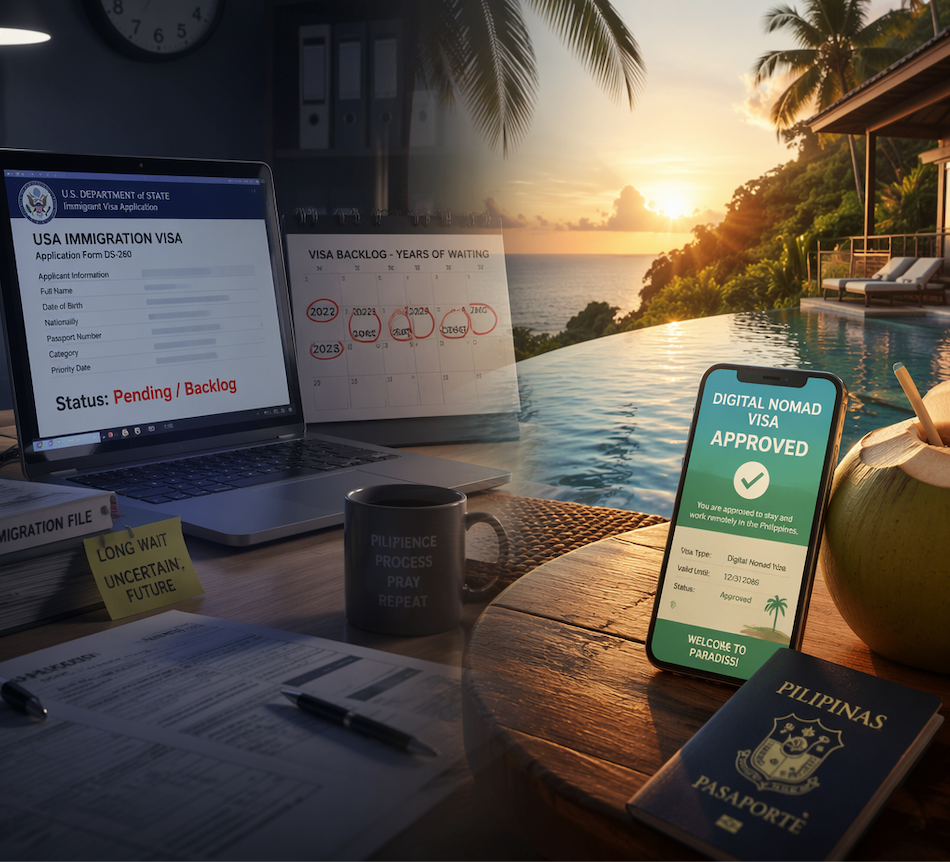
If you need to wait for US EW3 visa processing outside your home country, choosing the right base in Southeast Asia can shape your finances, family stability, and mental health across a multi-year timeline. Most EB-3 unskilled applicants from the Philippines, India, and other oversubscribed countries face priority date waits stretching from three to ten years or more. This article breaks down five realistic locations—Thailand under the Destination Thailand Visa, the Philippines through the Special Resident Retiree’s Visa, Bali via Indonesia’s long-stay frameworks, Ho Chi Minh City on Vietnamese business or temporary residence pathways, and Malaysia through its post-2021 residency programs—by life stage and budget rather than crowning a single winner. Your circumstances, not a generic ranking, should drive the decision.
How Long Is the EW3 Wait, Really? Why Your Base Location Matters
The EB-3 Other Workers category, commonly called EW3, remains heavily backlogged for applicants born outside Mexico. Priority dates for many countries lag several years behind the current processing month, and the visa bulletin advances unpredictably. Some applicants see their dates stall for years, then jump months in a single bulletin; others watch gradual creep that still leaves them half a decade from interview scheduling.
This volatility creates a practical problem. You cannot put your life on hold indefinitely. Maintaining a job, educating children, preserving savings, and staying healthy all require geographic stability. Yet committing to a location with the wrong cost structure, visa restrictions, or tax profile can drain resources you will need for the final immigration steps—medical exams, visa fees, travel to the U.S. consulate, and initial settlement costs.
The base you choose also affects your compliance posture. U.S. immigration authorities do not require you to remain in your home country during I-140 processing or priority date waiting. However, your conduct abroad—tax filings, visa status in the host country, any hint of unauthorized work—becomes part of your record. A clean, documented residency history in a stable jurisdiction helps; a patchy visa status or tax ambiguity can complicate your eventual consular processing.
The Five Contenders: At-a-Glance Comparison Table
The table below summarizes core dimensions for each location. Specific financial requirements, fees, and program rules change frequently. Verify current terms directly with official government sources before making any decisions.
| Dimension | Thailand (DTV) | Philippines (SRRV) | Bali/Indonesia | Ho Chi Minh City/Vietnam | Malaysia |
|---|---|---|---|---|---|
| Primary visa pathway | Destination Thailand Visa (DTV) | Special Resident Retiree’s Visa (SRRV) | Second Home Visa or B211A business visa | Business visa (DN) → Temporary Residence Card | Malaysia My Second Home (MM2H) or Premium Visa Programme |
| Typical initial stay | Up to 180 days per entry, extendable | Indefinite with annual renewal | 1–5 years depending on visa type | 1–2 years, renewable | 5 years, renewable |
| Financial threshold | Proof of remote/digital income or savings; no fixed deposit | Deposit varies by age and visa type; lower brackets for retirees | Second Home requires proof of funds; B211A lower barrier | Business registration or employer sponsorship typically required | Fixed deposit plus proof of monthly offshore income; requirements tightened post-2021 |
| Work authorization | DTV permits certain digital/remote activities; traditional employment prohibited | No local work permitted; passive income only | Work permit required for local employment; remote work legally gray | Work permit required; business visa alone does not authorize employment | MM2H does not permit local work without separate pass; Premium Visa has different rules |
| Property ownership | Foreigners cannot own freehold land; condominium quota purchase possible | Can purchase condominium; land ownership restricted | Hak Pakai (Right to Use) or Hak Guna Bangunan for structures; not freehold equivalent | 50-year leasehold typical for foreigners; complex ownership structures | Freehold possible in certain categories; generally more foreign-friendly |
| Tax residency trigger | 180+ days may trigger tax residency; 2024 reforms affect worldwide income reporting | Non-citizen residents taxed on Philippine-sourced income only | 183+ days triggers tax residency; complex compliance | 183+ days typical threshold; worldwide income exposure possible | 182-day physical presence test; territorial tax system for many income types |
| Healthcare quality | Good private hospitals in Bangkok, Chiang Mai; insurance essential | Variable by city; Manila and Cebu have adequate private care; many expats self-insure or use local plans | Bali limited for serious conditions; Jakarta better; medical evacuation insurance common | Rapidly improving in HCMC; international hospitals available; insurance recommended | Strong private healthcare in KL and Penang; medical tourism hub |
| Monthly budget (modest lifestyle) | $1,200–$2,500 | $1,000–$2,000 | $1,200–$2,200 | $800–$1,800 | $1,200–$2,500 |
| English prevalence | Tourist areas and medical settings; limited otherwise | High relative to region; widespread in business and services | Tourist zones only; Bahasa Indonesia required for legal matters | Growing in business districts; Vietnamese dominant | Very high; primary business language |
| Schooling for children | International schools in major cities; $8,000–$25,000/year | International schools in Manila, Cebu, Davao; $6,000–$18,000/year | Limited in Bali; Jakarta better; $8,000–$20,000/year | Expanding international school sector; $6,000–$15,000/year | Excellent international schools in KL; $8,000–$22,000/year |
| Family inclusion | Spouse and children can accompany; dependent rules apply | Spouse and dependents includable; additional fees | Spouse and children on dependent KITAS; additional documentation | Family members need separate visa basis or sponsorship | Spouse, children under 21, and parents may be included depending on program tier |
Segment 1: The Solo Applicant on a Tight Budget (Under $1,500/Month)
If you are single, under 35, and funding your wait through savings or modest remote work, your priorities are low burn rate and visa flexibility. Two locations stand out, with important caveats.
Ho Chi Minh City offers the lowest coherent cost of living among the five. A disciplined single person can live comfortably on $800–$1,200 monthly, with excellent street food, affordable motorbike transport, and reasonable apartment rents in District 2 or Binh Thanh. The challenge is legal status. Vietnam does not offer a straightforward long-stay visa for passive waiters. Most applicants cycle business visas (DN category) or pursue temporary residence cards through nominal company sponsorship. This creates compliance risk and periodic renewal friction. You must verify current requirements with the Vietnam Immigration Department, as 2023–2024 e-visa expansions changed tourist entry but not long-stay frameworks.
The Philippines (SRRV) becomes viable if you qualify for a lower deposit bracket, typically available to applicants meeting age thresholds. The SRRV Smile or Classic categories historically required differentiated deposits by age, with reduced amounts for retirees. However, the program was temporarily suspended in 2020 and eligibility rules shifted upon reopening. Confirm current deposit requirements and active program status with the Philippine Retirement Authority before proceeding. English fluency reduces daily friction dramatically.
Avoid: Malaysia post-2021 program restructuring, which raised financial barriers; Bali, where visa runs and limited infrastructure inflate hidden costs; and Thailand DTV if your remote income falls below demonstrable thresholds.
Segment 2: The Working Couple Who Needs Legal Income Options
Couples where both partners want legitimate income face the sharpest constraints. Most Southeast Asian visas explicitly prohibit local employment without separate work authorization.
Thailand’s DTV permits certain digital activities—freelancing, remote work for non-Thai employers, digital content creation—within defined boundaries. It does not authorize traditional employment with a Thai company or all employment structures. Verify permitted activities directly with the Royal Thai Embassy or official Thailand Pass system. For couples where one partner qualifies for DTV and the other can structure legitimate remote work, Thailand offers reasonable infrastructure, coworking spaces, and quality of life in Chiang Mai or Bangkok. The non-working partner typically holds a dependent extension.
Malaysia presents a split picture. The restructured MM2H program after 2021–2022 generally does not permit local work without a separate employment pass. However, Malaysia’s broader visa ecosystem includes pathways for skilled workers and entrepreneurs that some couples navigate. The Premium Visa Programme, launched as a parallel offering, has different rules regarding economic activity. Confirm current terms with the Malaysia My Second Home Centre. English prevalence and business infrastructure are superior to most alternatives.
Vietnam and Indonesia both require work permits for local employment, and enforcement has tightened. Nominal “business visa” arrangements that mask actual work create deportation risk and future immigration complications. For couples needing dual income, these are generally poor fits unless one partner secures legitimate corporate sponsorship.
Segment 3: Families with School-Age Children: Education and Stability First
Children need continuity. Switching schools mid-stream, coping with visa uncertainty, or facing medical emergencies without reliable care creates disproportionate stress during an already uncertain immigration wait.
Malaysia leads for education quality and stability. Kuala Lumpur and Penang host established international schools with recognized curricula (IB, British, Australian), and the MM2H or Premium Visa structures provide multi-year certainty. Healthcare is excellent and affordable. The tradeoff is higher financial requirements and, for MM2H, restrictions on local employment.
Thailand ranks second, particularly Bangkok and Chiang Mai, with strong international schools and good private hospitals. The DTV’s renewal structure requires attention—ensure you can demonstrate continued eligibility for extensions without disrupting children’s enrollment.
The Philippines offers the most affordable international schooling and English-native instruction, reducing language transition trauma. Manila and Cebu have adequate though uneven healthcare. The SRRV’s indefinite nature provides stability if you qualify and maintain the deposit. Verify whether your children’s ages affect dependent inclusion rules.
Avoid: Bali, where quality international schooling is limited and serious medical conditions require evacuation; and Ho Chi Minh City, where the international school sector, while growing, lacks the depth of established alternatives and visa instability disrupts planning.
Segment 4: Capital-Ready Applicants Who Can Park Funds for Residency
If you have liquid assets and can commit a fixed deposit for residency rights, your calculus shifts toward program stability, tax efficiency, and lifestyle quality rather than minimal cost.
Malaysia has historically attracted this segment with its property ownership allowances, territorial tax system, and developed infrastructure. Post-2021 MM2H changes increased financial requirements and added complexity, but the program remains operational with further 2024 modifications. The fixed deposit structure, combined with proof of monthly offshore income, suits applicants with investment income or retained earnings. Malaysia’s tax residency trigger at 182 days and territorial approach to many income types can be advantageous, though cross-border tax planning requires professional guidance.
The Philippines SRRV offers lower capital requirements for older applicants and indefinite stay rights. The deposit is recoverable upon program exit, though timing and conditions vary by visa category. Classic, Smile, and Courtesy visas carry different deposit schedules and ancillary benefits. This suits pre-retirement applicants with conservative risk tolerance who prioritize English fluency and cultural familiarity.
Thailand DTV does not require a fixed deposit, which paradoxically makes it less suitable for capital-ready applicants seeking structural stability. The income-demonstration model creates ongoing documentation burden.
Indonesia’s Second Home Visa, launched in 2022, targets this segment with multi-year validity and property-linked stay rights. However, foreign ownership structures (Hak Pakai, Hak Guna Bangunan) differ materially from freehold, and tax residency at 183+ days exposes worldwide income. Verify current validity periods with the Indonesian Directorate General of Immigration.
The Hidden Costs Nobody Tabulates: Tax, Compliance, and Exit Risk
Beyond visible rent and school fees, four hidden cost categories distort apparent affordability.
Tax residency exposure. Thailand’s 2024 tax reforms brought worldwide income into reporting scope for tax residents, defined broadly by physical presence. The Philippines taxes non-citizen residents only on local income, which favors passive foreign-income holders. Malaysia’s territorial system and 182-day threshold are more predictable. Vietnam and Indonesia both present worldwide income risk at 183+ days. These rules change; consult a cross-border tax professional rather than relying on generalized summaries.
Visa renewal friction. The DTV, B211A, and Vietnamese business visas require periodic renewal with documentation, fees, and occasional policy shifts. Each renewal carries rejection risk. Indefinite programs like SRRV and multi-year programs like MM2H reduce this friction but impose capital lockup.
Property ownership illusions. Foreigners cannot own freehold land in Thailand; condominium purchase is possible within quota limits. Indonesia’s title structures are not freehold equivalents. Malaysia offers more straightforward foreign ownership in certain categories. Misunderstanding these structures creates exit losses when you finally depart for the U.S.
Unauthorized work consequences. Working remotely for a U.S. employer while on a tourist or non-work visa constitutes visa violation in Thailand, Indonesia, and Vietnam. The DTV’s permitted activities have boundaries; “digital nomad” is not a universal work authorization. Enforcement varies, but a violation record can jeopardize future U.S. immigration processing.
What Happens If Your Priority Date Moves Faster—or Stalls Completely?
Your base choice must accommodate both scenarios.
If the visa bulletin accelerates unexpectedly, you need geographic flexibility to reach your designated U.S. consulate quickly. Locations with strong air connectivity to the U.S.—Bangkok, Manila, Kuala Lumpur—outperform those requiring multi-leg journeys. You also need liquid funds not trapped in property or fixed deposits with withdrawal penalties.
If your priority date stalls for years beyond projection, you need sustainable visa status without accumulating renewal risk. This favors indefinite programs (SRRV) or multi-year structures (MM2H, Second Home Visa) over repeated short-term renewals.
The worst position: committed to a location through property purchase or non-refundable deposits, then facing a sudden priority date advance that requires immediate relocation, or conversely, a decade-long stall that exhausts your visa pathway. Structure your base with explicit exit options.
Decision Framework: Picking Your Base Without Regret
Use this sequential filter rather than comparing locations in isolation.
First, constrain by legal viability. Can you realistically obtain and maintain the required visa given your age, capital, and employment structure? Eliminate options where your profile does not match program requirements.
Second, constrain by family needs. Do you have school-age children? Does your spouse need work authorization? These typically eliminate one or two locations immediately.
Third, optimize for timeline compatibility. Match visa duration to your realistic priority date range. A five-year MM2H visa suits a five-year projected wait better than annual renewals.
Fourth, stress-test for downside scenarios. Can you sustain the location if your priority date stalls two years beyond estimate? Can you exit cleanly if it advances suddenly?
Fifth, verify current rules with official sources. All programs discussed have undergone recent changes. Malaysia MM2H was suspended and restructured in 2021–2022. Philippines SRRV saw temporary suspension and rule shifts. Indonesia’s Second Home Visa launched in 2022 with evolving implementation. Thailand DTV is relatively new with developing extension practice. Vietnam’s long-stay frameworks continue to adjust. Do not rely on expat forum posts or outdated articles for current requirements.
When to Start Your Southeast Asia Setup Relative to Your Priority Date
Timing matters for both financial and psychological reasons.
Relocating immediately after I-140 approval, when your priority date is years from current, risks visa status expiration or excessive capital commitment before you have clarity. Conversely, waiting until your priority date is months from current leaves insufficient time to establish residency, open banking relationships, enroll children in school, and adapt culturally.
A pragmatic middle path: begin detailed location research and preliminary financial preparation when your priority date is approximately three to four years from the current visa bulletin date. Initiate actual relocation when the gap narrows to two years, assuming your I-140 remains valid and your petition has not encountered administrative issues. This preserves optionality while allowing genuine settlement.
For applicants with approved I-140, be mindful that consular processing requires you to attend interview at your designated post. If you establish residency abroad, you may request transfer to that consulate, but processing capacity and wait times vary. Some applicants maintain home country ties specifically to preserve consular options.
Common Risks or Mistakes
EW3 applicants frequently misstep in predictable ways when establishing Southeast Asian bases.
Assuming “digital nomad” status is universally legal. No Southeast Asian country offers blanket remote work authorization. Each visa has specific permitted activities, and enforcement is tightening. A visa violation can generate a record that complicates U.S. immigration.
Conflating property possession with ownership. Leasehold, Hak Pakai, and nominee structures create usable possession without secure ownership. Understand what you are actually acquiring and how you will exit.
Ignoring tax residency triggers. Days count. Crossing 180 or 183 days can shift your tax obligations dramatically, particularly under Thailand’s 2024 reforms. Track your presence and seek professional advice.
Underestimating school transition costs. International school deposits, withdrawal penalties, and curriculum mismatches create real losses if you must depart suddenly for visa interview.
Overcommitting to a single location. The EW3 timeline is uncertain by design. Structure your base with explicit reversibility.
Key Takeaways
- No single location is best for all EW3 waiters; match your life stage, budget, and family structure to the right program.
- Ho Chi Minh City offers lowest cost but highest visa friction; Malaysia offers most stability but highest financial requirements.
- Thailand DTV suits remote workers with demonstrable digital income but does not authorize all employment structures.
- Philippines SRRV provides indefinite stay and English fluency at moderate cost for those meeting age and deposit criteria.
- Malaysia leads for families prioritizing education and healthcare; Bali trails for families due to limited schooling and medical infrastructure.
- Tax residency rules vary sharply by jurisdiction and change frequently; professional guidance is essential, not optional.
- All programs discussed have undergone recent policy changes; verify current requirements directly with official government sources before acting.
- Structure your base for both sudden priority date advancement and indefinite delay.
- Maintain clean compliance records throughout your wait; visa violations abroad can affect U.S. immigration outcomes.
Frequently Asked Questions
Can I apply for the EW3 visa while living outside my home country?
Yes. U.S. immigration law does not require you to remain in your country of birth or last residence during I-140 processing or priority date waiting. You may file from abroad, and when your priority date becomes current, you can pursue consular processing at a U.S. embassy or consulate in your country of residence, subject to that post’s capacity and any transfer procedures. Maintain legal status in your host country throughout the process.
Does Thailand DTV allow me to work remotely for a US employer legally?
The DTV permits certain digital and remote activities, including freelance work and employment with non-Thai entities, within defined boundaries. It does not constitute blanket work authorization for all employment structures. Traditional employment with a Thai company requires a separate work permit. The precise scope of permitted activities should be verified with the Royal Thai Embassy, as implementation continues to evolve. Working outside permitted activities constitutes visa violation.
What happens to my Philippines SRRV deposit if I leave before getting my green card?
SRRV deposits are generally recoverable upon program exit, subject to the specific visa category’s terms and any applicable holding periods. Classic, Smile, and Courtesy categories have different deposit schedules and conditions. The Philippine Retirement Authority administers these deposits. Request current withdrawal procedures and timelines directly from the PRA, and ensure you understand any currency conversion or fee deductions that may apply.
Is Malaysia MM2H still accepting applicants after the 2021 program changes?
Yes, though with significantly modified requirements. The program was suspended in 2021 and restructured with higher financial thresholds, including increased fixed deposit amounts and proof of monthly offshore income. Further modifications occurred in 2024. The Malaysia My Second Home Centre oversees current applications. Premium Visa Programme offers a parallel pathway with different terms. Verify current eligibility, financial requirements, and processing status directly with official Malaysian sources before applying.
Can my spouse work in Vietnam while we wait for my EW3 priority date to become current?
Generally no. A business visa (DN) or dependent status based on your visa does not authorize employment. Your spouse would need an independent work permit, typically requiring a sponsoring employer and meeting Vietnamese labor market tests. Some multinational companies navigate this through internal transfers, but casual or remote work arrangements do not satisfy legal requirements. Unauthorized work carries deportation risk and potential future immigration consequences.
Related Reading on SerialExpat
- EW3 visa pathway overview and priority date strategy – related visa, residency, or migration planning articles.
Disclaimer
This article is for general informational purposes only and does not constitute legal, tax, immigration, financial, or property investment advice. Laws, government procedures, visa bulletin dates, processing times, tax rules, and local regulations may change. Readers should verify information with official sources or consult a qualified professional. Specific visa requirements, fees, deposit amounts, and program statuses must be confirmed directly with the relevant government authorities: Royal Thai Embassy, Philippine Retirement Authority, Indonesian Directorate General of Immigration, Vietnam Immigration Department, and Malaysia My Second Home Centre. Cross-border tax matters should be reviewed with a qualified tax professional familiar with both your home country and destination jurisdiction.