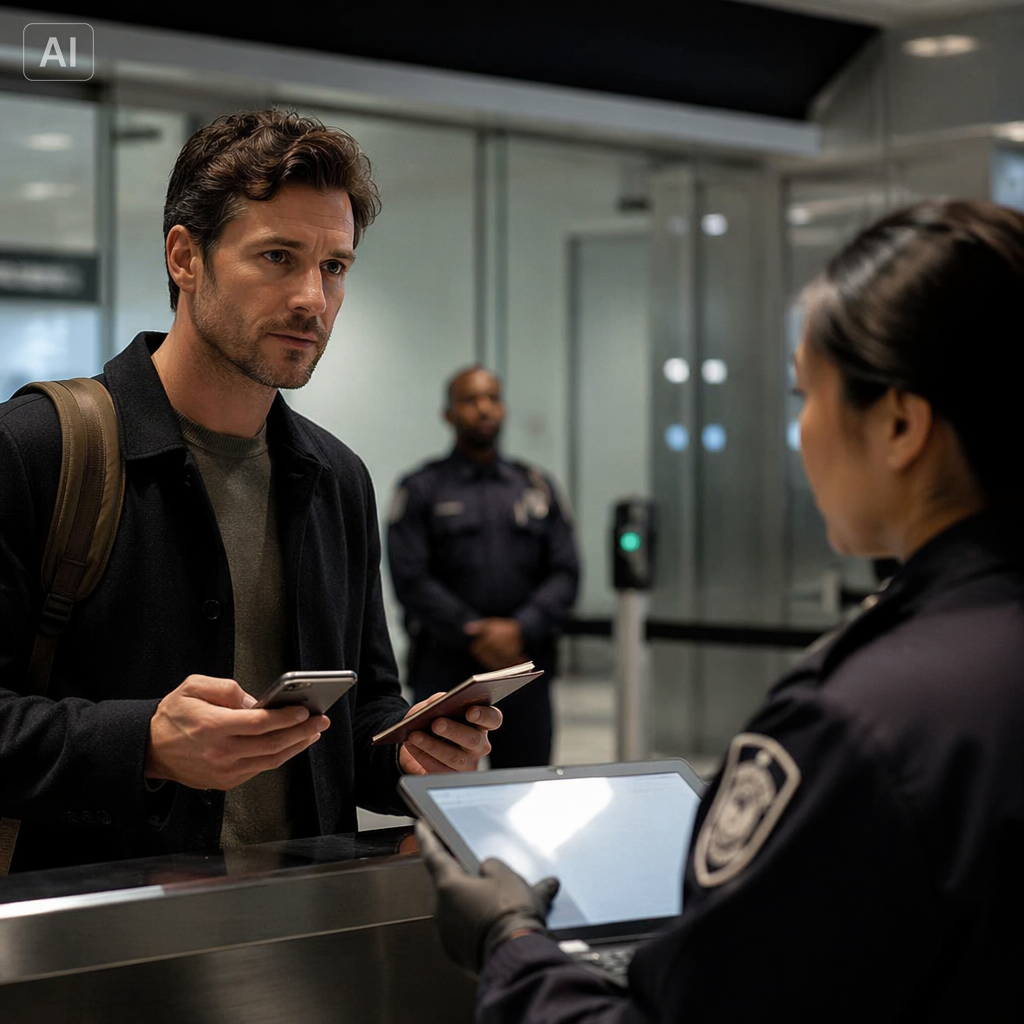
Border digital hygiene is not a privacy luxury—it is a visa survival protocol. Every year, travelers with valid B1/B2 tourist visas, pending EW3 petitions, and even permanent residents see their immigration status destroyed in minutes because of what CBP officers find inside their phones. This guide delivers forensic-level compliance intelligence for anyone whose relocation plan depends on clearing a single border interview. We will expose the exact file categories that trigger expedited removal, explain the real limits of digital privacy at ports of entry, and provide a defensible 24-hour pre-departure protocol that protects your immigration future without crossing into obstruction of justice.
The Border Search Exception: Why Your Phone Has No Fourth Amendment at Customs
The Fourth Amendment does not travel with you to the border. Under the Border Search Exception, recognized by the U.S. Supreme Court, customs officers operate with authority that would be unconstitutional anywhere else on American soil. This doctrine permits warrantless, suspicionless searches of persons and property entering the United States—including the full contents of electronic devices.
However, the legal landscape is not as absolute as some claim. In Alasaad v. Mayorkas, the First Circuit held that forensic searches of electronic devices—those using specialized software to recover deleted data or bypass encryption—require at least reasonable suspicion of criminal activity. Other circuits have not uniformly adopted this standard. CBP’s own Directive 3340-049A and any successor policies govern these procedures, but travelers should verify current policy revisions post-2023 with official CBP guidance. The critical point: manual review of your unlocked phone remains broadly permissible without any threshold showing.
The price of refusal is severe. If you decline to provide a password, CBP may detain your device for forensic examination, deny you entry under INA 212(a)(7)(A)(i)(I) as an intending immigrant without proper documentation, and initiate expedited removal proceedings under INA 235(b)(1). Device refusal does not legally shield you—it transforms a routine inspection into an adversarial encounter with discretionary consequences that may include multi-year reentry bars. Canadian CBSA officers exercise similar authority under the Customs Act, though specific procedural thresholds differ.
Circuit splits continue to evolve. No traveler should assume uniform protections across all U.S. ports of entry. Consult a licensed immigration attorney for jurisdiction-specific guidance before relying on any privacy expectation at the border.
Five Digital File Categories That Trigger Expedited Removal
CBP officers and their automated targeting systems examine digital content for evidence of visa fraud, immigrant intent, criminal activity, and security threats. The following five categories represent the highest-risk digital artifacts we have observed in entry denial cases.
Category 1: Smoking Guns of Immigrant Intent and Unlawful Labor
A tourist visa holder with a Resume or Cover Letter tailored to the destination job market has already confessed to immigrant intent before speaking a word. Browser history showing active LinkedIn Premium job searches, Indeed applications, or localized recruiting portal accounts destroys B1/B2 non-immigrant credibility instantly.
Chat log landmines on WeChat, WhatsApp, iMessage, or Telegram containing references to “work cash,” “find a boss,” “side hustle,” “send salary,” “maternity hotel,” or “birth tourism” function as admissions of intent to violate visa status. CBP officers are trained to keyword-search messaging databases once a device is unlocked. These phrases appear in actual denial narratives—not as theoretical risks, but as documented grounds for finding visa fraud under INA 212(a)(6)(C)(i).
Student visa (F1) holders face parallel exposure. Evidence of unauthorized employment arrangements, including payment apps configured for U.S. dollar receipts or group chat discussions about off-books work, may result in SEVIS termination and removal.
Category 2: Unreported Wealth, Offshore Assets, and Illicit Transfer Trails
Digital financial footprints trigger parallel referrals to Homeland Security Investigations (HSI) and IRS Criminal Investigation. Underground banking evidence includes WeChat Pay or Alipay transaction screenshots, hawala network coordination messages, or structured transfer instructions designed to evade Currency Transaction Reporting requirements.
The crypto hazard presents unique vulnerability. Unlocked non-custodial wallets—MetaMask, Trust Wallet, hardware wallet interfaces—expose transaction histories that officers may interpret as capital flight or money laundering indicators. P2P/OTC trading group memberships, large stablecoin transfer records without documented source-of-funds, and exchange accounts lacking tax reporting history all invite extended detention and financial crime referral.
No automatic criminality attaches to cryptocurrency possession. However, the combination of unreported holdings, active trading interfaces, and destination-country tax non-compliance creates a narrative that CBP may use to support fraud findings or mandatory detention.
Category 3: The Meme Trap — Contraband and Marginal Content
Passive media risk is the most insidious category because it requires no criminal intent to create devastating consequences. Dark humor memes, viral images, or cached group chat content depicting or adjacent to child exploitation material may constitute federal criminal possession under 18 U.S.C. Chapter 110, regardless of whether the traveler knowingly saved the file. Western jurisdictions including the United States, Canada, and Australia enforce strict liability approaches to cached image possession with affirmative defenses that are difficult to establish during a border inspection.
Security and geopolitical red flags extend to edgy jokes about “bombing a facility,” “crashing a server,” or possessing unauthorized proprietary source code, schematics, or industrial intelligence. CBP’s National Targeting Center coordinates with FBI counterintelligence on technology transfer concerns. Travelers with backgrounds in sensitive sectors—semiconductor manufacturing, aerospace, artificial intelligence—face elevated scrutiny for digital content that suggests trade secret misappropriation or export control violations.
Category 4: Immigration Agency Scripts and Coaching Sheets
The discovery of fraud blueprints permanently destroys credibility. PDFs, emails, or screenshots containing Q&A cheat sheets (“How to trick CBP”), fake hotel voucher templates, fabricated travel itineraries, or coordinated dummy sponsor storylines constitute direct evidence of misrepresentation. CBP officers routinely photograph these documents for inclusion in refusal packets that are shared across consular databases.
Even ostensibly legitimate immigration consultants may distribute materials that cross into fraud facilitation. Any document advising you to conceal material facts, provide false employment letters, or misstate the purpose of your visit becomes a weapon against you once discovered.
Category 5: Timeline Conflicts for Pending Visa Backlogs
This category is specific to applicants with pending immigrant petitions—particularly EW3 and EB-5 priority dates—who attempt entry on non-immigrant visas during processing delays. The legal requirement of non-immigrant intent (for B1/B2) or non-immigrant status maintenance (for F1) conflicts directly with digital evidence of permanent relocation planning.
High-risk files include: permanent relocation packing checklists, school enrollment research for minor children, pre-signed lease agreements, vehicle purchase inquiries, or furniture delivery scheduling. Email threads with U.S.-based relatives discussing “when you finally move here” or cloud-stored mortgage pre-approval documents function as admissions of abandoned foreign residence.
The EW3 entry denial risk is particularly acute. Unskilled worker visa applicants with approved I-140 petitions and pending priority dates face inherent skepticism about temporary intent. Digital content suggesting immediate settlement plans—rather than prospective employment contingent on visa availability—may result in refusal under Section 214(b) or expedited removal under INA 235(b)(1).
The 24-Hour Digital Border Security Loop: A Pre-Departure Protocol
Effective border digital hygiene is pre-travel data minimization, not destruction of evidence. The following protocol reduces forensic exposure without creating spoliation risk or misrepresentation liability.
The Hard Reset Strategy
For high-stakes travelers—those with pending EW3 petitions, prior visa denials, or sensitive professional backgrounds—leave primary devices at home. Ship them separately via traceable international courier with declared contents and proper customs documentation. Travel with a factory-reset device running a fresh operating system installation, containing only essential travel documents, confirmed accommodation reservations, and return itinerary evidence.
This approach carries its own risk: officers may question why a business traveler carries no professional correspondence, or why a tourist lacks personal photos. Prepare a truthful, consistent explanation. Material misrepresentation about device ownership or purpose—claiming a wiped phone is your everyday device—may violate 18 U.S.C. 1001 and trigger enhanced scrutiny or prosecution independent of immigration consequences.
The App-Level Wipe
Simply deleting messages is forensically useless. CBP and contracted forensic laboratories utilize extraction platforms—Cellebrite UFED and comparable tools—to recover deleted SQLite database fragments, parse application caches, and reconstruct communication timelines. The only effective countermeasure is complete application uninstallation followed by secure overwrite of device storage, or migration to cloud-only access with no local data residue.
For applications you must retain: perform encrypted cloud backup, verify backup completion, uninstall the application entirely, and if technically capable, perform a secure local storage wipe before reinstallation of only essential apps. Messaging platforms with disappearing message features provide minimal protection if the underlying database has been forensically preserved.
Group Chat Evacuation
Manually exit WhatsApp, Telegram, WeChat, and Signal groups that regularly distribute political satire, immigration loophole discussions, controversial memes, or unvetted financial opportunities. Group membership metadata—your presence in a channel, participation timestamps, and administrator status—survives individual message deletion and may be recovered or requested from platform providers under legal process.
Document your exit with screenshots for personal records. This demonstrates proactive compliance posture if questioned, though it does not eliminate all forensic traces.
Final Verification Checklist
Within 24 hours of departure: review downloads folder, screenshot cache, email attachments, cloud sync folders, and browser saved pages. Remove any document you cannot immediately explain as directly related to your stated travel purpose. Verify that no pending immigrant petition correspondence remains in local email storage if entering on a non-immigrant visa.
When Your EW3 Priority Date Meets CBP: Navigating the Non-Immigrant Intent Trap
EW3 applicants occupy uniquely precarious territory. The unskilled worker visa pathway involves multi-year priority date backlogs during which applicants often maintain legitimate reasons for temporary U.S. entry—family events, business consultations, tourism. Yet the very existence of an approved immigrant petition creates a rebuttable presumption of immigrant intent that B1/B2 applicants must overcome.
Digital content becomes dispositive. An applicant with a 2020 priority date and a current visa bulletin progression who carries evidence of U.S. apartment research, school enrollment for children, or employment discussions with the petitioning employer has functionally abandoned non-immigrant intent. CBP officers adjudicating entry are not bound by Department of State visa issuance decisions; they may find inadmissibility even with a valid visa foil.
The protective strategy is documentary consistency. Carry evidence of maintained foreign residence: active lease or property ownership, ongoing employment abroad, enrollment in foreign institutions for accompanying family members. Ensure digital content aligns with this narrative. Any contradiction between stated purpose and device contents invites prolonged inspection and potential refusal.
Processing times, visa bulletin dates, and CBP enforcement priorities change. Verify current conditions through official State Department resources and USCIS case status tools before finalizing travel plans.
Common Risks or Mistakes
Assuming encryption protects against compelled disclosure. Full-disk encryption prevents casual access but does not shield against password demands at the border. Biometric locks may be bypassed with physical compulsion in some jurisdictions; knowledge-based passwords provide stronger legal protections but may still result in device detention and entry denial.
Relying on “deleted” status. Forensic extraction recovers deleted data from unencrypted storage. SSD trim operations and mobile flash storage garbage collection do not provide reliable sanitization against Cellebrite-class tools.
Traveling with dual-intent visa confusion. H-1B and L-1 visas permit dual intent; B1/B2 and F1 do not. Applicants with pending immigrant petitions who enter on non-dual-intent visas must maintain scrupulous non-immigrant purpose documentation.
Ignoring Canadian and multi-jurisdiction exposure. CBSA maintains independent authority with distinct procedural requirements. A pattern of device refusal at U.S. ports may be shared through Five Eyes intelligence arrangements and affect Canadian admissibility.
Overstating burner device protection. Factory-reset devices without personal content may trigger “suspiciously clean” assessments. The goal is proportionate, explainable data minimization—not obvious evasion.
Key Takeaways
- The Border Search Exception permits broad device examination authority at U.S. ports of entry, though forensic search standards vary by circuit and current litigation.
- Resumes, job search history, and work-related chat messages on tourist or student visas constitute direct evidence of immigrant intent and visa fraud.
- Cryptocurrency wallets, unreported financial records, and underground banking references may trigger money laundering referrals and extended detention.
- Cached or passively saved marginal content—including certain memes and images—may constitute federal criminal possession regardless of intent.
- Immigration coaching materials, fake documents, and script sheets permanently destroy credibility and may result in permanent inadmissibility.
- Pending EW3 and EB-5 applicants must ensure digital content aligns with non-immigrant intent; relocation planning evidence invalidates temporary visa entry.
- Effective border digital hygiene requires pre-travel data minimization: device segregation, app-level wipes, and group chat exit—not mere message deletion.
- All CBP policies, visa bulletin dates, and processing times are subject to change; verify current official guidance before travel.
Frequently Asked Questions
Can CBP legally force me to unlock my phone at the border?
CBP may demand password disclosure as a condition of device examination. Refusal may result in device detention for forensic analysis, entry denial, and expedited removal. The legal standard for compelled decryption remains contested in some jurisdictions; travelers should consult a licensed attorney for case-specific guidance. CBP cannot typically compel disclosure of passcodes known only to the traveler without judicial process in certain circuits, but the practical consequence of refusal is often identical to compelled compliance—denial of entry.
Will a factory reset of my phone protect me from CBP forensic searches?
A proper factory reset significantly reduces recoverable data but does not guarantee forensic sanitization. Advanced tools may recover fragments from flash storage that has not been securely overwritten. For maximum protection, combine factory reset with fresh OS installation and avoid restoring from cloud backups that contain high-risk content at the border. The reset itself must not be performed to destroy evidence of a crime; pre-travel data minimization for legitimate immigration risk management is distinct from obstruction.
Can having a pending EW3 petition automatically deny me entry on a B1/B2 visa?
No automatic denial applies. However, the approved I-140 creates a rebuttable presumption of immigrant intent that the B1/B2 applicant must overcome with evidence of maintained foreign residence and genuine temporary purpose. Digital content inconsistent with temporary intent—relocation planning, U.S. employment discussions, school enrollment—may tip discretionary adjudication toward refusal. Each entry is independently assessed by the CBP officer at the port of entry.
What happens if CBP finds deleted WhatsApp messages on my device?
Deleted WhatsApp messages frequently persist in SQLite databases and are recoverable through forensic extraction. Their content determines consequences: innocent personal communications may prolong inspection but not result in denial; evidence of visa fraud, criminal activity, or security concerns may form the basis for refusal, detention, or referral for prosecution. The fact of deletion itself may be noted as consciousness of guilt in the inspection record.
Is it illegal to travel with a ‘burner’ phone for border crossings?
Possessing a secondary or minimal-content device is not per se illegal. However, material misrepresentation about why you carry it—claiming it is your primary device when it is not, or concealing the existence of other devices—may violate 18 U.S.C. 1001 or comparable false statement statutes. The recommended approach is transparency: if asked, truthfully state that you maintain separate devices for travel security and data minimization purposes. Never represent a device as containing your complete digital life if it does not.
Related Reading on SerialExpat
- Philippines Visa Pathways for Expats in Transition – Explore Southeast Asia contingency planning for periods of uncertain U.S. immigration status.
Disclaimer
This article is for general informational purposes only and does not constitute legal, tax, immigration, financial, or property investment advice. Laws, government procedures, visa bulletin dates, processing times, tax rules, and local regulations may change. Readers should verify information with official sources or consult a qualified professional. All statutory citations, circuit split descriptions, and policy references should be independently confirmed with a licensed immigration attorney before reliance. The digital hygiene practices described are framed as pre-travel risk management; they are not intended to and should not be construed as advice to destroy evidence, obstruct official proceedings, or make material misrepresentations to government officers.