THE SERIAL EXPAT

Category: Journeys & Places

Firsthand journeys, hotel stays and practical place guides.

  • Five Days in Bali: From Ubud to Canggu

    Five Days in Bali: From Ubud to Canggu

    Five Days in Bali: From Ubud to Canggu

    I split my 5-day Bali itinerary between two nights in Ubud and two in Canggu in May 2026, with two different settings: a wooden cabin and garden paths inland, followed by a hotel near the beach with a café where I could spend time upstairs.

    This five-day outline brings those stays together with the places I visited. It follows the two-base structure of my holiday, with suggestions for choosing your outings and keeping the final day flexible. The individual guides cover each hotel and experience in more detail, while the Canggu section below brings together five shops I visited and the things I brought home.
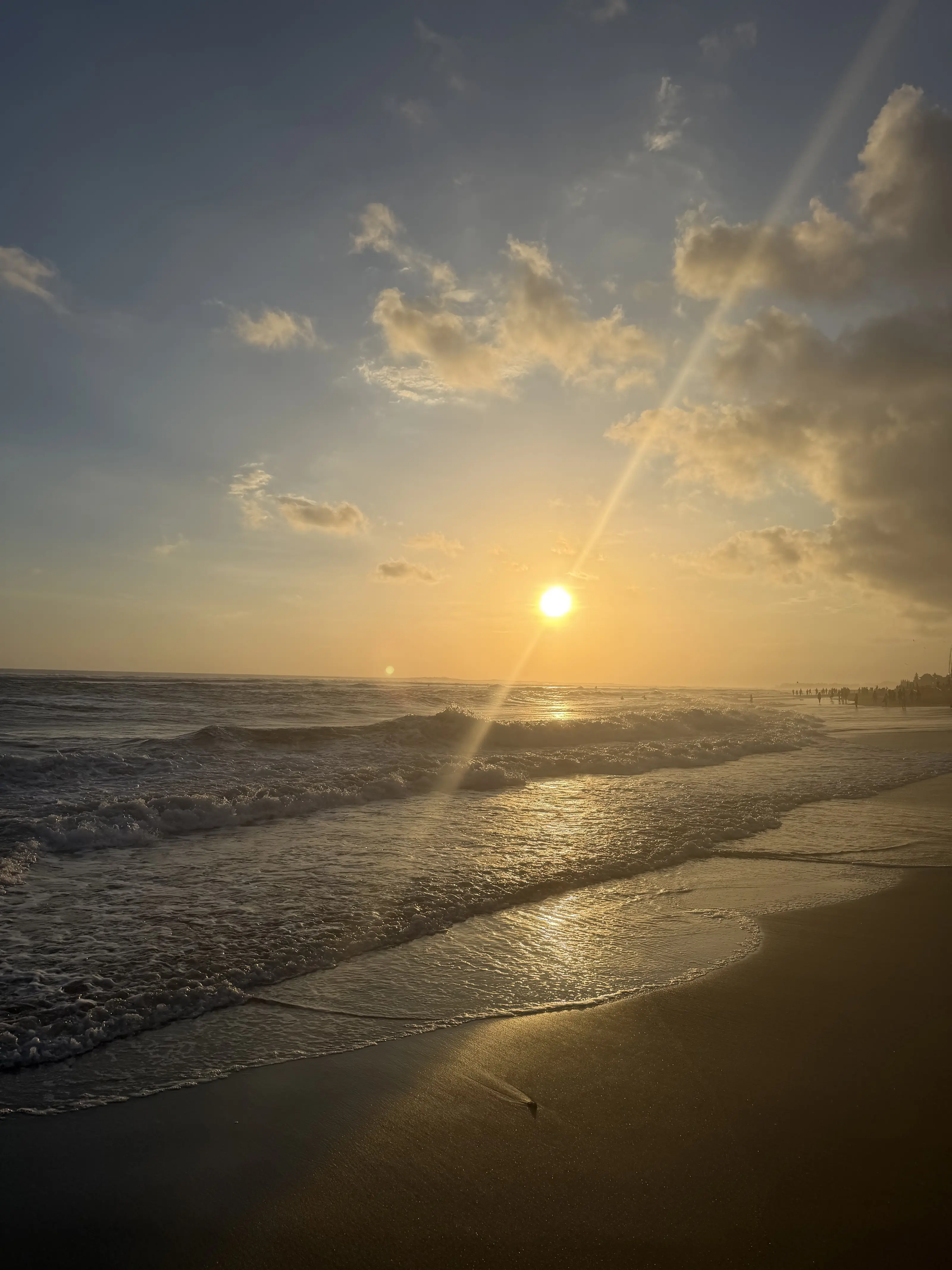
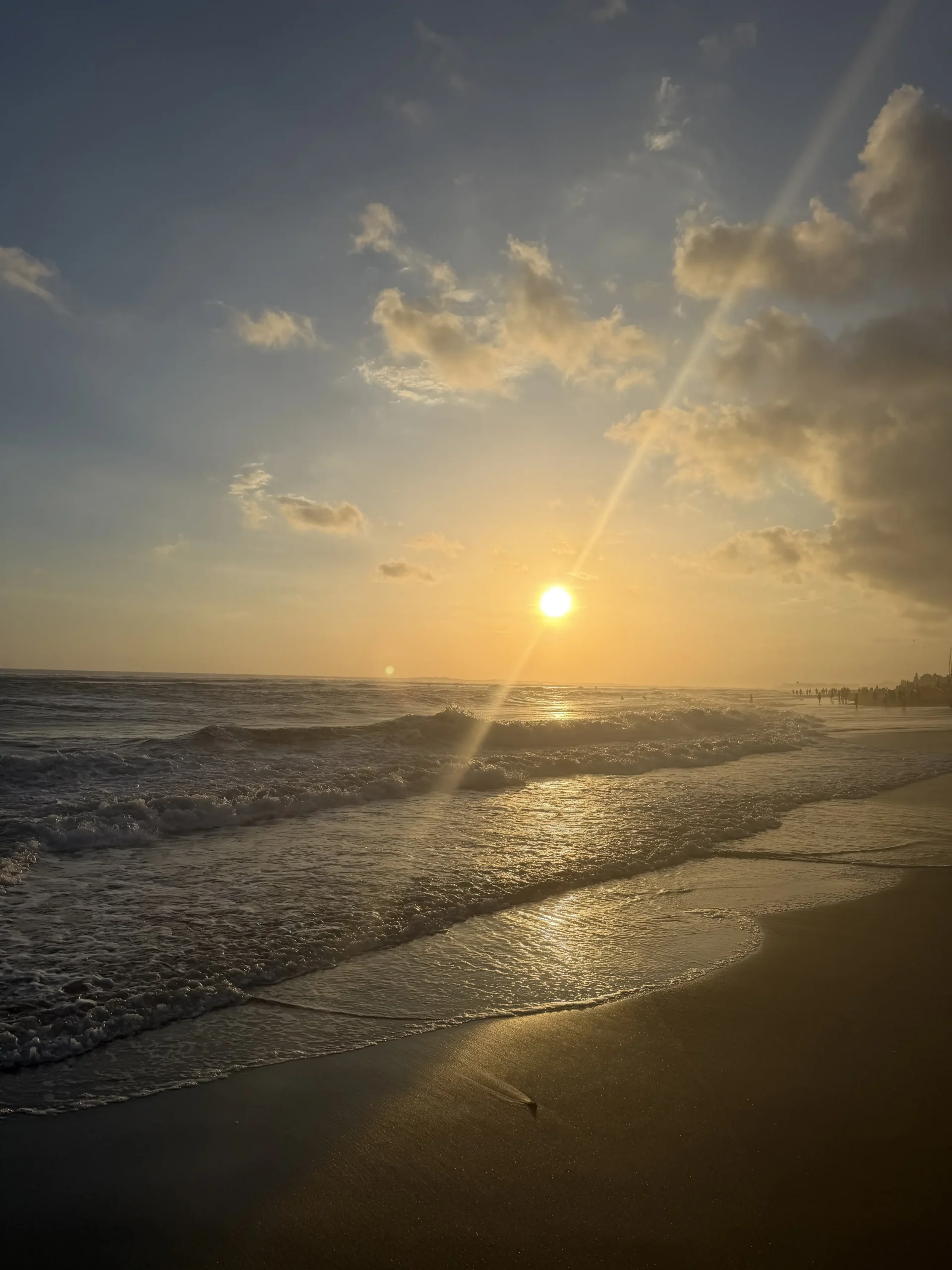
    Sunlight over the waves and sand at Pantai Nelayan, Bali

    5-Day Bali Itinerary at a Glance

    Five days, four nights: two nights in Ubud, followed by two nights in Canggu. There is one hotel move in the middle, with the first two nights allowing time for Ubud’s cultural and natural attractions before the coastal part of the trip.

    DayBaseSuggested focus
    1Ubud — first nightArrive, settle into Adiwana Svarga Loka, and consider a Pyramids of Chi session if your arrival leaves enough time
    2Ubud — second nightA morning walk or run, then choose your main temple, rice-terrace or waterfall stops
    3Canggu — first nightMove from Ubud to ZIN Canggu, check in and get to know the hotel and nearby beach
    4Canggu — second nightBeach time, the café, and room for browsing shops or an activity you particularly want
    5Flexible final dayWork around checkout and onward travel, keeping any last outing close and easy to leave

    Why I Chose Two Different Bases

    In Ubud, my memories centre on Adiwana’s garden setting, the sound session at Pyramids of Chi, a morning run and visits to temples, terraces and waterfalls. Canggu brought the beach, ZIN’s wood-toned spaces and its upstairs café into the holiday.

    The main reason I chose Ubud first was the journey back to the international airport. Canggu is closer to the airport than Ubud, so I wanted to finish the trip on the coast. Reversing the order would have left me travelling from Ubud on the final day, which felt tighter for my return plans. Ending in Canggu made more sense for me, although I would still allow plenty of time for traffic on departure day.

    Moving once also gave each part of the trip its own base. Two nights in each worked for my holiday; someone mainly interested in temple visits or a longer coastal stay might divide the nights differently.

    For broader destination background, Indonesia Travel has official guides to Ubud and Canggu.

    Day 1 — Settle into Ubud

    My Ubud stay was at Adiwana Svarga Loka, in a standalone wooden cabin. After arriving and putting down my luggage, I went to Pyramids of Chi for a sound session.

    That experience remains one of the clearest memories of the trip. There were many international visitors, and I remember a sensation that felt like energy returning to my palms. I have described the visit separately in my Pyramids of Chi experience and booking guide.

    If you want to do something similar on arrival day, choose a session only after allowing time for the journey, hotel check-in and transport to the venue. With a later arrival, I would give the afternoon or evening to settling in and move the session to another available slot.

    The hotel is part of the experience too. Leave time to notice the gardens and find your way between your room and the shared spaces. My Adiwana Svarga Loka stay shows the setting, breakfast area and facilities to consider when comparing bookings.

    Garden paths, tropical plants and Balinese architectural details at Adiwana Svarga Loka

    Day 2 — A Morning Run and Your Choice of Ubud Outings

    The following morning, I joined a run in Ubud. I met people from Malaysia, and we chatted and took photographs together. It was a small encounter, but it became part of how I remember the holiday.

    My Ubud visits also included the Tegallalang rice terraces, Tirta Empul, Tibumana Waterfall and Kanto Lampo Waterfall. I did not swim at the waterfalls; I went to see the surroundings and experience the atmosphere.

    For your own day out, I would choose two main stops before adding anything else. Walking, queues and the journeys between places all need time. Ask your driver to check the order against your accommodation, the day’s conditions and the stops you actually want.

    If Culture and Rice-Terrace Views Come First

    Consider Uma Ceking in the Tegallalang area and Tirta Empul as the focus of the day. The Uma Ceking guide covers the terrace setting and practical choices, while the Tirta Empul guide explains the temple visit and respectful preparation.

    Give the temple enough time in its own right. Decide whether you want to look around or participate in the purification ritual, and follow the instructions given on site.
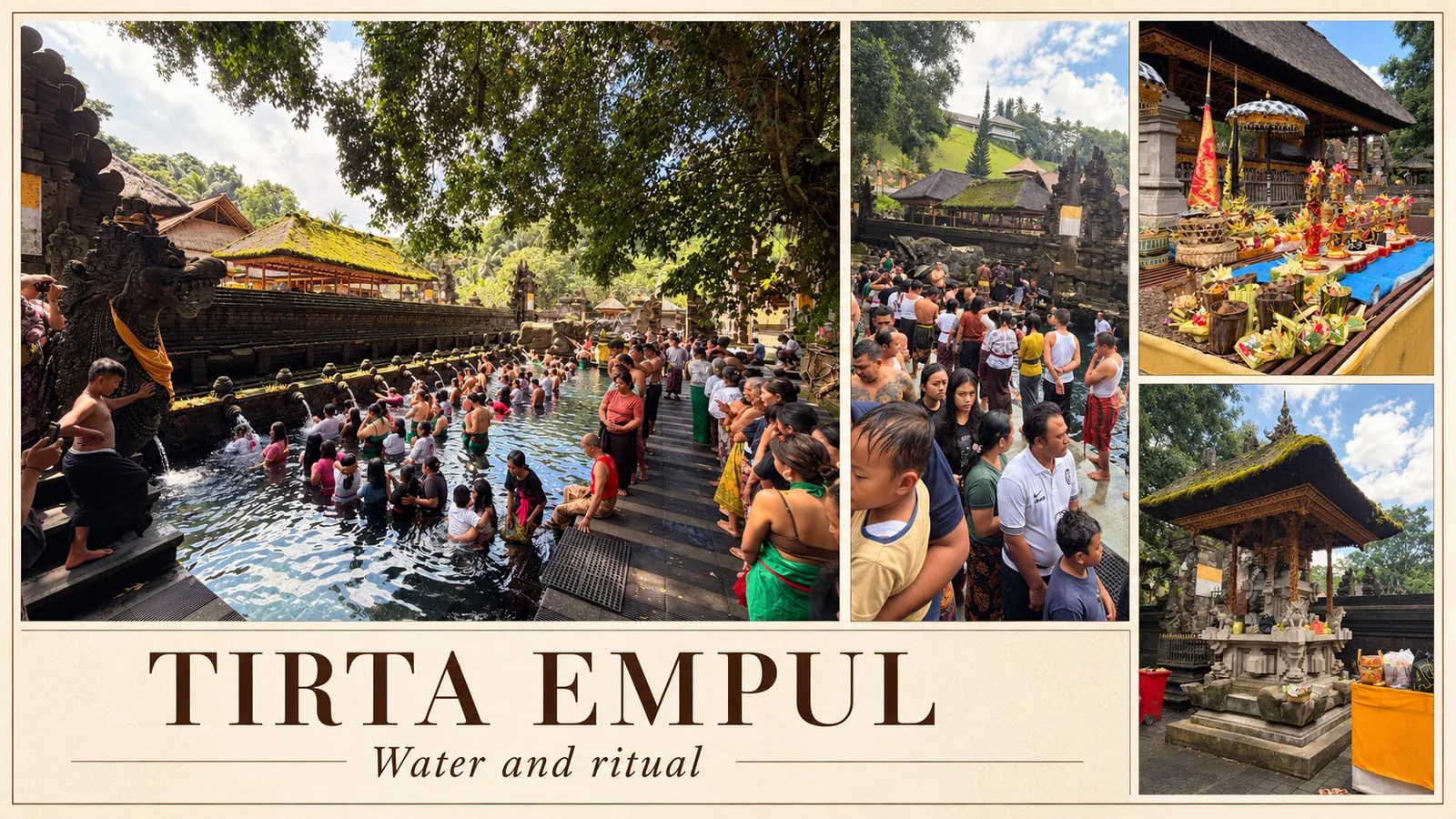
    Visitors at Tirta Empul’s purification pools, offerings and a shrine pavilion

    If Waterfalls Are Your Priority

    Tibumana and Kanto Lampo were both places I visited during the Ubud part of my holiday. They can be the focus of a nature-oriented outing, with the day’s route arranged around access and conditions.

    My Tibumana Waterfall guide covers the forest walk, photographs and practical preparation. You can enjoy the visit from the paths and viewing areas; entering the water should depend on the rules and conditions at the time.

    Day 3 — Move from Ubud to Canggu

    After two nights in Ubud, I moved to ZIN Canggu, where I also stayed for two nights. I liked the hotel’s natural wood tones, the café and being able to walk to the beach.

    I would make the hotel transfer the main commitment of this day. Confirm checkout and check-in times, arrange the journey and ask about luggage storage if the timing leaves a gap. Add an outing only if it fits comfortably around those arrangements.

    Once you arrive, take a short walk to understand the immediate area: the beach access, somewhere to eat and the route back to your accommodation. That small bit of orientation makes the next day easier to use.

    My ZIN Canggu stay covers the room, café, pools and the coastal setting in detail.

    Day 4 — Beach Time, Café Time and Browsing

    For a full day based in Canggu, I would keep the structure simple: a beach walk or run, breakfast, and time for the places that interest you nearby.

    ZIN’s upstairs café is one of the spaces that stood out to me. My photographs include the seating areas and my tablet beside a coconut. For a trip that includes some work or writing, a café pause can be part of the day without taking over the holiday.
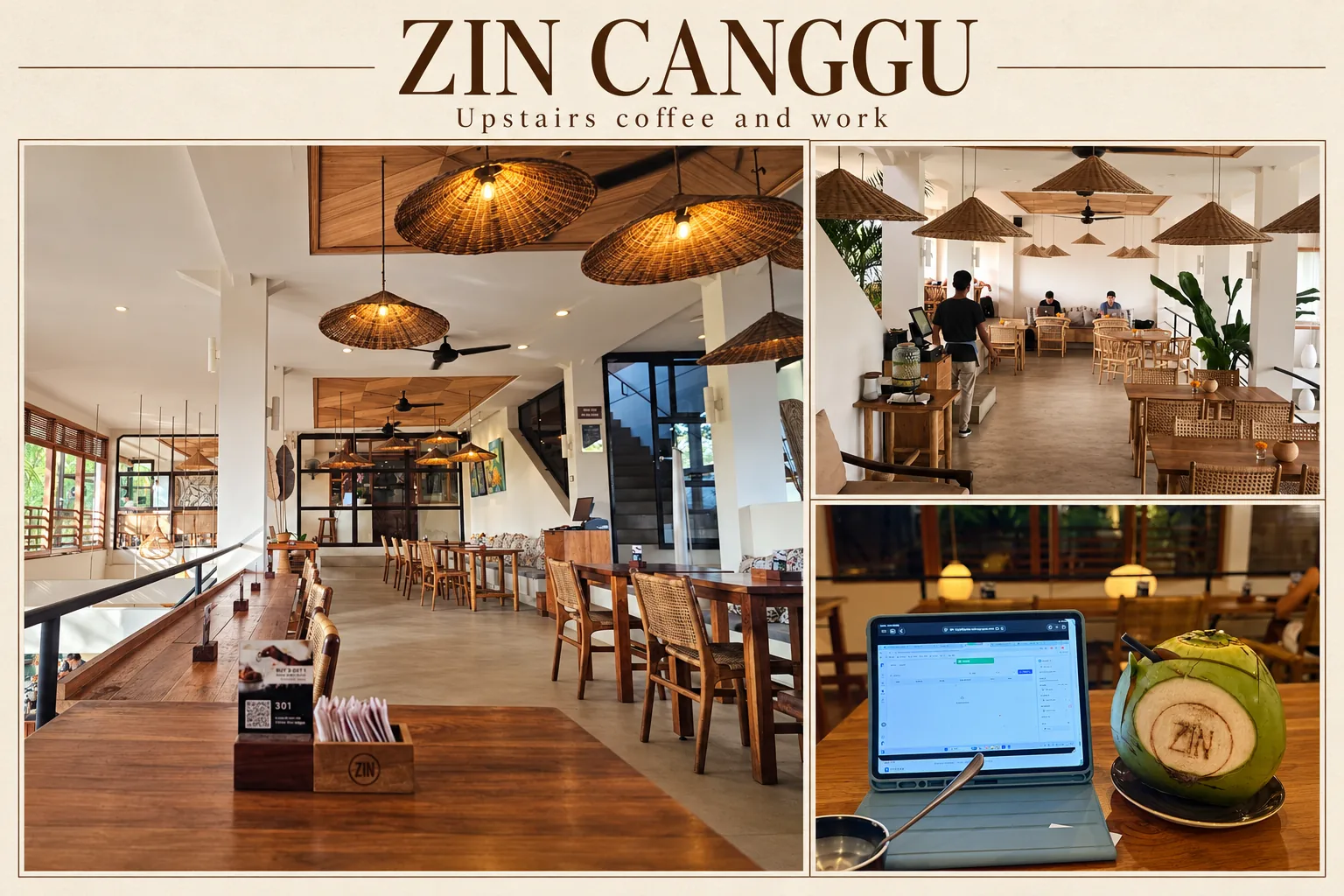
    Upstairs ZIN Canggu café seating alongside my tablet and a fresh coconut on a table

    Choose any spa appointment, fitness session or other activity around the time you have left. Check what is included in your hotel rate and what needs a separate booking or payment.

    Shopping in Canggu: Five Shops I Visited

    Shopping became another part of my Canggu stay. I visited several shops, found plenty I liked and brought quite a few things home. These five stops show different sides of browsing here: fragrance, skincare, jewellery and casual clothing, with interiors that are worth noticing along the way.

    I would choose the shops that match your interests rather than turn them into a checklist. Batu Bolong and Berawa can each have a place in your Canggu plans, but this list is not a timed walking route or a record of everything I did on one day.

    ISHA Naturals — Fragrance and Pillow Mists in Batu Bolong

    ISHA’s black-and-white interior makes it easy to recognise: white shelves, dark outlines on the walls and a chequered floor. The simple bottles keep the focus on the products, including pillow mists, oils and body-care items.

    The pillow-mist display is a useful place to start if you enjoy home fragrance. My photographs show several named scents, including Sweet Dream, Sleeping Beauty and Sleep Tight, alongside testers. Several of those white bottles also appear in my purchases at home.

    ISHA’s pillow mists and bed fragrances have become more than holiday souvenirs for me. I have been using them for six months now and have been really happy with them. That continued enjoyment is why these are among the products I would look at again. Compare the scents yourself and follow the directions on the product you choose.
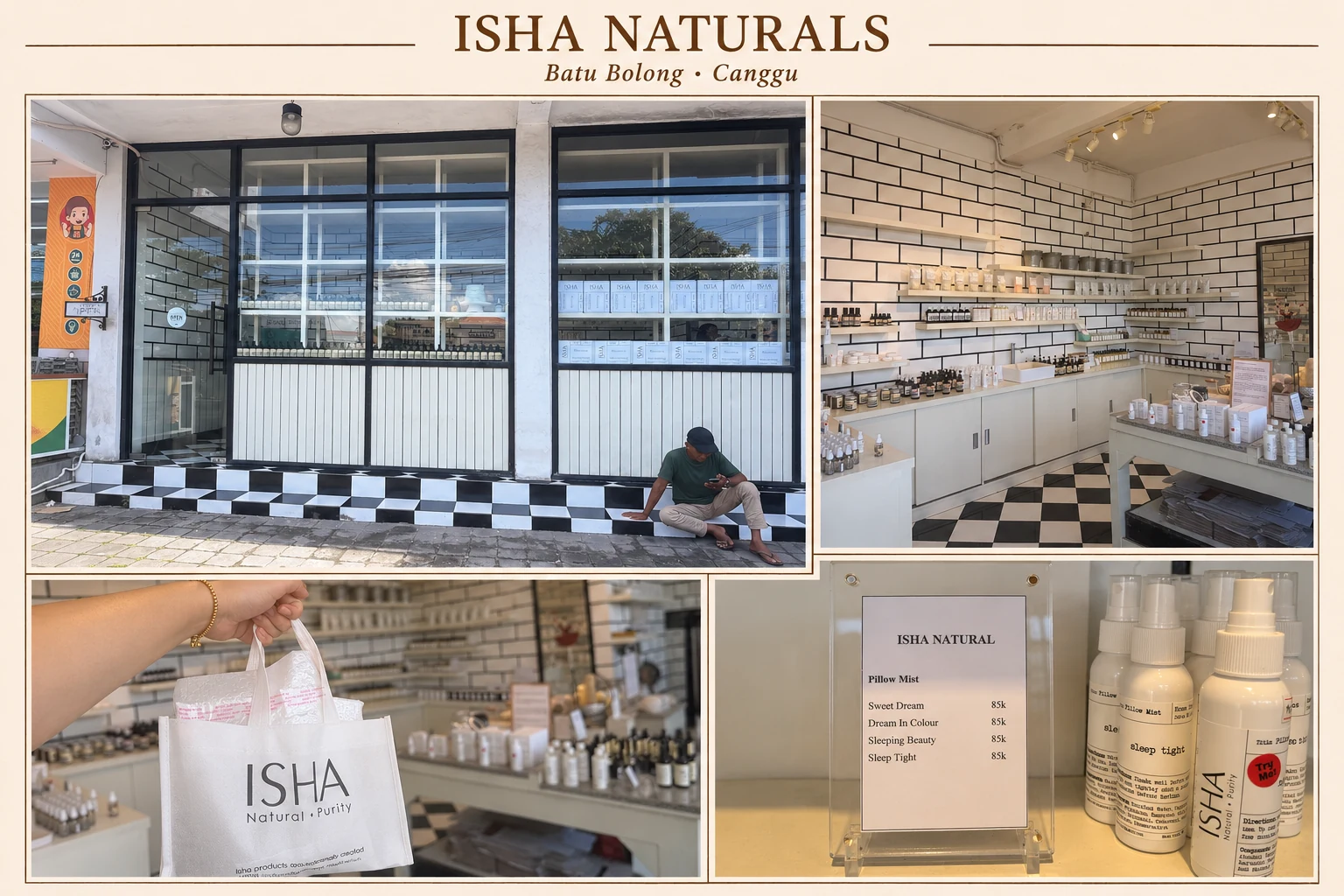
    ISHA Naturals in Batu Bolong: the storefront, black-and-white interior, shopping bag and pillow-mist display

    Utama Spice — Incense, Oils and Small Gifts

    Utama Spice has a different feel: warm wooden cabinets, green branding and shelves holding bottles, jars and incense. The range gives you several ways to bring something home, from a small lip-balm set to a fragrance for your room.

    My purchase photographs include Utama Spice lip-balm trios, incense, Rosehip Oil and an Immortelle Serum box. Those are examples of what I bought, rather than a claim that every product will suit everyone. For someone choosing gifts, I would begin with the recipient’s preferences: incense for a person who already enjoys it, or a compact everyday item they are likely to use. The Utama Spice product catalogue is useful for checking the range before visiting.

    For using incense at home, my preference is the thinner sticks rather than the thicker ones. If you are choosing between the two, the fine sticks would be my pick for home use.
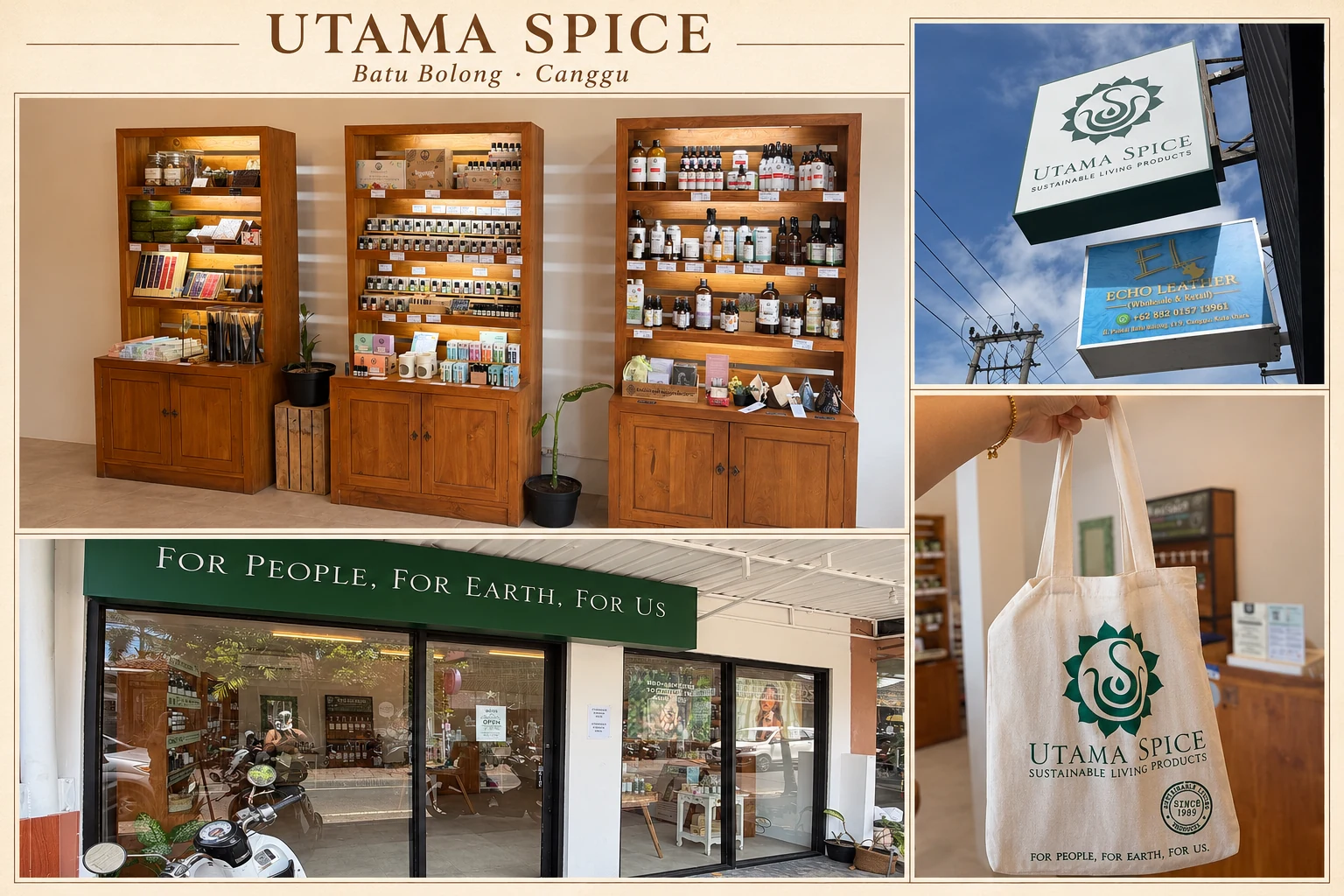
    Utama Spice in Batu Bolong: wooden product cabinets, green storefront, hanging sign and branded tote

    Fields of Yarrow — Skincare and a Carefully Designed Space

    Fields of Yarrow combines a deep-green frontage with a much softer interior: pale textured walls, wooden shelves, a curved green counter and a quiet seating corner. Compared with a densely stocked shop, the displays give individual products more room.

    My photographs show skincare bottles and boxes, including a Wild Rose & Geranium face-oil display, as well as fragrance products. The brand’s current catalogue includes cleansers, serums, oils and creams; it also has a separate perfume-oil collection. This is the stop I would set aside for a more focused look at skincare or scent. Compare the actual labels and sizes, and choose around what you already like using.
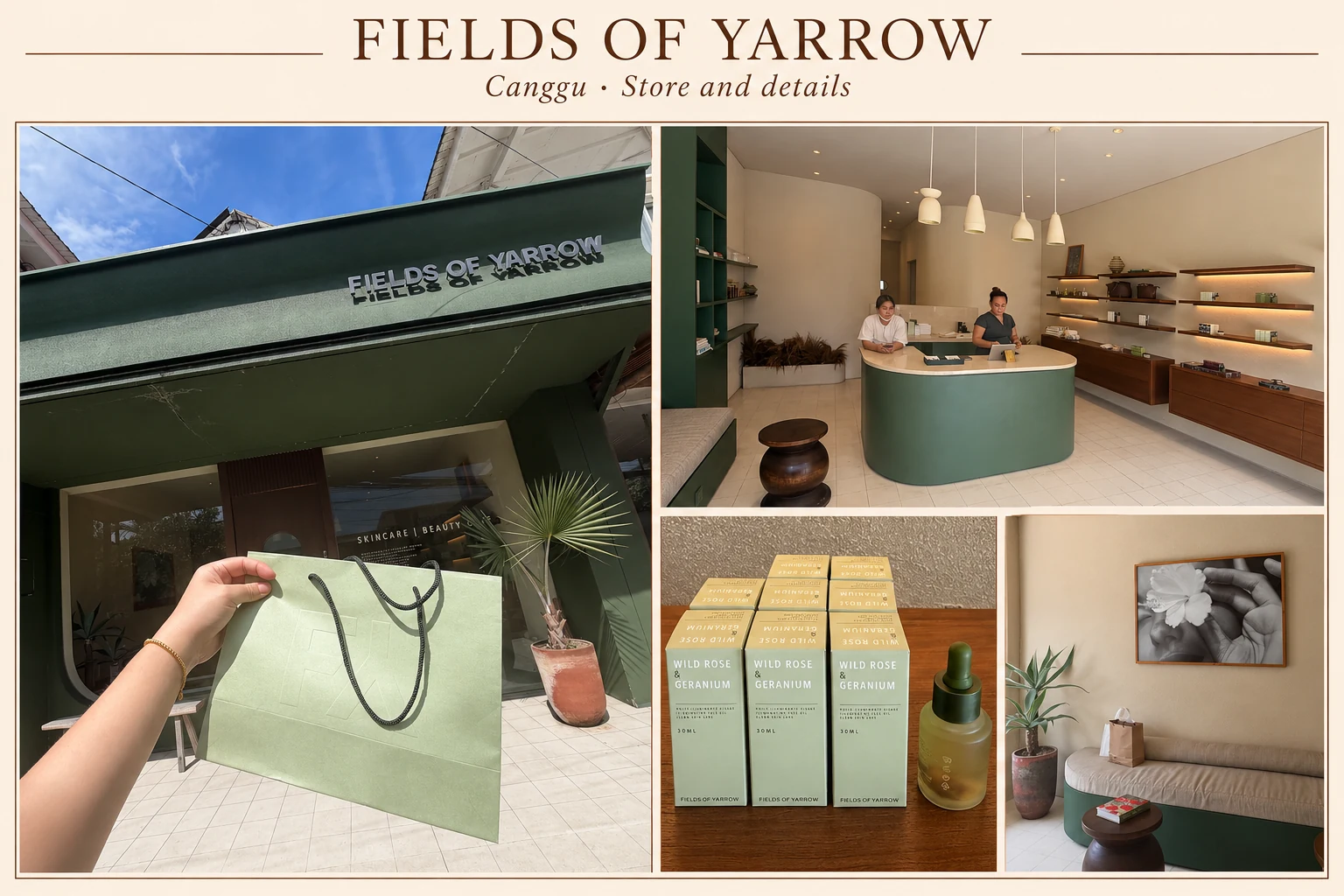
    Fields of Yarrow in Canggu: green storefront and shopping bag, curved counter, skincare display and seating corner

    MONSIEUR BLONDE — Jewellery and a Vintage Boutique Atmosphere

    MONSIEUR BLONDE in Berawa changes the mood again. Its dark exterior opens onto crystal chandeliers, glass display cases, ornate mirrors and a weathered white counter. Pink jewellery boxes and gold-toned pieces stand out against those quieter surfaces.

    The shop combines jewellery and lingerie, as reflected in Monsieur Blonde’s collections. My photographs include necklaces, rings and a close view of decorative drop earrings. The unusual designs are the main attraction for me: this is a place to browse for an accessory with a distinctive look.

    My reservation is the material. Although I like the styles, I would be cautious about recommending these pieces to someone with sensitive skin. Ask about the material of the particular piece before buying, as well as trying its size and weight. For me, the design is a reason to look closely, rather than enough on its own to choose a piece.

    Monsieur Blonde in Berawa: chandelier-lit interior, dark storefront, vintage display counter and earrings on a pink box

    The Sneakers — Shoes, Casualwear and a Blue-and-White Interior

    The Sneakers was the most sportswear-focused stop in this group. My photographs show a blue-and-white shop with footwear on the walls, caps, bags and racks of casual clothing. The blue shoe wall and illuminated athlete outline give the interior an immediately recognisable look.

    This is a different kind of browse from choosing a scent or a piece of jewellery: there is room to compare clothing, bags and footwear within the same visit. I would look at fit, fabric and how an item works with what I already own. For shoes especially, try them on and check the retailer’s product and return information before paying. My photographs show what was on display during my visit; stock can change.
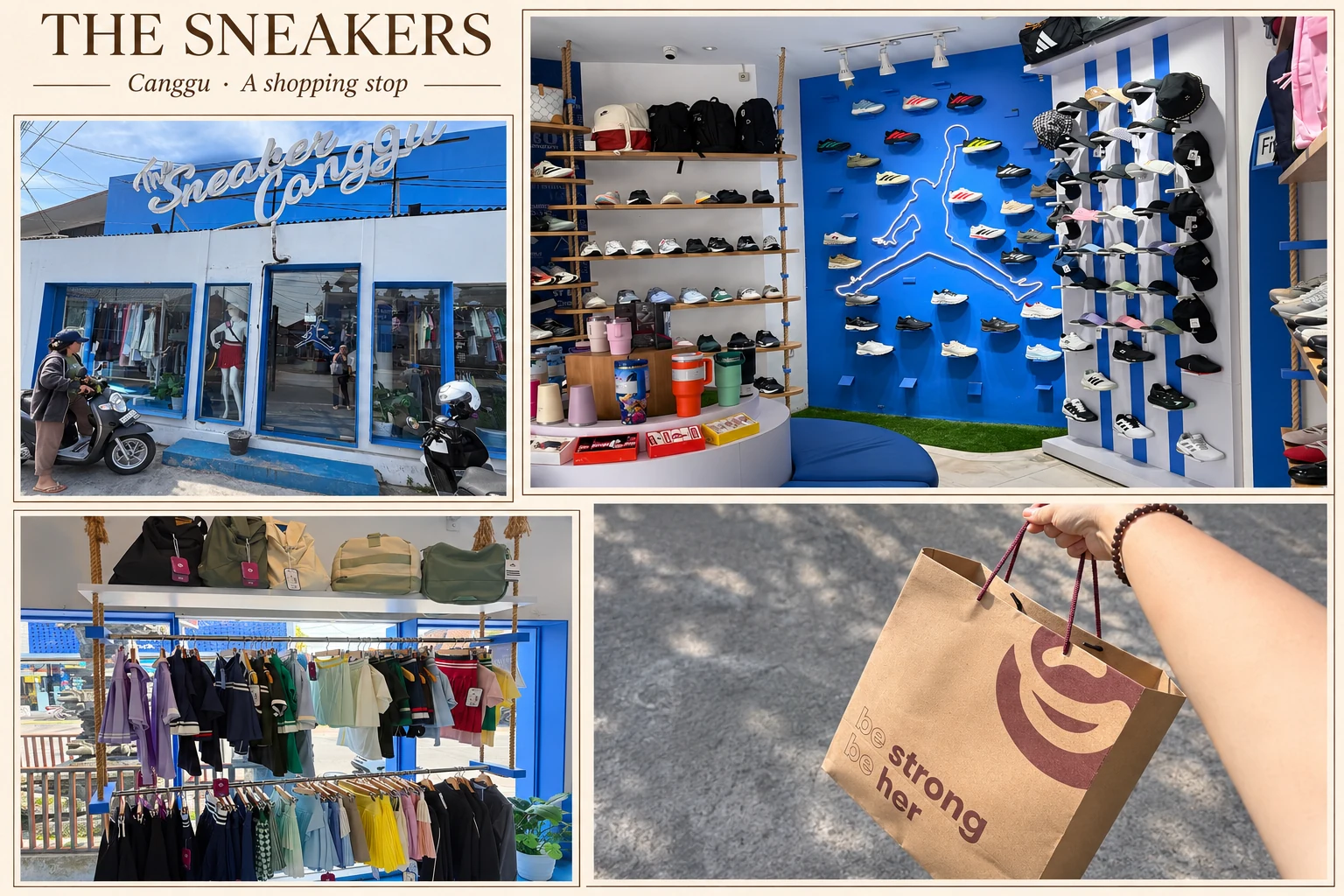
    The Sneakers in Canggu: blue-and-white storefront, blue shoe wall, clothing and bag displays, and a shopping bag

    What I Brought Home

    Back home, I photographed the things I had bought together. The table brings several parts of the holiday into one view: fragrance bottles, pillow mists, Utama Spice products, jewellery, incense, coffee and souvenirs connected with Pyramids of Chi. It is a mix of purchases from the trip, rather than a collection from one shop.

    Looking at them together gives this part of the journey a more personal ending. If you are planning your own browsing time, leave room in your luggage and choose a few things you want to keep using or give to someone, instead of buying something at every stop.

    My Bali purchases at home, with an overview of the table and details of fragrance bottles, pillow mists, incense, skincare and souvenirs

    Day 5 — Keep the Final Morning Flexible

    Use checkout and onward travel to set the limits of the final day. A nearby breakfast or a short last browse is easier to fit around luggage and departure arrangements than a distant excursion.

    If you are flying out, work backward from your airline’s check-in requirements and arrange the airport transfer with time for traffic. If you are continuing elsewhere in Bali, use the same approach: confirm the next journey first, then decide what fits before it.

    What I Would Arrange Before Leaving Home

    • The two hotel bookings: Compare the exact room, breakfast terms, taxes and cancellation conditions. At Adiwana, confirm the accommodation category if you want a wooden-cabin style of stay.
    • The main journeys: Plan arrival transport, the Ubud–Canggu move and your onward transfer as separate parts of the budget.
    • Any session you care about: Check availability for Pyramids of Chi or another timed activity before building the rest of the day around it.
    • Your priority outing: Choose the places that matter most, then discuss a workable route rather than buying a long list of stops by default.

    The part of this trip I would keep is the change of setting: Ubud first, then the coast. The two hotels, the sound session, the morning conversation and the places I visited gave each part of the holiday something distinct. Use the outline to choose your own priorities, then follow the detailed guides for the stops you want to include.

    Explore the Indonesia collection for more of my Bali travel notes.

  • Pyramids of Chi, Ubud: My Visit and Booking Guide

    Pyramids of Chi, Ubud: My Visit and Booking Guide

    Pyramids of Chi, Ubud: My Visit and Booking Guide

    After arriving in Ubud and leaving my bags at Adiwana Svarga Loka, I went to Pyramids of Chi for a sound session. Of all the things I remember from that first day in Bali, one sensation has stayed with me: it felt as though energy was returning to my palms.

    I visited during my May 2026 trip. The experience became part of the beginning of my Ubud stay, alongside the hotel’s gardens and a morning run the following day. Here is what made the visit memorable, with practical details for planning a session of your own.

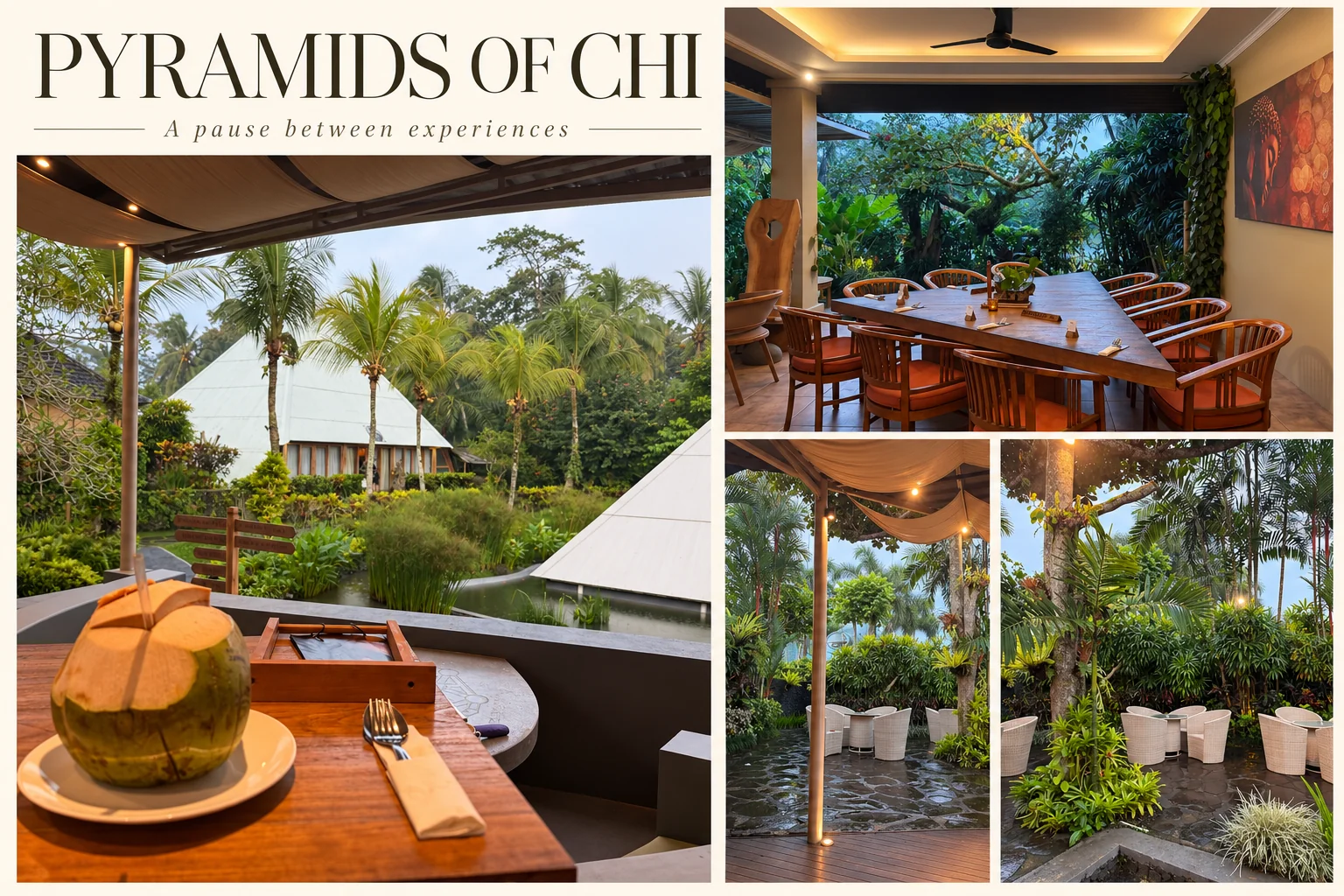
    Pyramid buildings, garden paths and water features at Pyramids of Chi in Ubud

    My First Afternoon in Ubud

    There were many international visitors at Pyramids of Chi when I went. That shared setting was part of the experience: people had come to the same place to spend time listening and taking a pause.

    The feeling in my palms is difficult to put into precise words. “Energy returning to my hands” is the closest description I have. It remains a vivid personal memory of the session, and it is the reason this visit deserves its own place in my Bali travel notes.
    For an arrival day, I would leave plenty of room around a booking like this. You need time to reach Ubud, check into your accommodation and travel to the venue. A flexible afternoon gives the experience space without making the journey from the airport a race against a session time.

    The Pyramids and the Sound Spaces

    The buildings make the venue immediately recognisable. My photographs show pale pyramid structures among palms and garden planting, with paths and water features connecting the surrounding spaces.

    Inside, the photographs show rows of mattresses, large gongs and decorative details. The arrangement helps explain the format before you book: the venue describes its signature Ancient Sound Healing as a session where participants lie down and listen to instruments played by the facilitators. See the official session description for the current format.

    I would approach it with curiosity and allow the experience to be your own. The sensation I remember is personal; another visitor may notice different aspects of the sound, the room or the time spent resting.

    Gongs, floor mattresses, artwork and carved details around the sound spaces at Pyramids of Chi

    Booking Details at a Glance

    The following information is a planning reference checked on 3 November 2026. The listed price is the current public rate for Ancient Sound Healing; it is separate from the cost of my May visit.

    Planning detailWhat to know
    LocationJalan Kelebang Moding No. 22, Bentuyung, Ubud, Bali
    Signature session to look upAncient Sound Healing
    Public listed price350,000 IDR per person
    ArrivalThe venue recommends checking in 30 minutes before the session
    Date and durationCheck the selected event in the live booking calendar
    Age requirementThe current single-session page lists a minimum age of 14

    The price appears in the official events list. Check the individual session page for arrival guidance, participation conditions and the terms attached to your booking.

    How I Would Arrange a Booking

    1. Open the official events list and choose the specific experience you want. The venue offers several sessions, with different formats and prices.
    2. Select your date and check the available start and finish times.
    3. Read the participation conditions and cancellation terms, then review the total and payment options before confirming.
    4. Save the confirmation and plan your transport around the recommended early arrival.

    If you need help choosing a session, use the contact links on the venue’s own website. For a first visit, I would ask what the session involves and how long to allow on site.

    Getting There from Ubud

    For transport from your accommodation, ask the hotel about arranging a driver or check the pickup and drop-off details in your chosen ride app. Allow a traffic buffer and decide how you will return before the session begins.

    There is also an official shuttle option. The venue advertises a free service between Pyramids of Chi and the area opposite Ubud Palace on Jalan Suweta, with the pickup point described as being in front of Milk & Madu. Its timetable includes return departures, so check both directions against your booking. The operator warns that traffic can delay the service. Official shuttle details and timetable.

    I would choose a departure that leaves room for the check-in time, rather than the last possible connection. This is especially useful when you have another activity or dinner planned afterward.

    The Café and Garden Setting

    The café and garden spaces are another part of the venue worth allowing time for. My photographs show seating looking toward the pyramids, shaded tables and tropical planting around the walkways.

    For planning, I would keep a little time free before leaving. You might want a drink, a conversation or simply a chance to look around the grounds. Check the café’s current menu and service hours if you plan to eat there.

    Café seating, a coconut on a table and garden views at Pyramids of Chi

    Small Objects That Carry the Memory Home

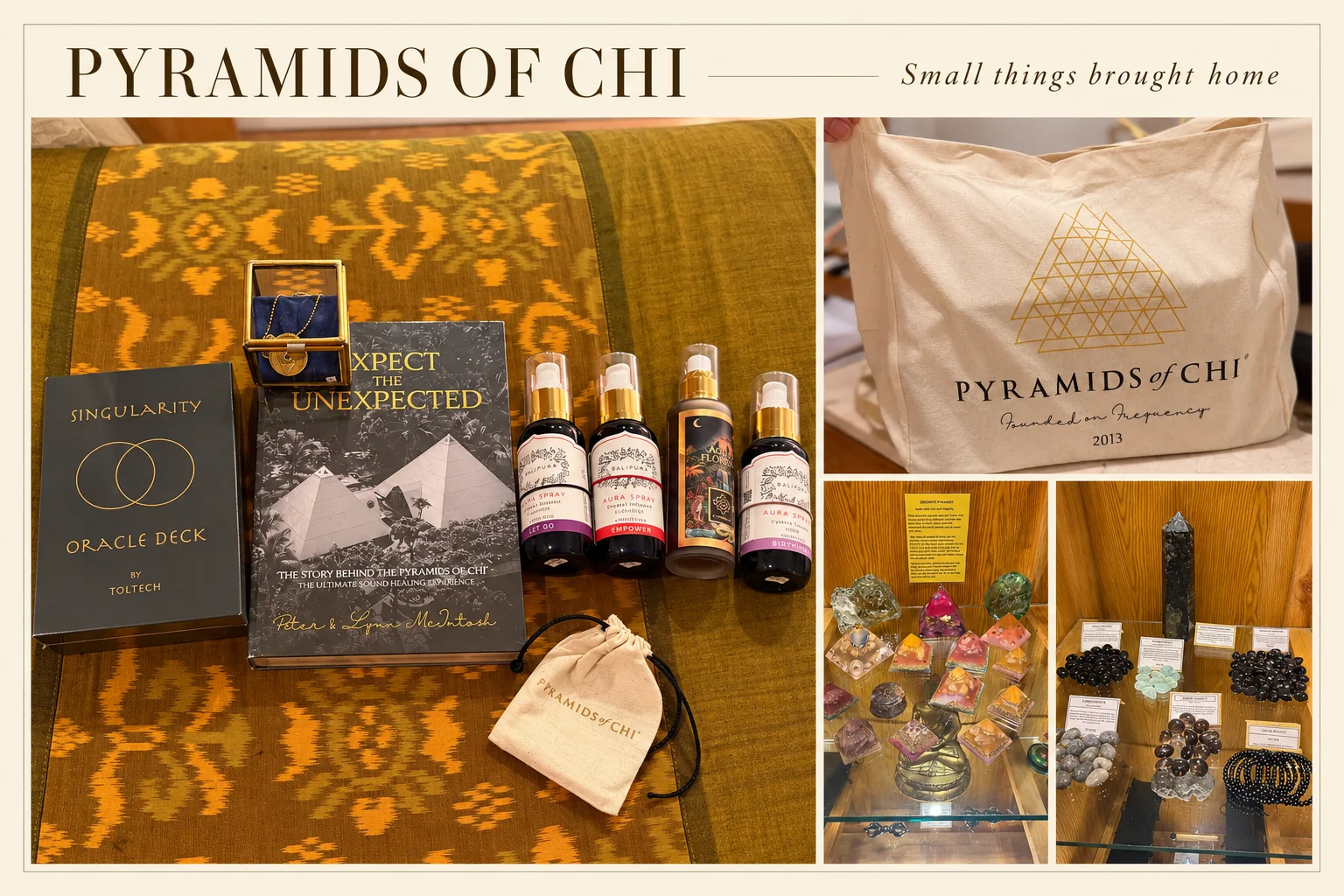
    My photographs also include the venue’s books, an oracle deck, spray bottles, a pendant and displays of crystals and bracelets. The objects add another layer to the visit: something tangible to associate with a place and an experience after the trip has ended.

    Among the visible labels are Balipura Aura Spray and Agua de Florida, alongside a book about Pyramids of Chi. If something interests you, read its label, check the ingredients and compare the price before buying. I would choose a souvenir for its scent, design or personal meaning.

    Books, spray bottles, a pendant and souvenir displays photographed during my Pyramids of Chi visit

    Where This Fits in an Ubud Stay

    Pyramids of Chi worked as an early experience in my Ubud trip. I had arrived at my hotel, put down my luggage and gone out for one activity. The next morning brought a different kind of connection: a run in Ubud, where I met people from Malaysia and we chatted and took photographs together.

    That combination is what I remember most clearly about the beginning of the holiday. There was a booked experience, but there were also ordinary moments and encounters that a schedule could not have supplied.

    If I were arranging a similar afternoon, I would book one session, make the transport straightforward and keep the surrounding hours flexible. For me, the value of this stop is still tied to that feeling in my palms and the memory it left behind.

    Continue Planning Your Bali Trip

    My Ubud base was Adiwana Svarga Loka, where I stayed in a standalone wooden cabin. I later moved to ZIN Canggu for the coastal part of the holiday.

    For a separate cultural outing, see my Tirta Empul temple visit and practical guide. The Indonesia collection brings together more of these Bali travel notes.
  • Adiwana Svarga Loka, Ubud: My Wooden Cabin Stay

    Adiwana Svarga Loka, Ubud: My Wooden Cabin Stay

    Adiwana Svarga Loka, Ubud: My Wooden Cabin Stay

    A standalone wooden cabin, garden paths and breakfast overlooking the greenery: Adiwana Svarga Loka was my Ubud base before I moved on to the coast in Canggu.

    I stayed at Adiwana during my Bali trip in May 2026. My accommodation was an independent wooden cabin, and the hotel became the starting point for several experiences I still associate with Ubud: a visit to Pyramids of Chi, a morning run, and days exploring temples, rice terraces and waterfalls.

    If you are choosing accommodation for a similar trip, this is how the property fitted into mine—and what I would check when booking it again.

    Garden paths, tropical plants and Balinese architectural details at Adiwana Svarga Loka

    Adiwana Svarga Loka at a Glance

    Planning detailWhat to know
    AreaPenestanan Kelod, Sayan, Ubud, Bali
    My visitMay 2026
    My accommodationA standalone wooden cabin
    SettingTropical gardens along the Campuhan River
    Facilities to exploreSwimming pool, restaurant, spa and yoga spaces
    Place in my tripThe Ubud stay before moving to ZIN Canggu

    The address and riverside setting are listed on the official hotel website.

    Staying in a Standalone Wooden Cabin

    I stayed in a standalone wooden cabin. That is the detail I would put first when describing my accommodation, because the type of room can shape a stay as much as the hotel name.

    Around the property, paths pass through dense planting, with carved doors, tiled roofs and stone details between the buildings. The accommodation and shared spaces sit within that garden setting, giving you something to notice on the walk between your room and breakfast.

    If you want a similar room, send the hotel a photograph and ask which accommodation category matches it. The current official accommodation guide uses categories including Deluxe Room, Deluxe Room with Balcony, Grand Deluxe Room and Junior Suite. Confirm the precise room and its features before booking.

    Breakfast Above the Greenery

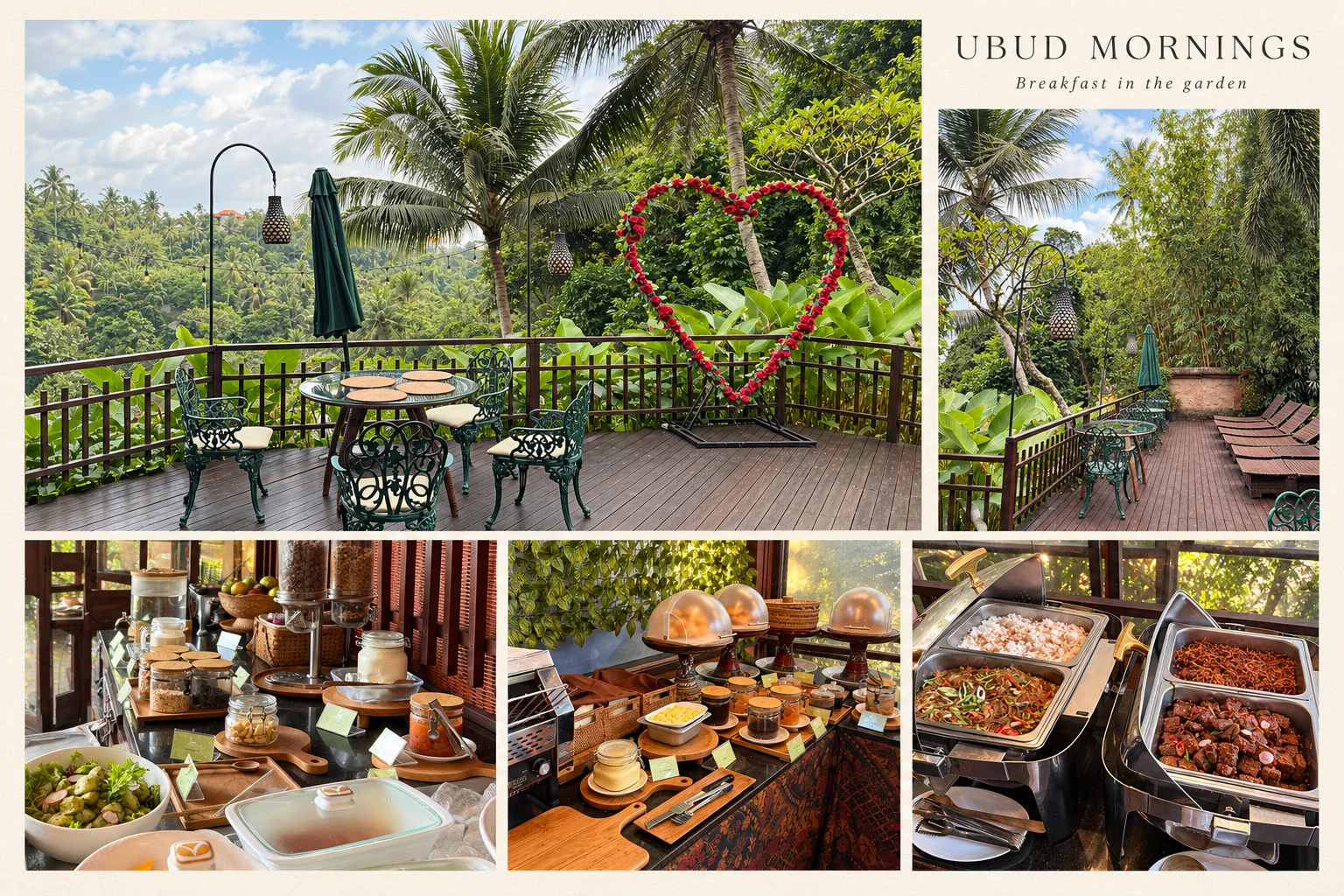
    The breakfast area was one of the places I photographed most closely. Tables on the outdoor terrace look across the greenery, with palms, umbrellas and the valley beyond. The view gives this part of the property a character of its own.

    My breakfast photographs also show the buffet setup: cereal jars, fruit, drinks and covered hot-food stations. They give a useful picture of the setting and the spread during my visit, although the dishes available on another morning may differ.

    For an Ubud itinerary, I would leave enough time to enjoy breakfast before heading out. It is easy to fill a day with stops; allowing some time at the hotel makes the accommodation part of the holiday too.

    The hotel lists Kemangi Ubud Resto as its riverside restaurant. Check whether breakfast is included in your selected rate, especially if you are comparing offers across booking platforms. Official restaurant and facilities information.

    Adiwana Svarga Loka breakfast terrace and buffet displays

    The Pool, Spa and Spaces for a Slower Day

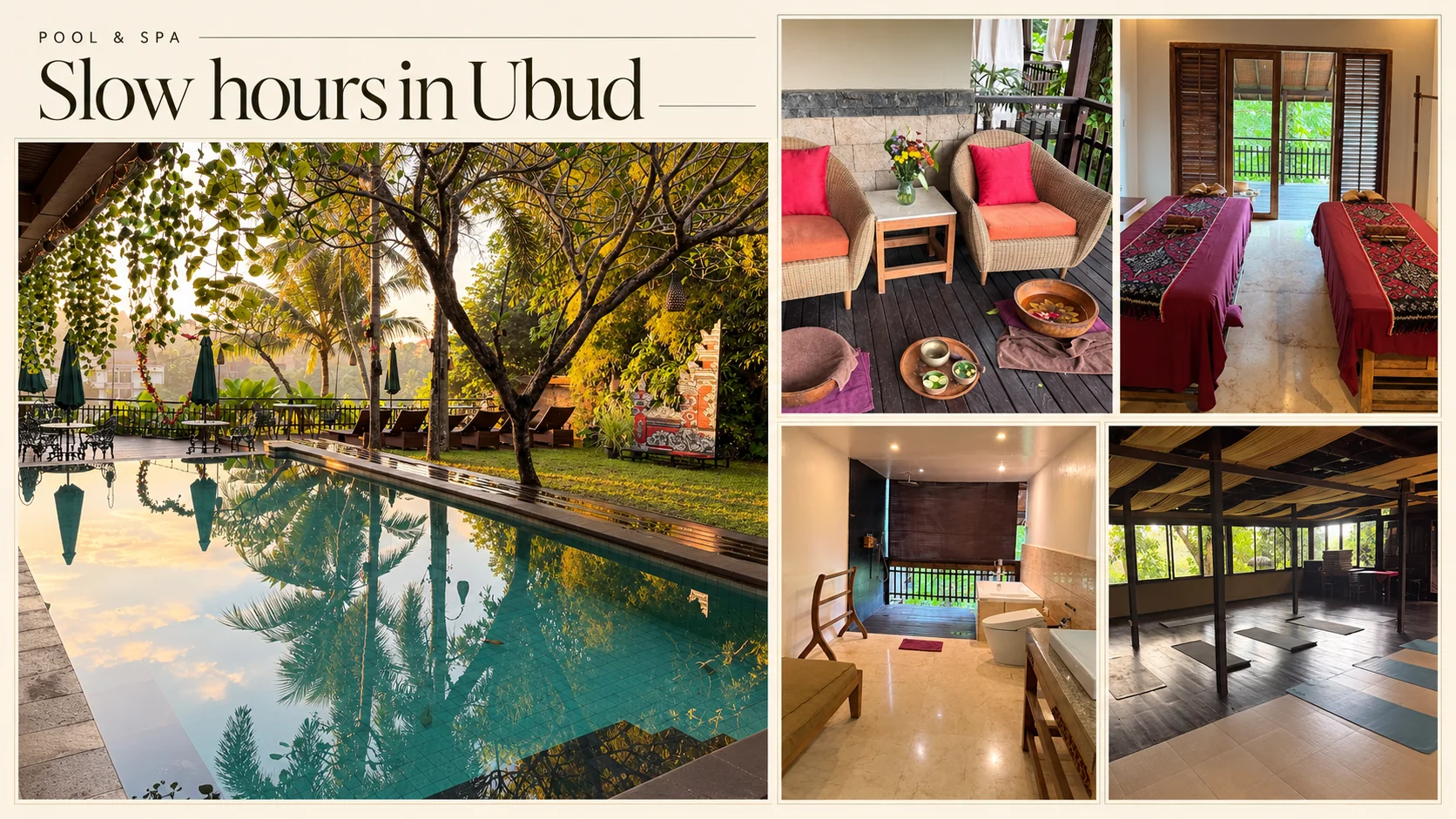
    The pool area brings together water, trees and the surrounding valley landscape. In the photographs, the pool sits beside a terrace with seating and umbrellas, framed by the property’s planting.

    The hotel’s facilities guide lists a swimming pool, Ayusha wellness facilities and spaces for yoga and meditation. These give you options for spending time at the property between outings.

    If a particular class or treatment is important to your stay, ask about the current timetable, price and booking arrangements. A room reservation, a wellness package and an individual treatment can have different inclusions. The hotel’s published flexible-rate offer, for example, lists benefits attached to that specific offer; check the terms of the rate you actually choose.

    For a short stay, I would keep some unscheduled time available. A swim or a pause on the terrace can fit comfortably between a morning outing and an evening plan.

    Adiwana Svarga Loka pool, terrace, spa spaces and yoga hall

    How I Combined the Hotel with Exploring Ubud

    My First Afternoon at Pyramids of Chi

    After arriving at Adiwana and putting down my luggage, I went to Pyramids of Chi for a sound-healing experience.

    There were many international visitors there. One sensation has stayed with me: it felt as though energy was returning to my palms. That was my personal response to the session, and it remains one of the clearest memories of the beginning of this trip.

    For someone arranging a similar stay, the practical point is to give an arrival-day activity enough breathing room. Allow for the journey to Ubud, checking in and reaching the venue before choosing a session time.

    A Morning Run and a Conversation

    The following morning, I joined a run in Ubud. I met people from Malaysia, and we chatted and took photographs together.

    That small encounter added something a sightseeing itinerary cannot plan in advance. Alongside the places I visited, I remember the people I happened to meet and the conversations that came out of an ordinary morning activity.

    Temples, Rice Terraces and Waterfalls

    During the Ubud part of the trip, I also visited the Tegallalang rice terraces, Tirta Empul, Tibumana Waterfall and Kanto Lampo Waterfall. I did not swim at the waterfalls; I went to see the surroundings and experience the atmosphere.

    These places deserve their own time. When planning a day out, choose the stops you care about most and leave room for the drive, walking and queues.

    I have written more about three of these visits:

    Who I Would Consider This Stay For

    I would consider Adiwana for an Ubud visit built around a garden setting, time at the hotel and outings to cultural and natural attractions. The restaurant, pool and wellness spaces give you ways to divide your time between exploring and staying close to your room.

    Before booking, I would focus on three practical questions:

    • Which room will you receive? Confirm its category, layout and outlook, particularly if you want the wooden-cabin style of stay I had.
    • What does your rate include? Check breakfast, activities and any treatment benefits against the exact booking terms.
    • How will you move around? Ask about the route between your room, reception and shared facilities, and arrange transport around the outings you want to take.

    This matters more than choosing a hotel from one attractive photograph. The room, inclusions and location need to work together for your particular trip.

    Pairing Ubud with Canggu

    After Ubud, I moved to ZIN Canggu, where being within walking distance of the beach and spending time at the upstairs café became part of the stay.

    The two hotels gave my Bali holiday different settings: Adiwana for the garden and river landscape of Ubud, followed by ZIN for the coastal part of the journey. Splitting the trip this way let me spend time in both areas.

    If you are considering the same combination, my ZIN Canggu stay covers the room, café, pools and beach access in more detail.

    Adiwana belongs to the Ubud chapter of that trip for me: the wooden cabin, the breakfast terrace and the paths through the garden, alongside a sound session and a morning run that became lasting memories.

  • Tibumana Waterfall, Bali: My Visit and a Practical Guide

    Tibumana Waterfall, Bali: My Visit and a Practical Guide

    Tibumana Waterfall, Bali: My Visit and a Practical Guide

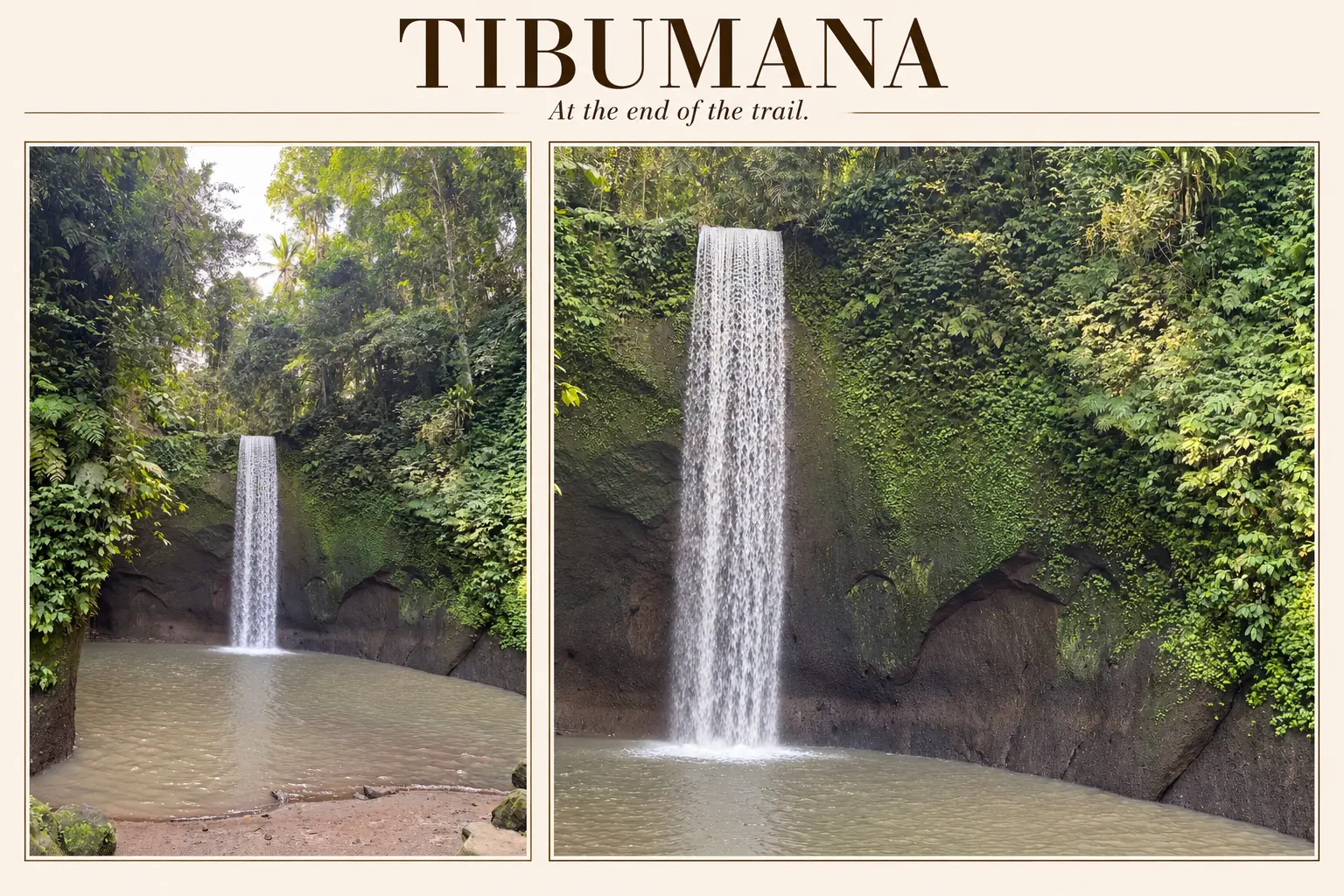
    Editorial diptych of Tibumana Waterfall, its pool and vegetation-covered cliffs
    The main waterfall. Water colour varies with conditions.

    Tibumana Waterfall is worth considering if you want a waterfall stop near Ubud with a relatively short forest walk. Allow time for steps, bridges and photographs—not just the final viewpoint. Arrange your return transport, bring cash and check conditions before entering the water.

    I visited Tibumana during my Bali trip in May 2026. I didn’t swim. I came to see the waterfall, take photographs and enjoy the surroundings, and those were enough to make the stop worthwhile.

    What stayed with me was not only the waterfall itself, but the changing scenery along the way: rice fields, coconut palms, shaded paths and water moving between rocks.

    Tibumana Waterfall at a Glance

    Planning questionWhat to know
    Where is it?In the Apuan area of Bangli, east of Ubud
    Published opening hours7:00 AM–6:00 PM daily
    Estimated admissionIDR 25,000 per person
    Walk from the parking areaApproximately 10–15 minutes, with steps
    Do you need to swim?No—I enjoyed the visit without entering the pool
    What should you arrange first?Transport back to your accommodation or next stop

    Opening hours, charges and access can change. Confirm locally before travelling. Published visitor information

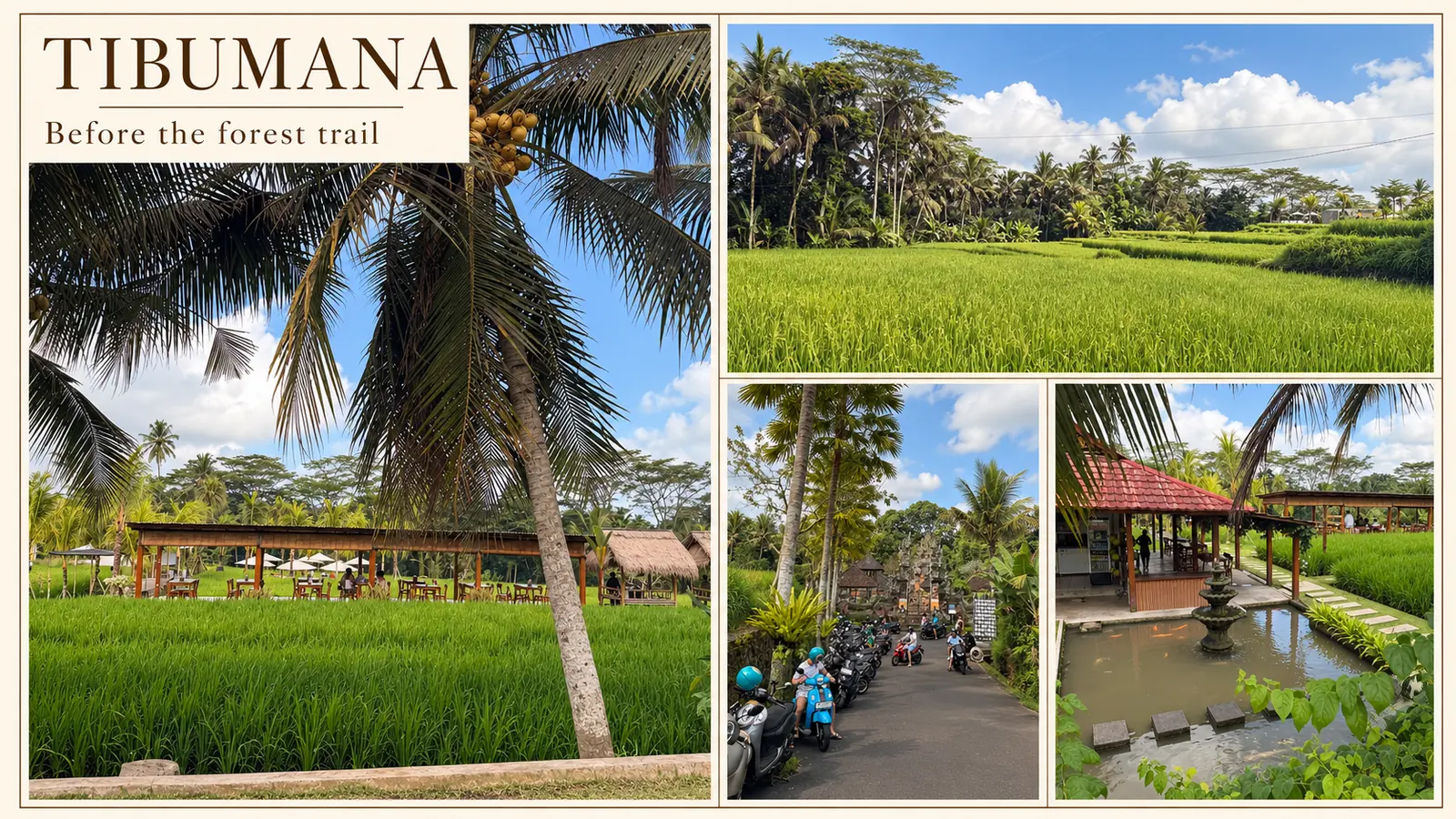
    The Approach: Rice Fields Before the Forest

    The countryside approach deserves a little attention of its own.

    My photographs show coconut palms rising above rice fields, village buildings and a narrow road lined with parked scooters. These scenes give the visit context before the forest closes around the trail.

    If you stop for pictures, keep the road clear and leave room for residents and other visitors to pass.

    Editorial collage of rice fields, palms, approach road and pond near Tibumana
    Countryside views before the walk down.

    How to Get to Tibumana Waterfall

    From Ubud

    For planning, allow approximately 35–45 minutes from central Ubud. The distance is roughly 15 kilometres, depending on your starting point and route.

    From Kuta

    Allow approximately 1.5–2 hours, potentially longer in traffic. The route is roughly 41 kilometres, but your accommodation’s location will affect the journey.

    These are estimates, not fixed transfer times.

    Private Driver, Scooter or Ride-Hailing?

    A private driver is a straightforward option when combining several attractions. Agree on the stops, waiting time and total charge beforehand.

    A rental scooter offers flexibility for experienced riders with the appropriate licence and insurance. Allow for narrow village roads and changing weather.

    If using Grab or Gojek, arrange your return before arriving. Do not assume that a driver will be available when you finish. Discuss a waiting arrangement or onward pickup in advance.

    Entrance Fees and What to Budget

    Bring Indonesian rupiah in cash.

    ItemPlanning estimate
    AdmissionIDR 25,000 per person
    Scooter parkingAround IDR 5,000
    Car parkingAround IDR 10,000
    Locker rentalAround IDR 5,000

    These are reference amounts, not my documented personal spending or a guaranteed current tariff. Confirm charges and locker availability on arrival. Admission and parking reference, locker reference

    What Is the Walk Like?

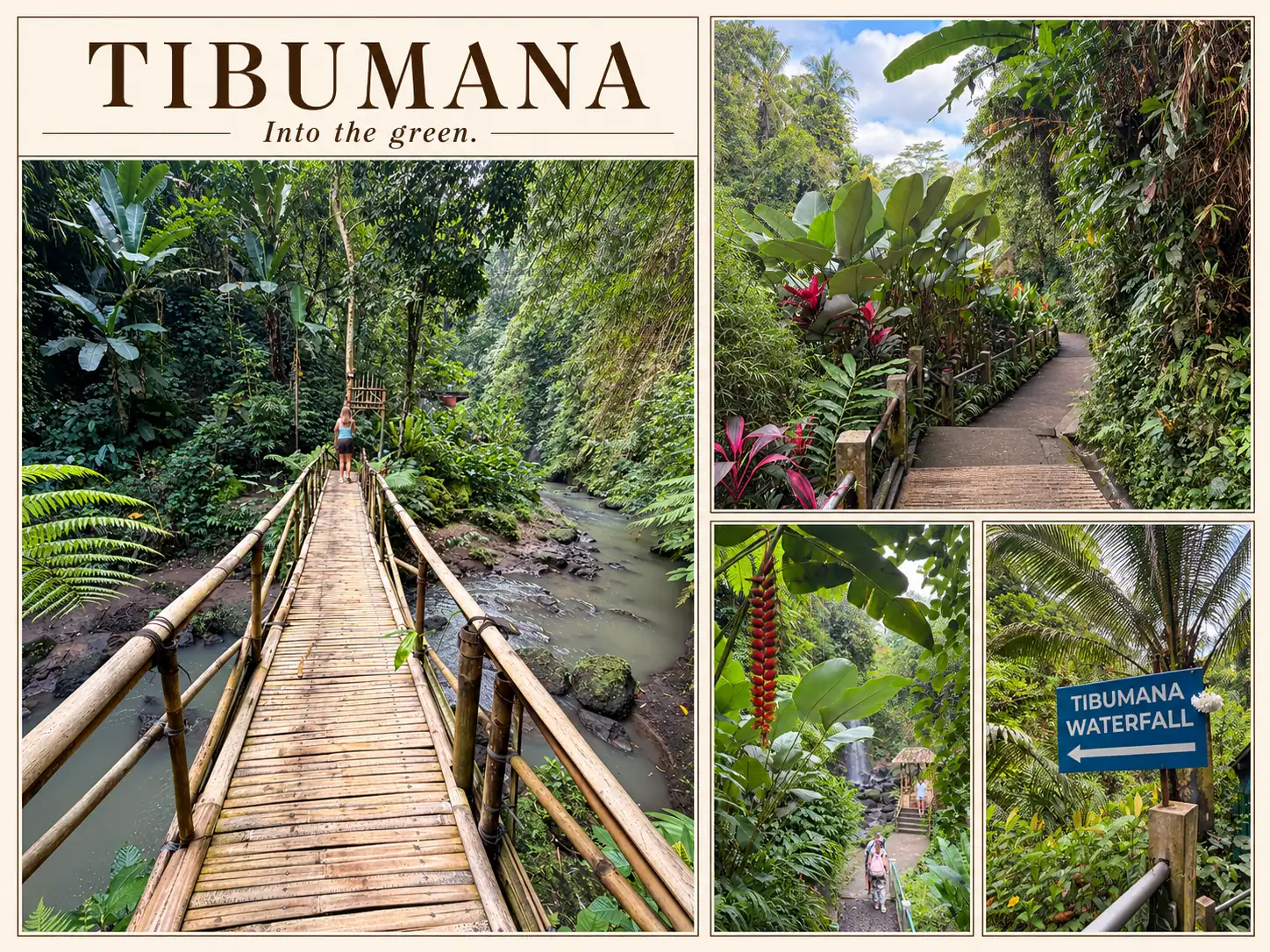
    The walk is relatively short, but it is part of the experience rather than something to rush through.

    My photographs capture bamboo bridges, tropical plants, shaded paths and flowing water. Looking beyond the main waterfall gives the visit more variety—and a more complete photographic story.

    Allow approximately 10–15 minutes each way, with additional time for photographs and the uphill return. The route includes stairs and potentially slippery surfaces; it is not step-free. Trail and accessibility information

    A short walk is not automatically suitable for every older visitor or young child. Consider mobility, balance and comfort with stairs before deciding.

    Editorial collage of bamboo footbridge, shaded trail, tropical plants and Tibumana direction sign
    Bridges and greenery along the approach.

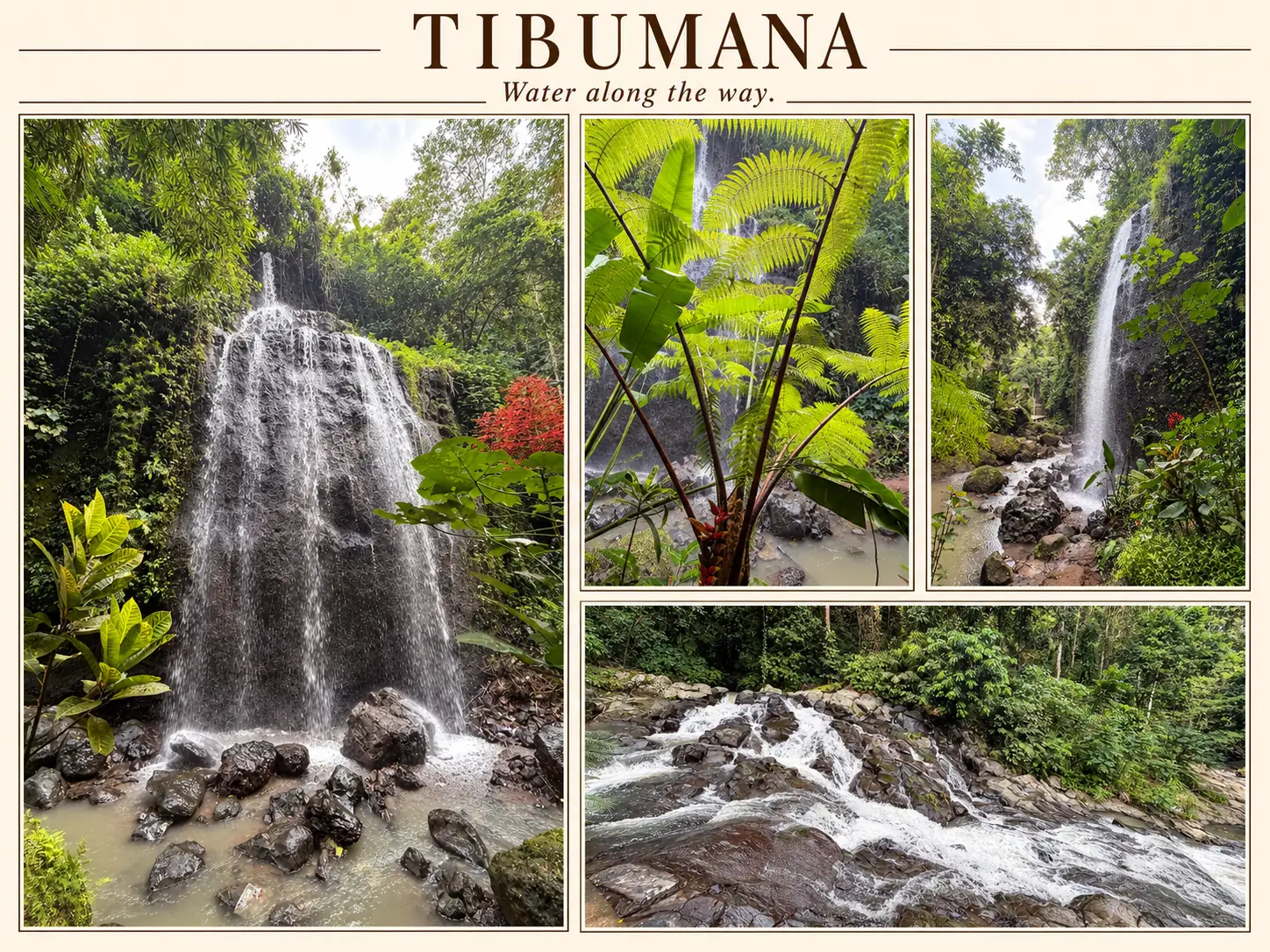
    Water and Plant Details Along the Way

    Some of my photographs focus on smaller cascades, fern fronds and rocky streams rather than the main waterfall. These details are part of the visit’s visual story.

    The following collage presents separate viewpoints from the visit. It should not be read as one continuous waterfall or as a map of the trail.

    Editorial collage of cascades, fern fronds and rocky streams from the Tibumana visit
    Separate viewpoints from the visit, not one continuous waterfall.

    Can You Swim at Tibumana?

    Swimming may be permitted when conditions allow, but it should not be treated as a guaranteed part of the visit.

    I did not enter the pool, so this is practical guidance rather than a first-person swimming review.

    Check the notices and follow staff instructions. Do not swim directly beneath the falling water or enter the recess behind it. Do not assume a uniform depth or trained lifeguard supervision. Visitor restrictions

    If conditions look unsuitable, stay out. You can still enjoy the setting from the permitted viewing areas.

    Photography Tips and What to Bring

    An early visit around 7:00–9:00 AM may suit travellers hoping for a quieter start. However, an empty viewpoint, clear weather and dramatic sunbeams are never guaranteed.

    For photographs, consider three kinds of scene:

    • The wider setting: rice fields, palms and the forest approach.
    • Smaller details: bridges, leaves, rocks and moving water.
    • Personal memories: a few photographs of yourself within the landscape.

    Wear comfortable clothing and footwear with reliable grip. Bring water, cash and protection for your phone or camera. Add a towel, spare clothes and a wet bag if you intend to swim.

    Choose a stable, permitted place to take photographs. A particular pose is not worth a fall on wet rocks.

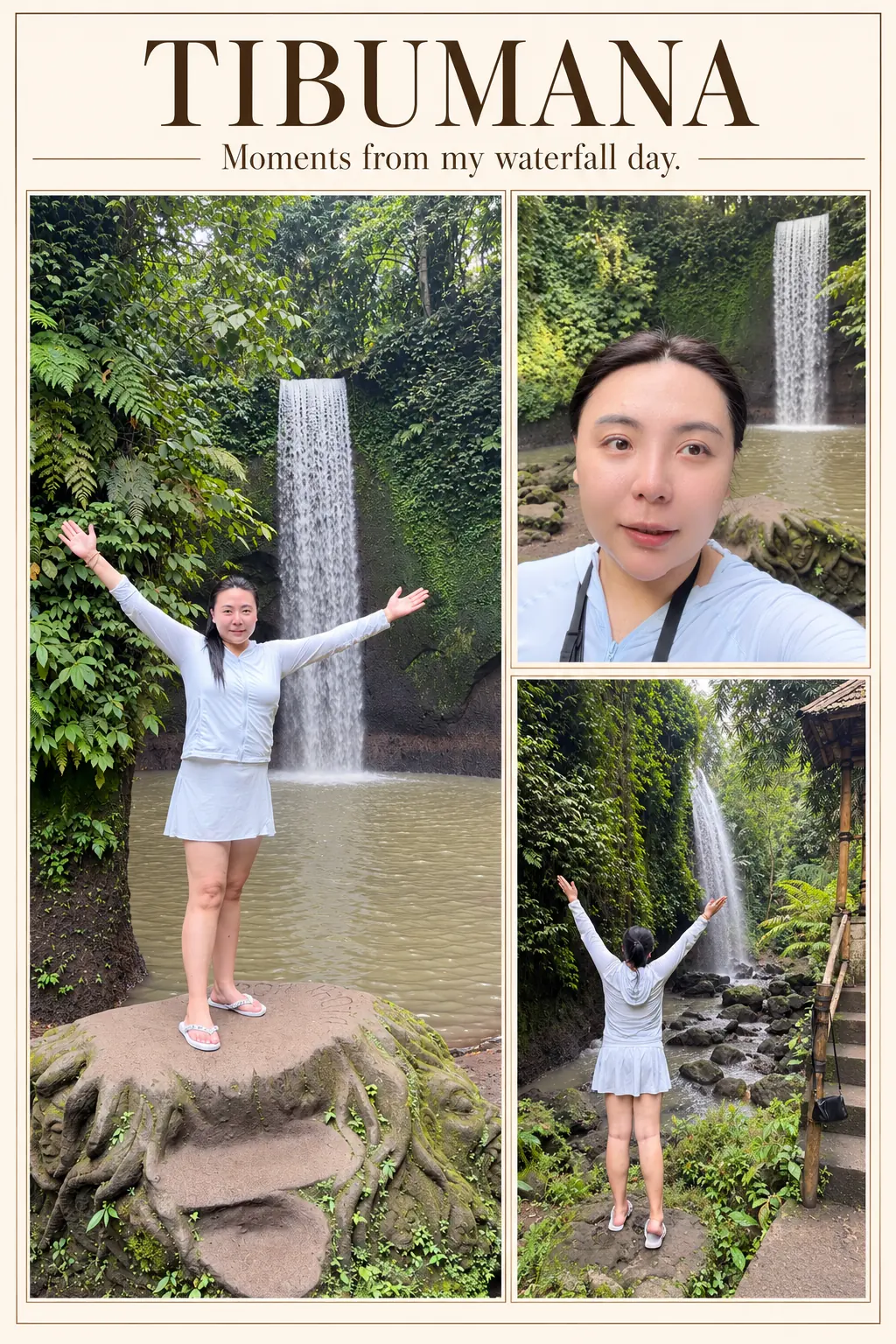
    Editorial collage combining personal travel portraits at Tibumana Waterfall
    Personal moments from my visit.

    Can You Combine Tibumana with Other Attractions?

    I also visited Kanto Lampo Waterfall during this trip. These two stops can form the basis of an outing without making every nearby attraction compulsory.

    If you are also considering Tukad Cepung Waterfall or Penglipuran Village, discuss the order with your driver. Your accommodation, road conditions and time at each stop matter more than following a fixed online sequence.

    Choose fewer stops if you want time to walk, photograph and enjoy the surroundings.

    If your wider trip also includes a temple visit, see my guide to Tirta Empul.

    Frequently Asked Questions

    Is Tibumana worth visiting without swimming?

    Yes, in my experience. I stayed out of the pool and enjoyed the waterfall, forest walk and photography.

    Is the walk suitable for everyone?

    No. Although relatively short, it includes steps, an uphill return and surfaces that may be slippery. Assess it against your own mobility needs.

    What does entry cost?

    Use IDR 25,000 per person as a planning estimate. Parking and lockers may cost extra; confirm the current charges locally.

    Should I arrange a return ride?

    Yes. Arrange a waiting driver or onward pickup rather than depending on an available ride-hailing car when you finish.

    My Takeaway

    Tibumana was more than a place to collect one waterfall photograph.

    The countryside approach, bridges, greenery and time beside the water all contributed to the visit. My advice is simple: leave room to enjoy the walk, and don’t feel that you have to swim to make the stop worthwhile.

  • Tirta Empul Temple: Holy Springs, Melukat and Visiting Respectfully

    Tirta Empul Temple: Holy Springs, Melukat and Visiting Respectfully

    Tirta Empul Temple: Holy Springs, Melukat and Visiting Respectfully

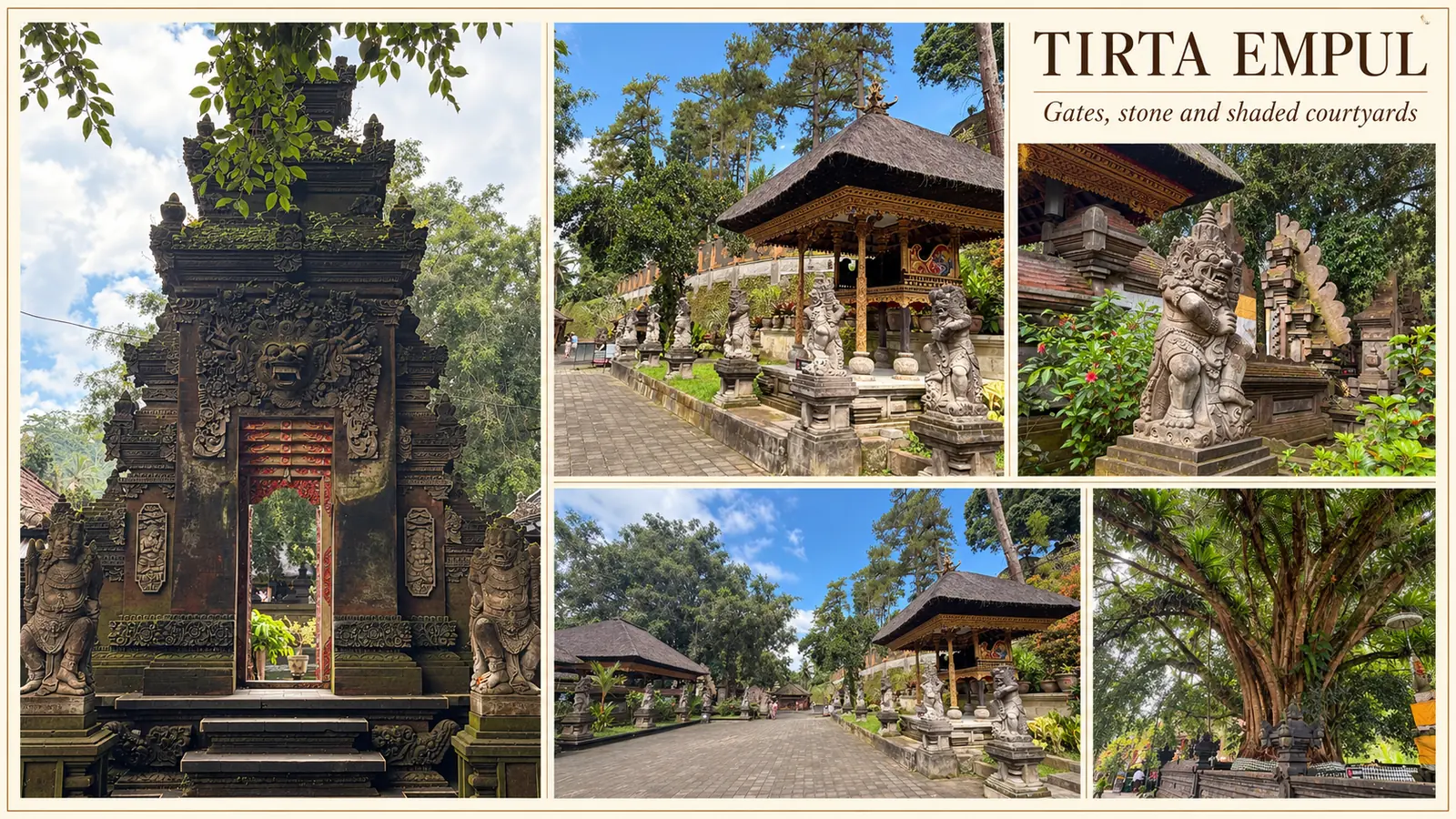
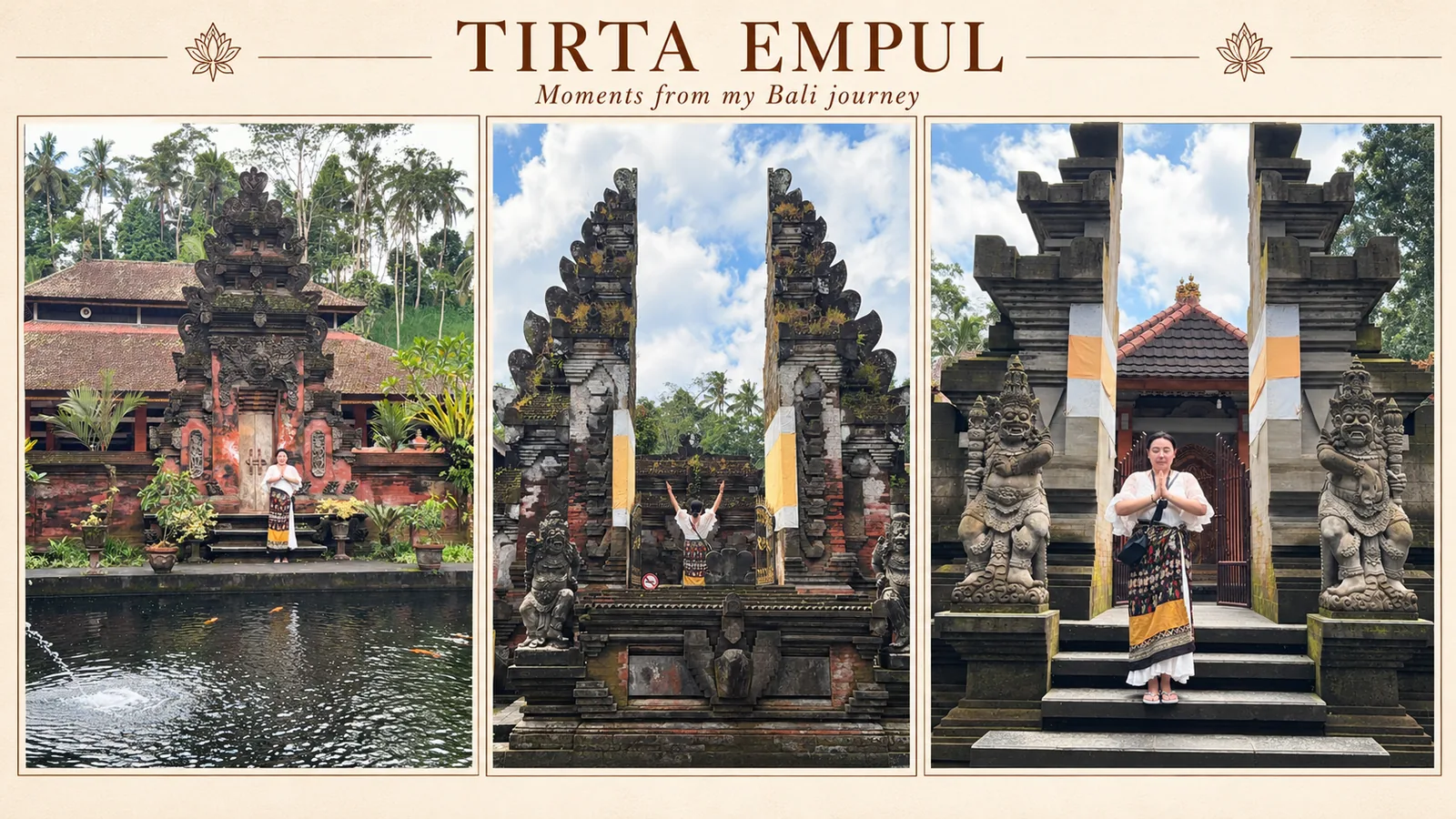
    Editorial collage of Tirta Empul’s carved gateway, guardian sculpture, pavilions and large shade tree
    Architecture and shaded courtyards at Tirta Empul. Editorial collage based on my photographs.

    At Tirta Empul, water connects different parts of the visit: the busy purification pools, the reflective spring basin and the koi pond beside the temple buildings. My photographs capture all three, alongside carved gateways, shaded courtyards and a few personal moments from the day.

    This is somewhere to approach as an active place of worship, not simply another photo stop on an Ubud itinerary. You can appreciate its architecture and surroundings without making the purification ritual the only focus of your visit.

    A Living Water Temple Near Ubud

    Pura Tirta Empul stands in the Tampaksiring area of Bali. Its history reaches back to the tenth century, and its natural spring remains central to the temple’s religious significance. The name refers to holy water rising from the ground. These are spiritual associations within Balinese Hindu tradition, rather than promises of a particular outcome for visitors. Indonesia’s official tourism introduction.

    In my photos, the carved stone doorways and guardian figures frame the grounds, while large trees provide shade over parts of the complex. It is worth looking beyond the best-known pool views to notice those architectural details.

    The Courtyards and Spring Pools

    The temple follows a three-part courtyard arrangement. The outer area leads toward the middle courtyard, Jaba Tengah, where visitors encounter the purification pools; the inner courtyard, Jeroan, has a worship function. Follow signs and staff directions about access rather than assuming every area is open. Official guide to the temple layout.

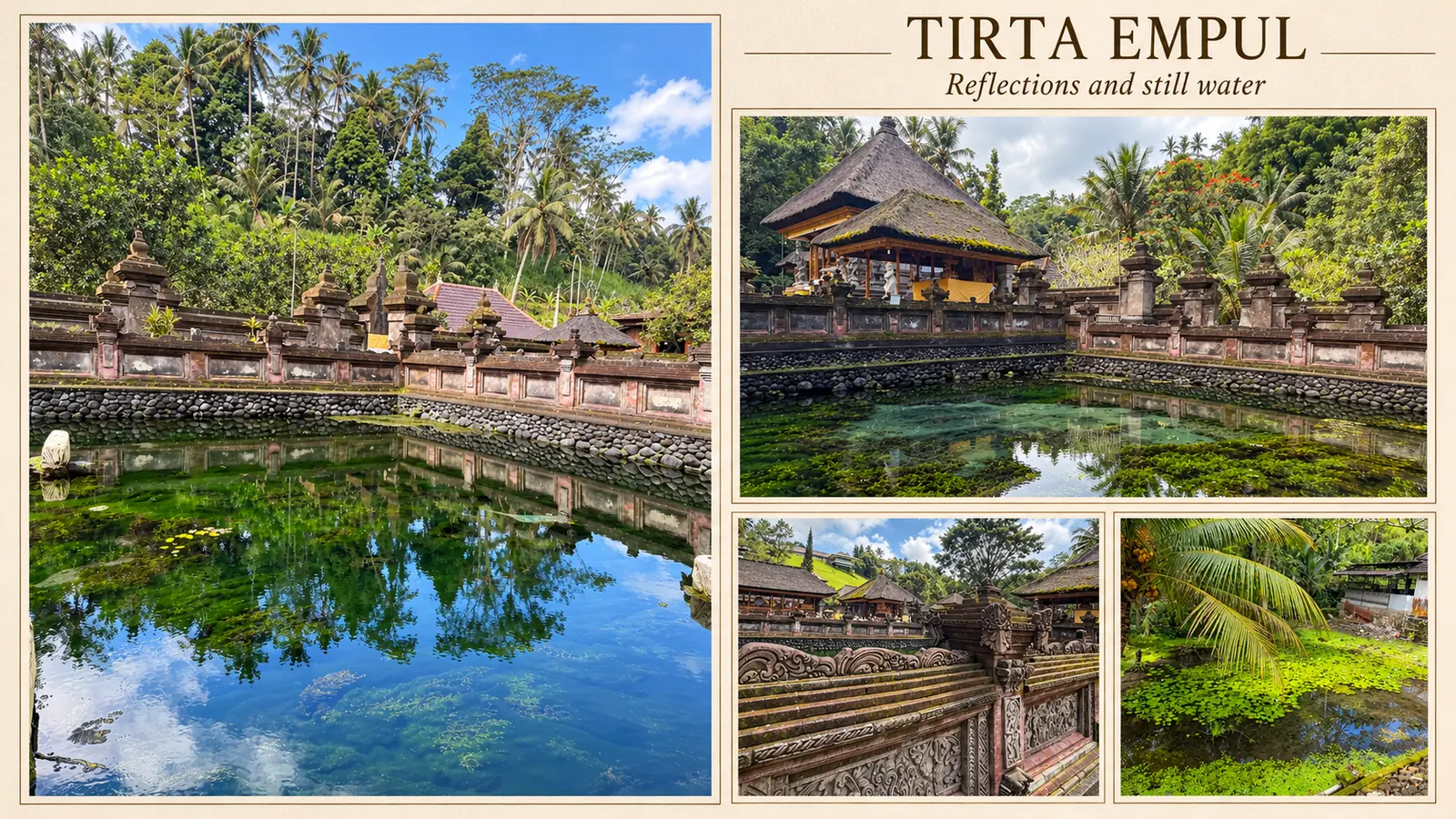
    The spring basin and the bathing pools offer different scenes. My photographs of the spring basin show reflections, patches of submerged green growth and the surrounding stonework. In contrast, the purification-pool photographs show people sharing a busy space and waiting their turn beneath the water spouts.

    Neither view tells the whole story on its own. Together, they offer a more rounded impression than a single carefully framed photograph.

    Editorial collage showing clear pool water, cloud reflections, temple stonework and a palm-fringed pond
    Water, reflections and stonework around the grounds. Editorial collage based on my photographs.

    Understanding Melukat Before Joining

    Melukat is a Balinese Hindu purification practice involving sacred water. Visitors may participate subject to temple rules, but an online description should not replace instructions from an appropriate local guide or temple attendant. Some spouts have specific ceremonial uses and are not intended for general participation. Indonesia Travel’s holy-springs guide.

    If you want to join, use the following as a preparation checklist rather than a fixed ritual script:

    1. Ask before entering. Confirm where to change, which clothing is required and which areas are open that day.
    2. Listen to the explanation. Ask where the sequence begins and which spouts you should avoid. Do not identify them simply by looking for an empty queue.
    3. Follow the guidance on site. Let the attendant explain the prayer and washing sequence instead of copying nearby visitors or relying on a universal number of repetitions.
    4. Allow others space. Keep the line moving considerately and avoid turning a shared worship area into an extended photography session.

    The photographs supplied for this article do not establish that I completed the full ritual. This section introduces the experience without presenting it as my step-by-step personal account.

    Editorial collage of visitors at Tirta Empul’s purification pools, offerings and a shrine pavilion
    The shared purification-pool area and offerings. Editorial collage based on my photographs.

    What to Wear and Bring

    Wear appropriate temple clothing and check the current sarong and sash requirements at the entrance. Clothing suitable for walking around the grounds may not be the same as clothing permitted in the bathing pools. Confirm bathing-sarong arrangements and any separate charges before changing.

    If you plan to enter the water, bring a change of clothes, a towel and a bag for your wet personal belongings. Ask how rented garments should be returned rather than packing them away with your clothes.

    Check locker availability and fees on arrival. Carry only what you need, and do not treat a locker as a guarantee against loss.

    Temple entry and participation rules also include restrictions related to menstruation. Read the notices and follow directions respectfully; ask discreetly if you are unsure which areas are affected. Official visitor-etiquette guidance.

    This guide does not recommend drinking the pool or spring water: its appearance and religious significance do not establish that it is drinking water.

    Make Time for the Koi Pond and Architectural Details

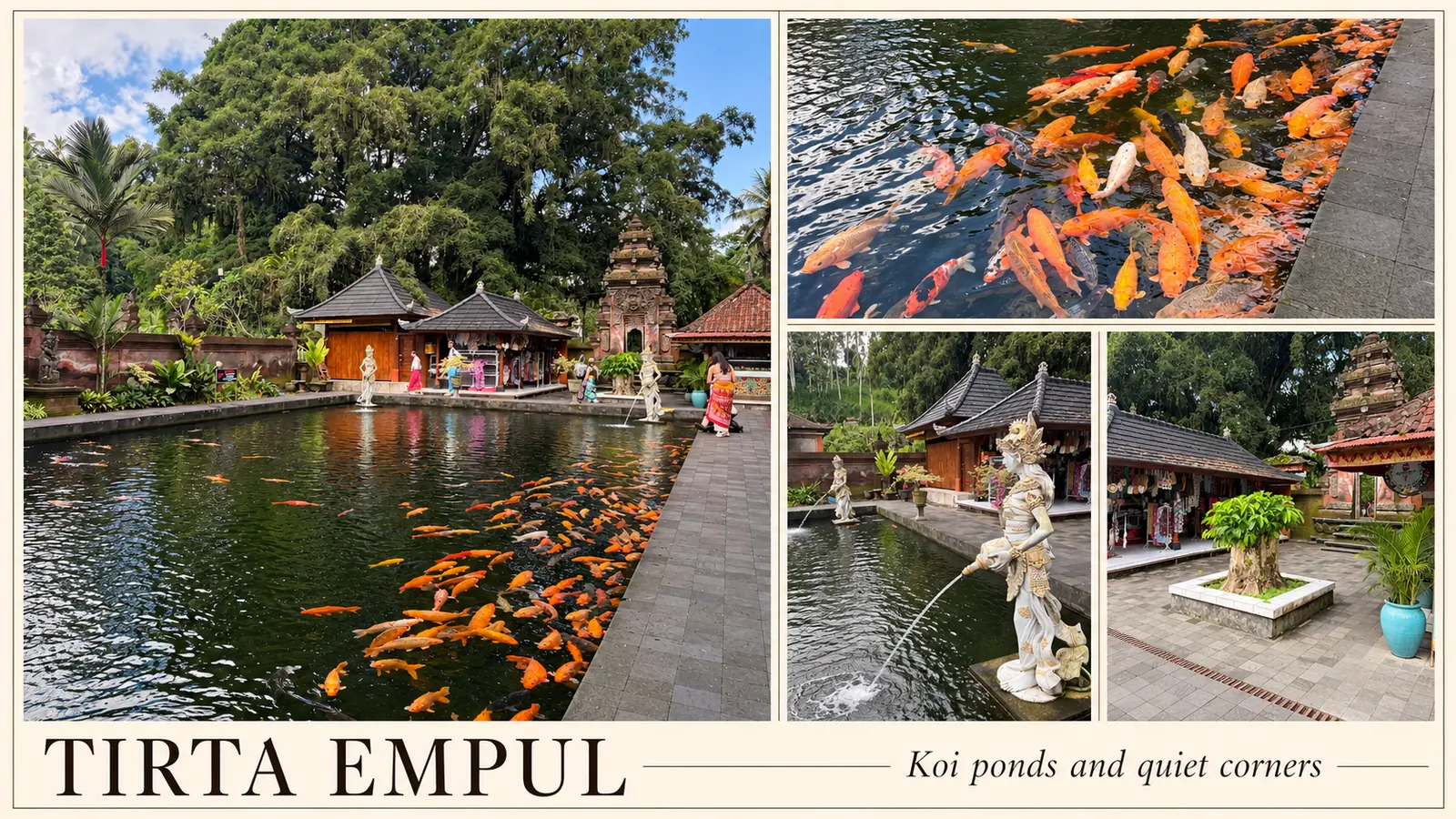
    The koi pond provides another visual chapter of the visit. My photographs show orange fish gathering near the edge, fountain sculptures and reflections of the buildings around the water.

    Other images focus on pavilion roofs, carved stonework and the shaded paths between areas. These details give the visit a sense of place beyond the purification pools.

    When taking photographs, avoid blocking circulation or worship, and ask permission before making someone else the subject of a close portrait. Personal memories matter, but so does leaving other visitors room for theirs.

    Editorial collage of orange koi, fountain sculptures and pond-side buildings at Tirta Empul
    The koi pond and its surrounding courtyard. Editorial collage based on my photographs.

    A Respectful Way to Include Tirta Empul in Your Trip

    Leave enough room in your itinerary to walk, observe and ask questions. Do not assume that a short stop will be enough to join the ritual, change clothes and photograph every part of the grounds.

    Confirm current opening hours, admission and rental charges before travelling. None of the photographs or draft prices should be treated as a current fee schedule.

    My suggestion is to visit with curiosity rather than a checklist of spiritual results. Whether you participate or simply explore the permitted areas, take time to notice the water, architecture and activity around you.

    Three-panel editorial collage of my travel portraits beside temple gateways and the koi pond
    Personal moments from my visit. Editorial collage based on my photographs.

    For another stop around Ubud, see my Tibumana Waterfall guide, including the walk and return-transport planning.

  • Uma Ceking Resto and Swing: A Different View of Bali’s Rice Terraces

    Uma Ceking Resto and Swing: A Different View of Bali’s Rice Terraces

    Uma Ceking Resto and Swing: A Different View of Bali’s Rice Terraces

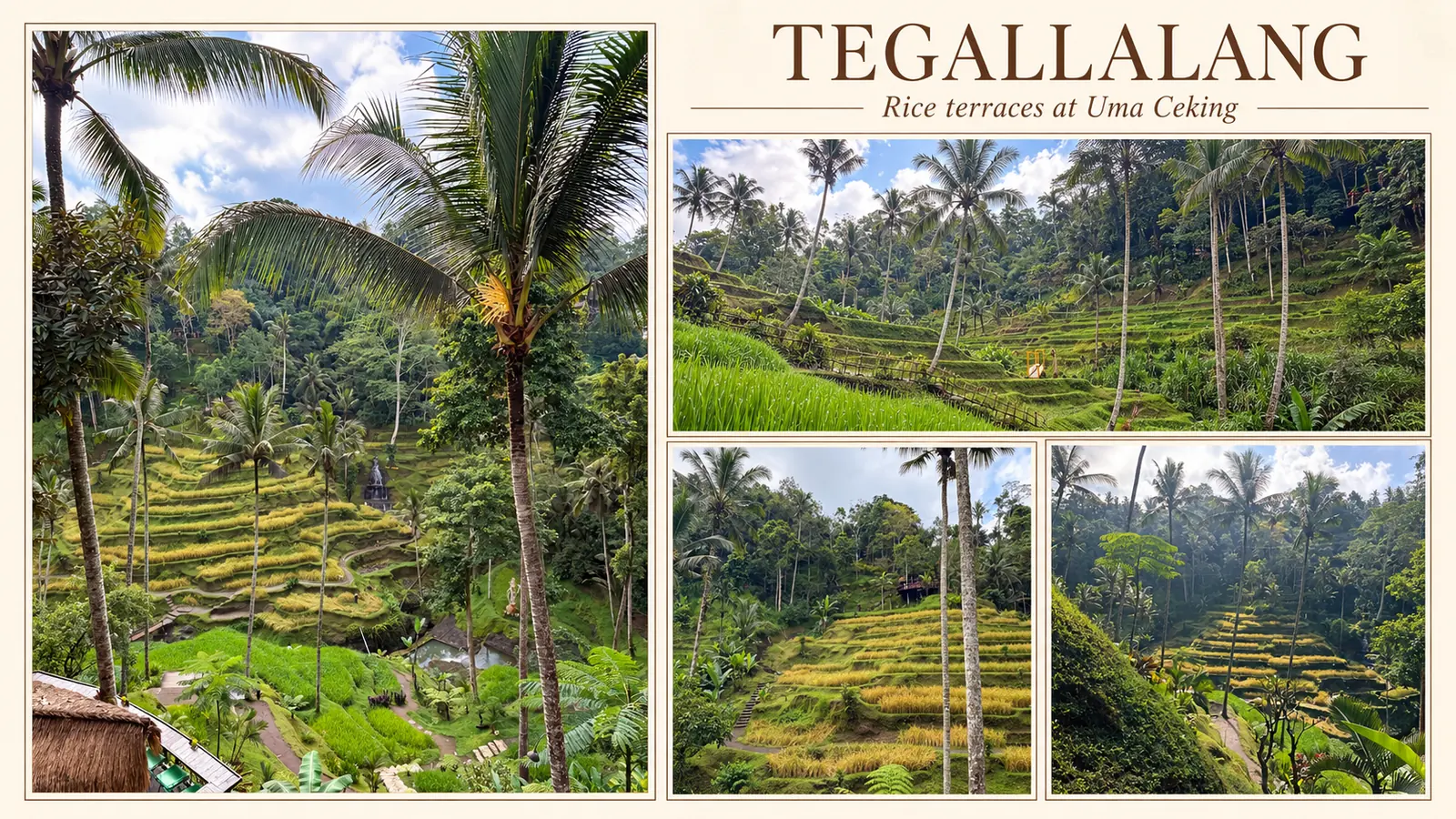
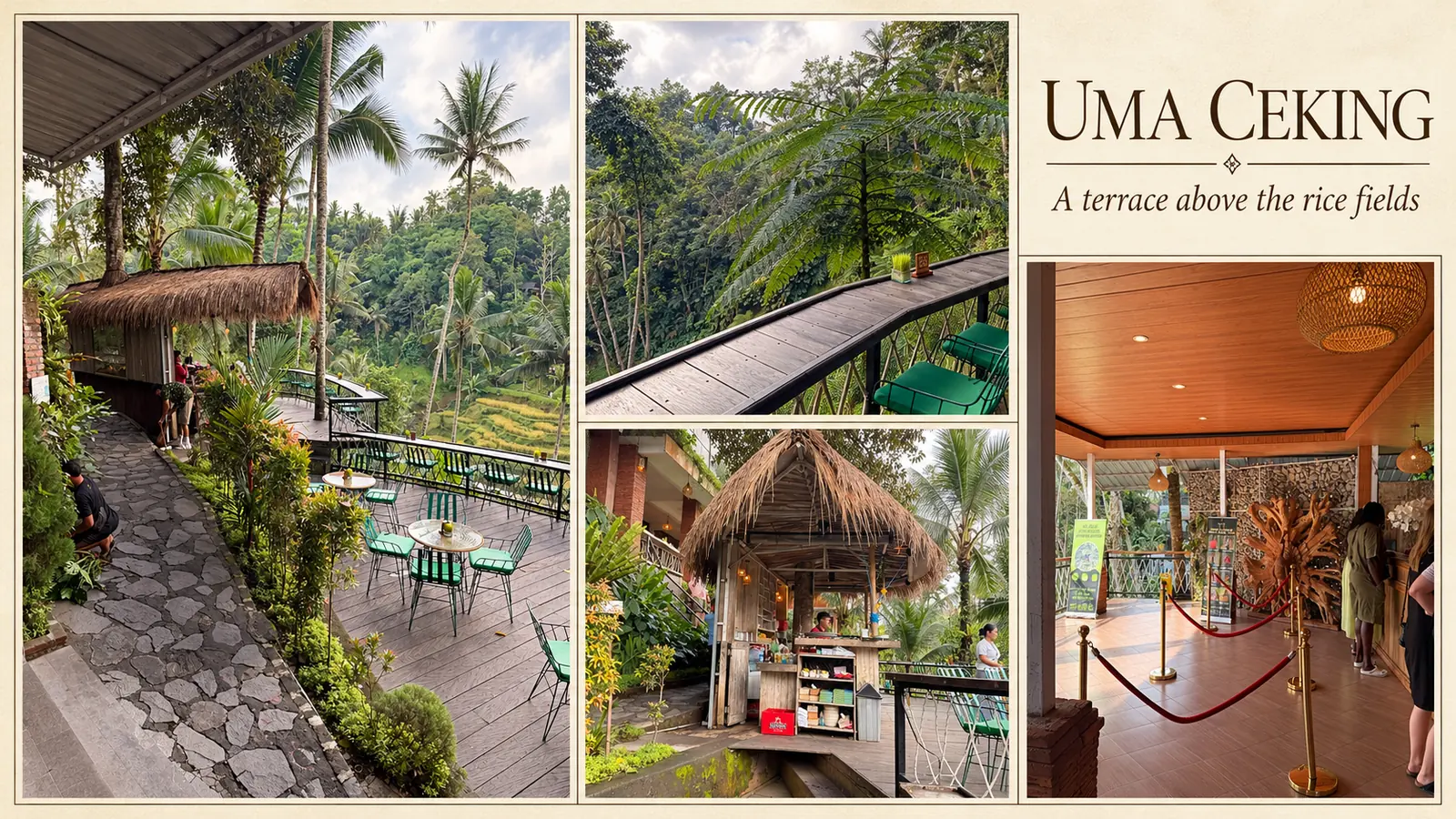
    Editorial collage of stepped rice fields and tall palms at Uma Ceking in Tegallalang, Bali
    Rice terrace views at Uma Ceking. Editorial collage based on my photographs.

    There is more to Tegallalang than its famous swing photographs. Between the palms, narrow paths wind through stepped rice fields, while open terraces offer places to pause and take in the valley.

    Uma Ceking Resto and Swing brings several parts of that experience together: rice terrace views, walking paths, a restaurant, photo installations and optional adventure activities.

    For me, this stop was an opportunity to photograph the landscape from different angles—from above the valley to the paths running between the fields.

    The Landscape Beyond the Photo Spots

    The rice terraces are the main reason to spend time here.

    In my photographs, bright green patches sit alongside golden rice, with tall palms rising above the slopes. The landscape is not one uniform shade of emerald, and that variation is part of its character.

    From the upper viewing areas, you can appreciate the shape of the valley. Further down, the details become more noticeable: narrow water channels, planted terrace edges, bamboo railings and steps following the hillside.

    Rather than treating the visit as a single photo stop, leave yourself time to explore the different viewpoints.

    Walking Through the Terraces

    The paths offer a closer perspective than the restaurant viewpoints alone.

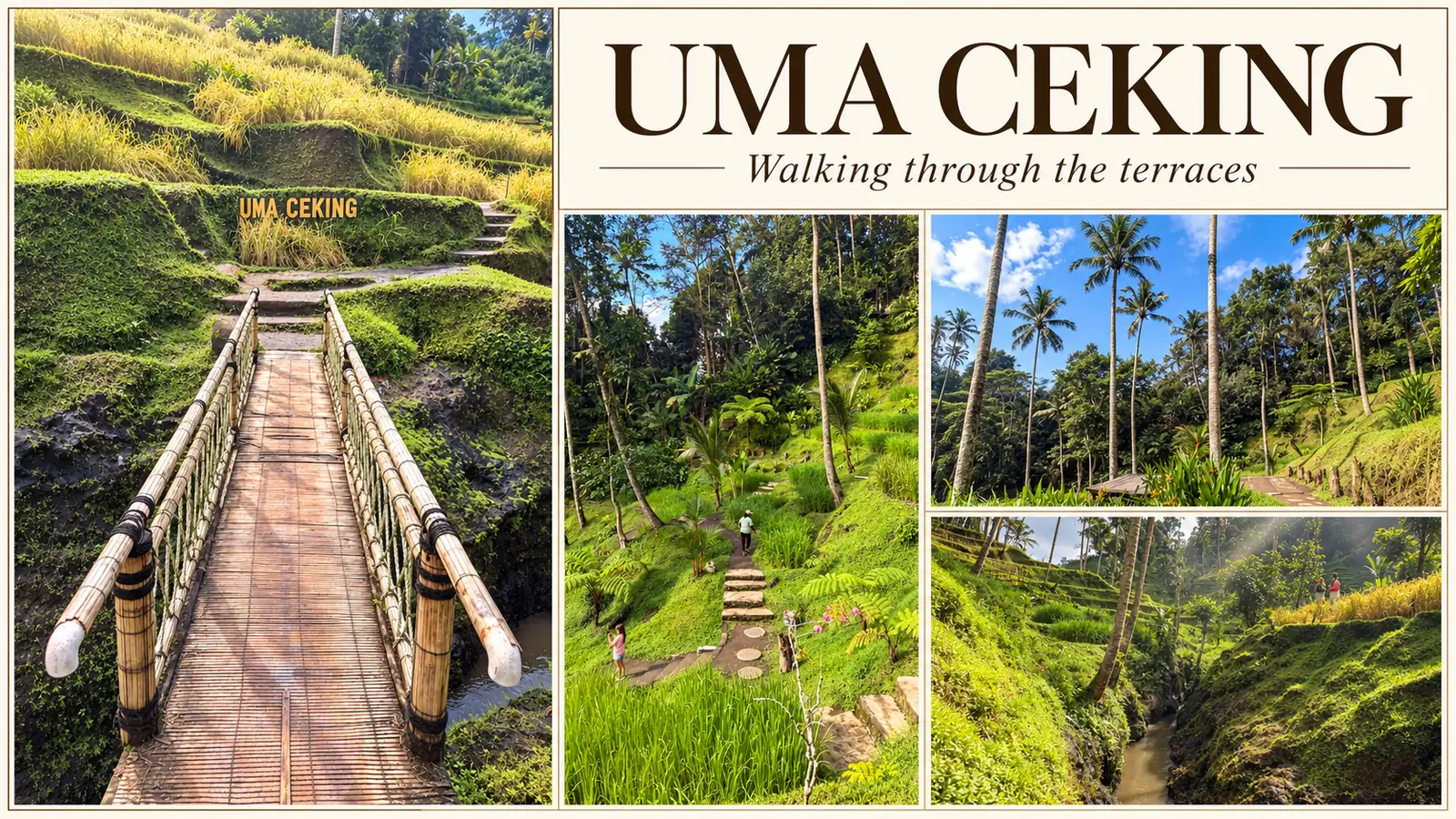
    My photos include a narrow bamboo bridge, stepping-stone paths and small waterways between the terraces. These quieter details help tell the story of the place beyond its better-known attractions.

    Wear shoes with a reliable grip, particularly if you plan to explore after rain. Expect steps and uneven surfaces rather than a completely flat route.

    Bring water, sun protection and a light bag. You will enjoy the walk more without carrying everything you packed for the day.

    Editorial collage showing a bamboo bridge, stone paths and a water channel among the rice terraces
    Walking routes through the terraces. Editorial collage based on my photographs.

    The Restaurant and Viewing Terraces

    Uma Ceking also provides somewhere to slow down between walking and taking photographs.

    The areas I photographed feature timber decking, green chairs, woven lighting and thatched structures, with seating looking out toward the valley. The appeal is the setting: somewhere to sit, look across the fields and take a break from moving between attractions.

    If you plan to eat here, check the current menu and prices before ordering. This section focuses on the surroundings rather than a food review.

    Editorial collage of Uma Ceking’s outdoor seating, valley-facing counter and thatched pavilion
    Restaurant and viewing areas at Uma Ceking. Editorial collage based on my photographs.

    Swings and Other Optional Activities

    Travel listings describe swing experiences, a skybike and a zipline alongside the restaurant and photo spots. Availability and ticket inclusions should be confirmed for your visit. Activity overview.

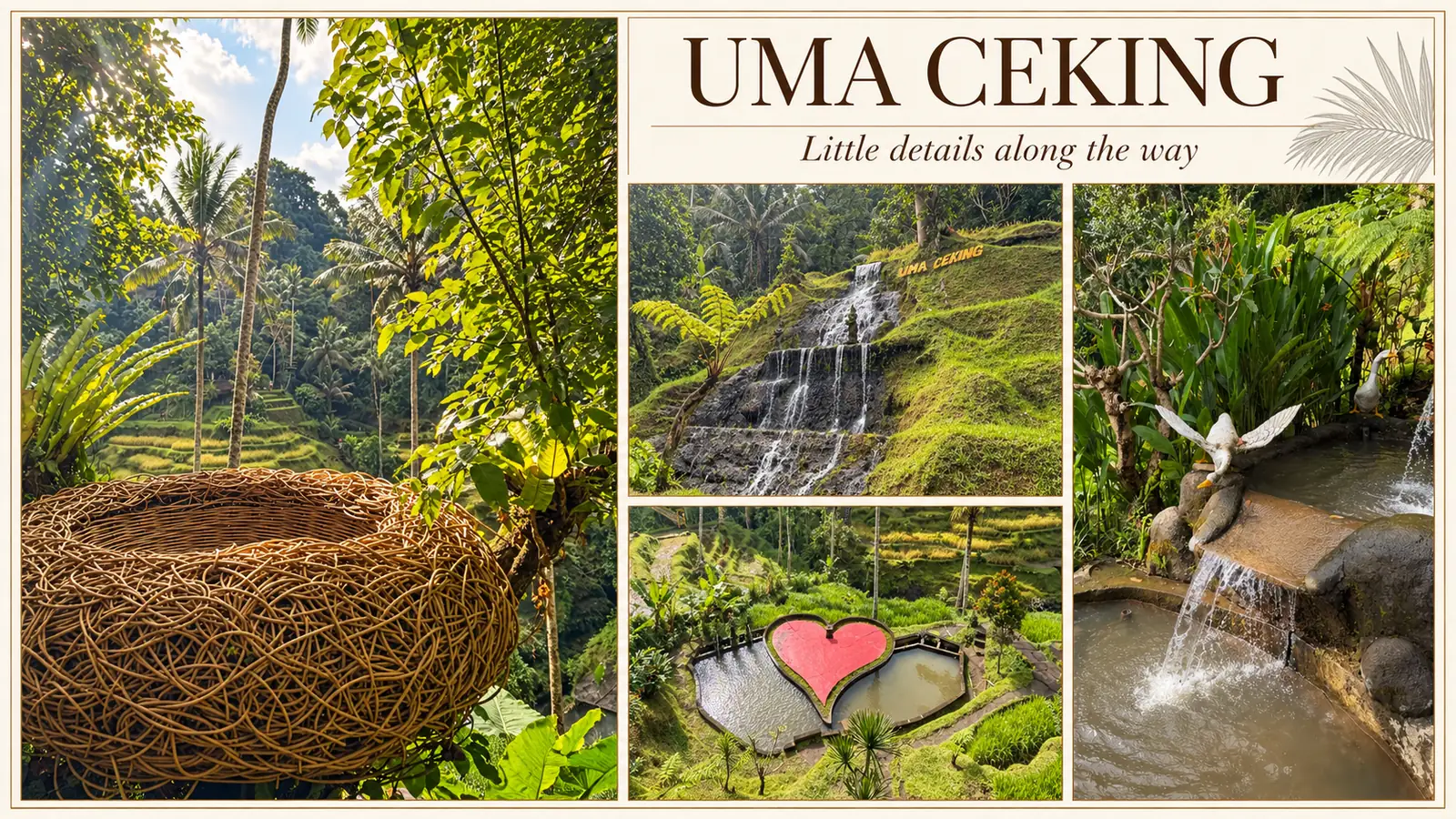
    My photo collection focuses on the landscape, paths, viewing areas and installations—not a firsthand review of riding the swings.

    You can enjoy the visit without building it around an adventure activity. The terraces and walking routes provide plenty to photograph on their own.

    Editorial collage of a woven bird’s nest seat, heart-shaped photo platform and water features at Uma Ceking
    Photo installations and garden details—not a record of riding the swings. Editorial collage based on my photographs.

    Price and Fee List

    Plan your budget around an entrance ticket plus optional activities and dining, or a bundled package if one is available for your visit. A package described as “all-inclusive” should not be assumed to cover every meal, rental or photography service.

    The following figures are indicative planning estimates, not a confirmed current price list or a record of what I paid. Confirm rates, taxes and inclusions before booking.

    1. Basic Admission and Dining Prices

    • Entrance fee: Approximately IDR 50,000–70,000 per person. Check whether your ticket includes terrace walking paths and bird’s-nest photo spots; access can depend on the ticket selected.
    • Dining budget: Allow approximately IDR 100,000–200,000 per person, depending on your order.
    • Tropical fruit smoothie or juice: Approximately IDR 40,000–50,000.
    • Local main course: Approximately IDR 80,000–120,000.

    2. Adventure Activity Prices

    Activities may be sold individually or included in a package. Confirm availability and participation requirements directly with the operator.

    • Jungle swing: Approximately IDR 197,000–200,000 for a single experience.
    • Skybike: Approximately IDR 300,000 per person. The supplied reference lists a 40–100 kg weight range; confirm the current weight, age and other eligibility requirements before purchasing.
    • Two-way zipline: Approximately IDR 307,000. Confirm whether the quoted ticket covers both directions.

    3. Dress Rental and Photography Extras

    • Long, flowing dress rental: Approximately IDR 200,000–300,000 per dress. Ask about sizing, rental duration and any deposit before paying.
    • Professional drone video service: Approximately IDR 100,000–450,000, depending on filming duration and the final video package. Confirm the number of clips, editing, delivery method and any additional charges.

    An online tour or activity booking does not automatically include every entrance fee. Compare the listed inclusions rather than the headline price alone.

    Planning Your Visit

    For a walking-focused visit, I would aim for the morning and leave some flexibility for the weather. Earlier light may be gentler, but clear skies, quiet paths and short queues are never guaranteed.

    Check the venue’s current opening hours and the last admission time for individual activities before travelling. Avoid planning a late arrival around an unconfirmed closing time.

    Is Uma Ceking Worth Including in an Ubud Itinerary?

    Uma Ceking makes sense if you want a convenient combination of rice terrace views, walking, photo stops and somewhere to sit afterward.

    It is a developed visitor attraction rather than an undiscovered corner of rural Bali. Go with that expectation, choose the activities that genuinely interest you, and allow time for the landscape itself.

    My suggestion: come for the terraces, explore beyond the first viewpoint, and treat the extras as optional—not the whole reason for being there.

    For the wider route, see my five-day Bali itinerary from Ubud to Canggu. If you are also planning a temple stop, read my Tirta Empul visiting guide.

  • ZIN Canggu Resort & Villas: My Stay near the Beach

    ZIN Canggu Resort & Villas: My Stay near the Beach

    ZIN Canggu Resort & Villas: My Stay near the Beach

    ZIN Canggu Resort & Villas suited the coastal part of my Bali trip: a beach within walking distance, a room with warm wood tones, and a cafe where I could spend time upstairs. If you are comparing places to stay in Canggu, those everyday details are a useful starting point.

    I stayed here after Ubud during my five-day Bali itinerary in May 2026. What appealed to me was the combination: I could enjoy being near the sea while still having a comfortable base for breakfast, coffee and some work. Here is what stood out from my stay, alongside practical details to check for your own booking.

    ZIN Canggu at a Glance

    Planning questionWhat to know
    LocationJalan Nelayan No. 78, Canggu, Bali
    My visitMay 2026, after the Ubud part of my trip
    Beach accessA short walk; my own rough estimate was around 500 metres
    What I likedThe wood-toned room, beach access and upstairs cafe atmosphere
    BreakfastIncluded in my booking; check the rate you choose
    Working spaceAn upstairs cafe area, plus the separately described ZIN@Work facilities

    The address and facility information are available on the official ZIN Canggu website. My visit notes describe my stay; the linked hotel pages describe its current offering.

    Location: A Beach Walk from Jalan Nelayan

    The location was one of the strongest parts of my stay. The beach was close enough to walk to—roughly 500 metres by my own estimate, rather than a measured route.

    That access changes the feel of a hotel stay. You can make the coast part of an ordinary day instead of treating every visit to the sea as another transfer to arrange.

    For orientation, the hotel lists Nelayan Beach, Batu Bolong Beach and Echo Beach among nearby beaches. They are separate places, so check the route to the particular stretch of coast you want to visit. Hotel location information

    I would choose ZIN for having the beach within reach, rather than assume that every room faces the ocean. Beach access and an ocean-view room are different booking choices.

    My Room: Warm Wood and a Style I Liked

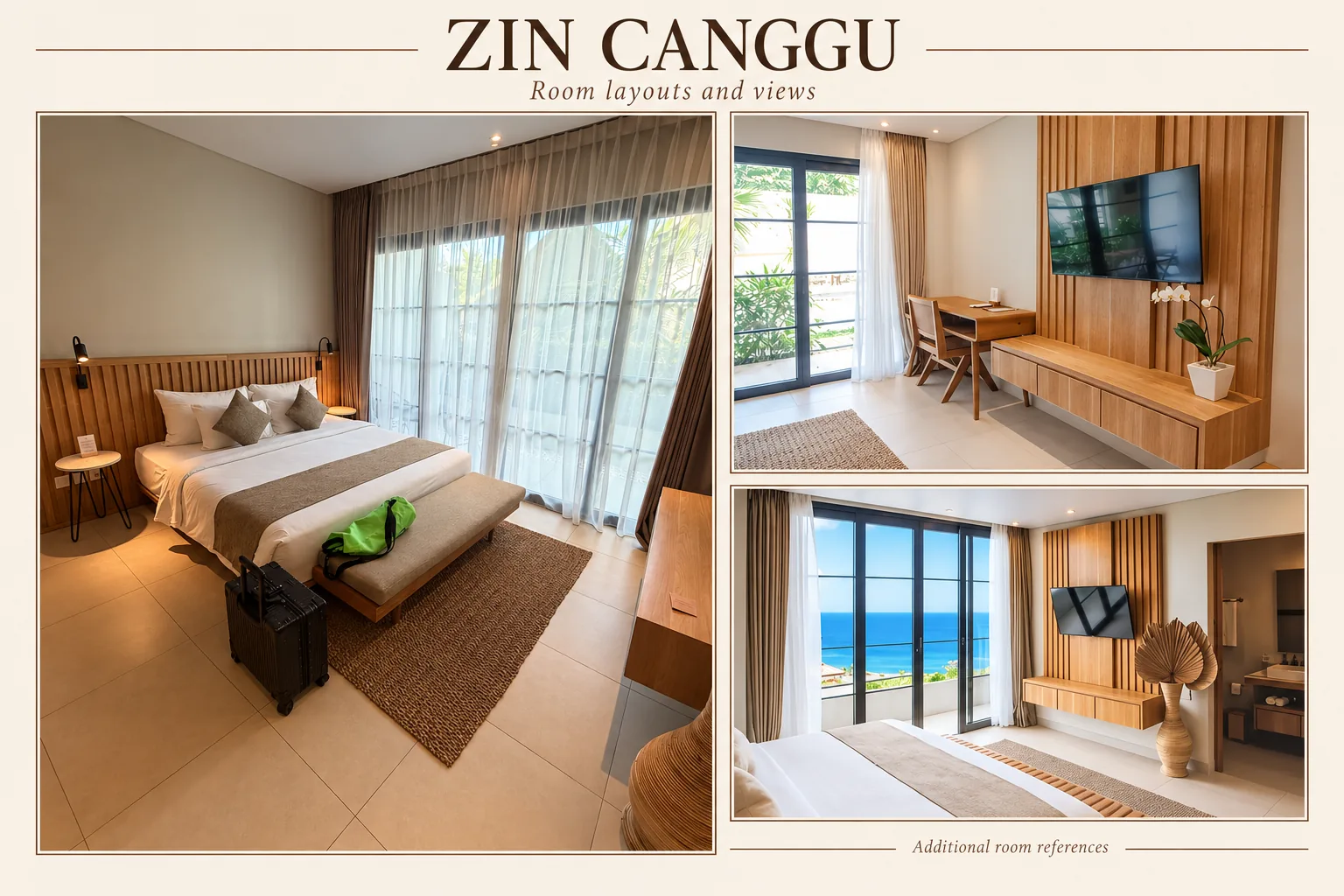
    The wood-toned interior was immediately appealing to me. My room photograph shows a simple palette of white bedding, natural wood, neutral textiles and light through the curtains. It was a style I liked, without needing a lot of decoration.

    The hotel offers several accommodation categories, including rooms, suites and private-pool villas. Its official room guide also lists specific pool-access and ocean-view options. Choose by the named category and its inclusions, rather than by a general hotel gallery.

    ZIN Canggu room collage with my wood-toned bedroom on the left and supplementary room views on the right
    My room is shown in the large left-hand panel. The two right-hand panels are additional room references, including a different ocean-view room.

    Pools and Garden Corners

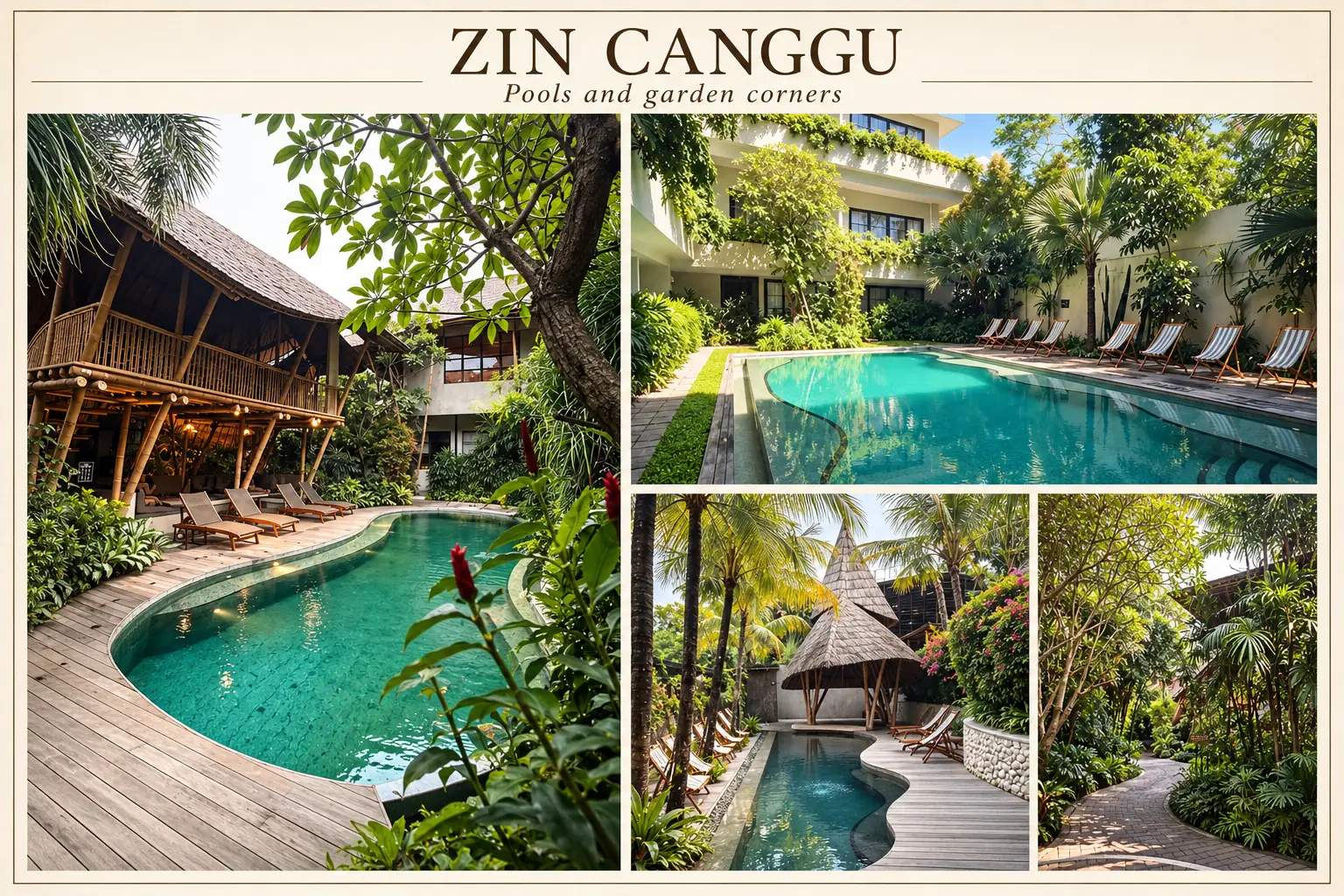
    The pool and garden images show another side of the property: water bordered by timber decking, planted walkways and greenery around the buildings. Together, these spaces help explain the appeal beyond the bedroom.

    ZIN lists swimming pools, a pool sundeck and a bamboo pool lounge among its facilities. If direct pool access matters to you, check the exact room category before paying. Official facilities

    ZIN Canggu collage showing garden pools, timber decking, tropical plants and a shaded walking path
    Pool views and garden corners around the property.

    Breakfast and the ZIN Cafe Atmosphere

    Breakfast was included in my booking. That is worth checking when comparing rates, because the room price alone does not tell you what your stay includes.

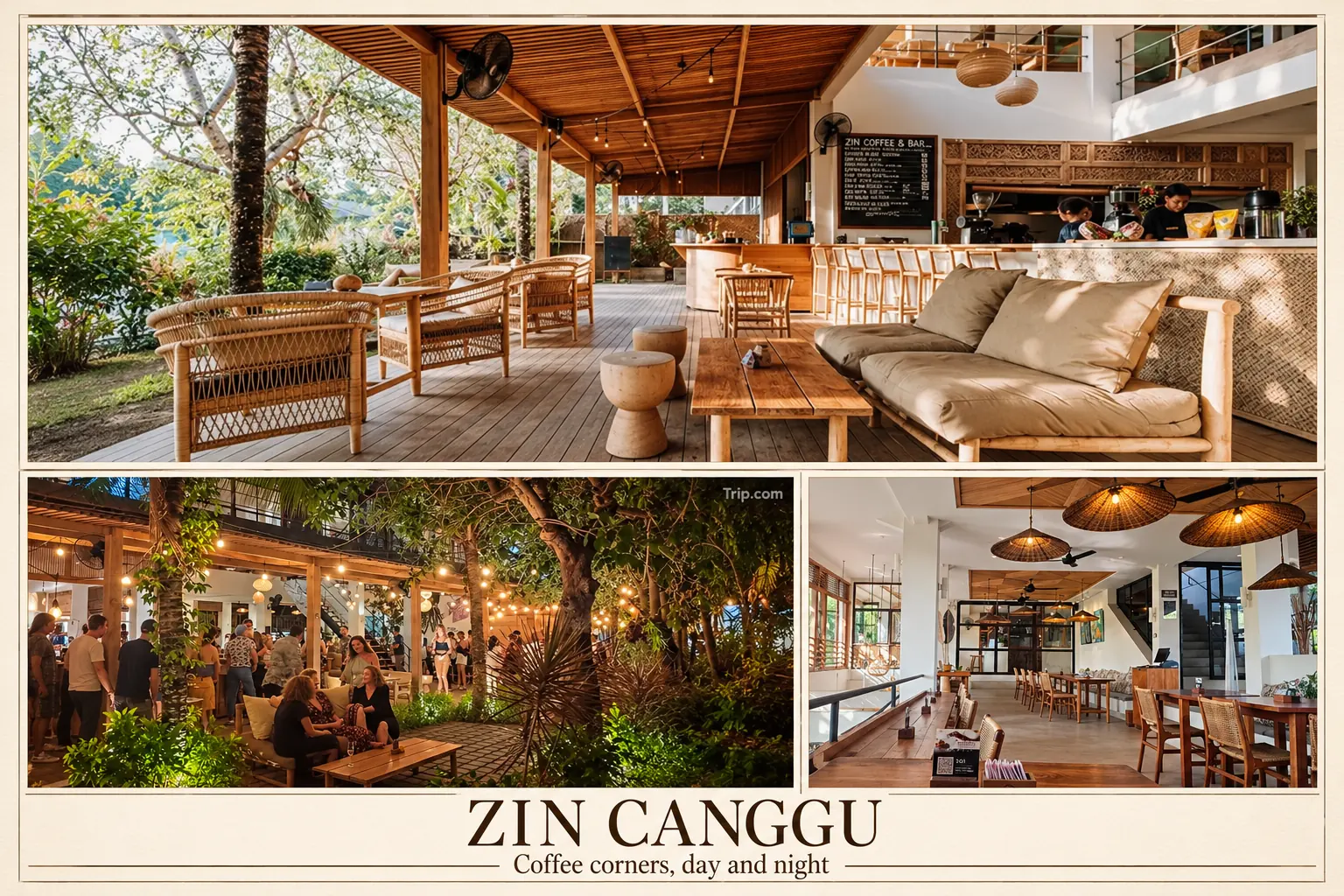
    The cafe is also part of what makes ZIN interesting as a place to stay. The images bring together the open seating, timber details and different moods of the space, from daylight to evening.

    ZIN Cafe serves local and international dishes and houses Z Roasters, its in-house coffee roastery. You can check the official cafe page for its current offering.

    ZIN Canggu cafe collage with open seating, an evening courtyard gathering and an upstairs dining area
    Coffee corners and cafe spaces, by day and at night.

    Upstairs Coffee and Space to Work

    I noticed people working in the upstairs cafe during my stay. That atmosphere appealed to me: the hotel could fit a trip with some work in it, alongside time at the beach.

    My tablet-and-coconut photograph captures that part of the visit more personally than a list of office facilities could.

    The cafe’s official information also describes ZIN@Work, with a bamboo workspace and an air-conditioned focus room. It is advertised as free to use, subject to designated areas and event arrangements. Coworking details and terms

    Upstairs ZIN Canggu cafe seating alongside my tablet and a fresh coconut on a table
    Upstairs seating, with a personal moment from my stay.

    For a work-heavy trip, I would test the connection where you intend to sit before scheduling an important call. An appealing workspace and a reliable setup for your particular work are both worth checking.

    Bamboo Architecture and Spa Spaces

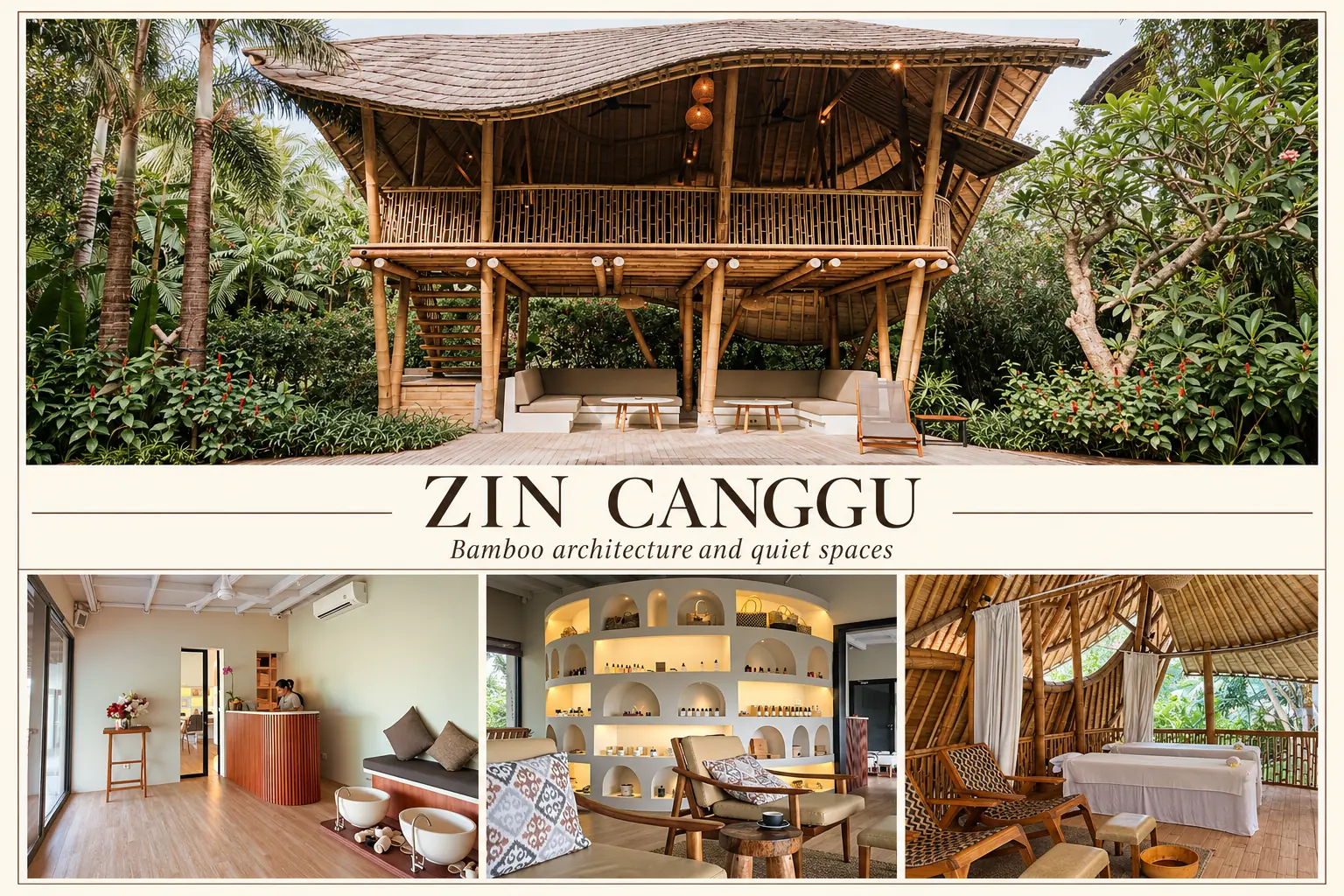
    The bamboo pavilion and spa images add to the property’s natural-material palette. They show open structures, treatment areas and quieter seating, giving a sense of the spaces beyond the cafe and pools.

    ZIN Wellness currently lists Balinese and aromatherapy massage, among other treatments. Check the official wellness menu for the treatment, location, price and appointment you want.

    ZIN Canggu bamboo pavilion collage with spa reception, lounge seating and a bamboo treatment area
    Bamboo architecture, spa spaces and quiet corners.

    These are options to consider when planning a stay, rather than treatments I am reviewing from personal use.

    Gym Access and Studio Classes

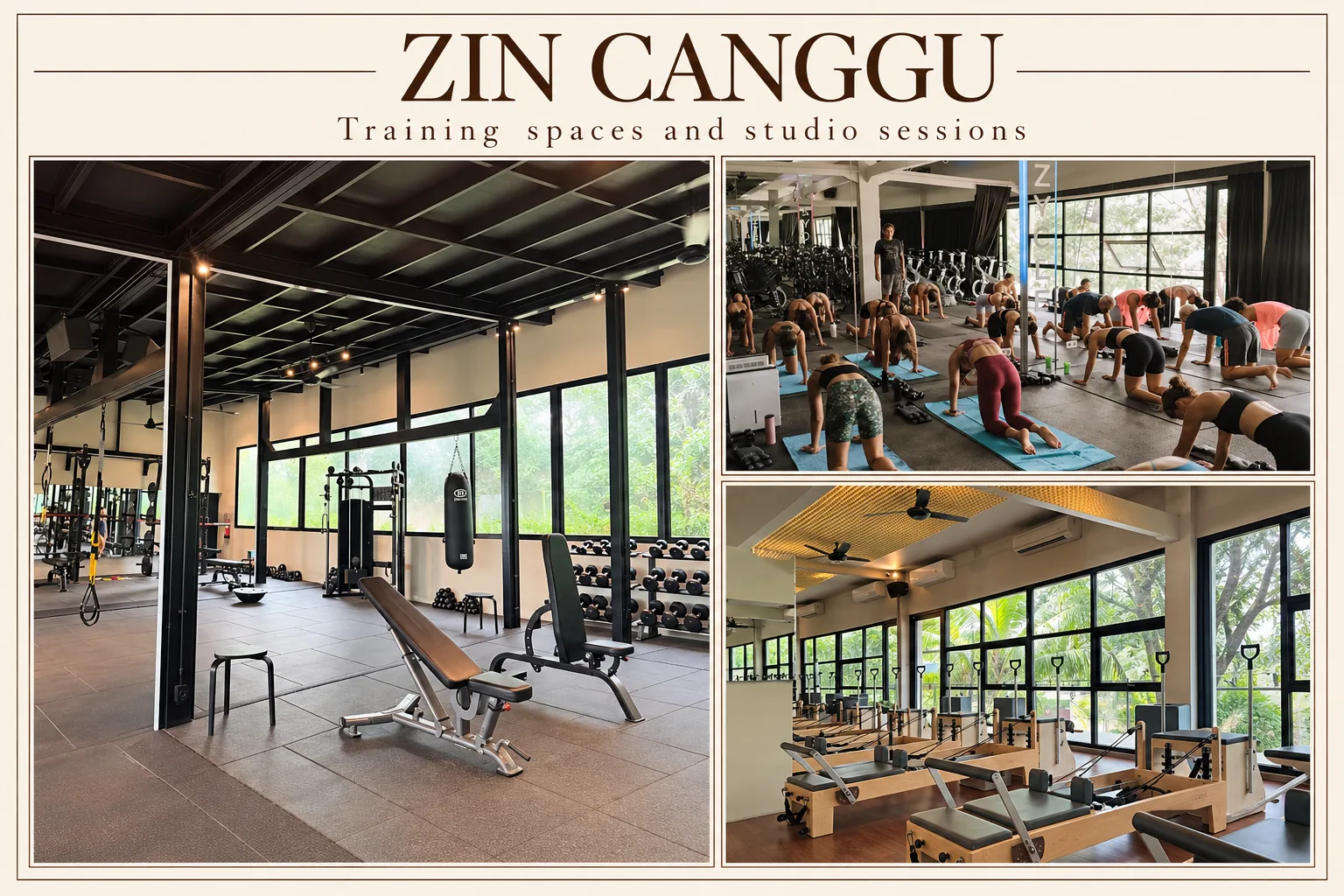
    ZIN’s hotel information states that hotel guests can use the gym free of charge. Its gym page describes cardio and weight-training equipment upstairs at ZIN Cafe. Hotel guest access

    The wider fitness offering includes studio activities such as cycling and Pilates. Before planning around a class, ask about the timetable, reservation requirements and whether your booking includes it. Gym access should not be read as an all-inclusive class pass. ZIN fitness and membership options

    ZIN Canggu fitness collage showing gym equipment, a group exercise session and Pilates reformers
    Gym and studio references; check the current timetable and access conditions before booking.

    Who Would I Recommend ZIN Canggu To?

    I would put ZIN on the shortlist for travellers who want a beach walk, a comfortable room and somewhere pleasant to spend time over coffee. It is also worth considering if your holiday includes some remote work.

    Before booking, I would check four things:

    • The room: confirm the category, outlook and any balcony, pool-access or private-pool feature you want.
    • Breakfast: compare the actual rate inclusions.
    • Work arrangements: check workspace access and try the connection before an important call.
    • Extra activities: confirm spa appointments and class charges separately.

    For current availability, use the official ZIN Canggu booking links. Compare the complete stay, including cancellation terms, rather than choosing from photographs alone.

    Frequently Asked Questions

    Is ZIN Canggu within walking distance of the beach?

    Yes, the beach was a short walk during my stay. My rough estimate was around 500 metres; check the route from your room or building to the beach you intend to visit.

    Is breakfast included at ZIN Canggu?

    It was included in my booking. Check your chosen rate for the number of guests and meals covered.

    Can you work at ZIN Cafe?

    I saw people working upstairs during my visit. ZIN also advertises ZIN@Work facilities; check the designated work areas and any event restrictions.

    Does every room have an ocean view or a private pool?

    No. These are category-specific features. Match the room name and description to the features you want before booking.

    What Stayed with Me

    ZIN worked well for this part of my Bali trip because the things I valued were close together: the beach, a room whose style I liked, breakfast and the upstairs cafe.

    That is the reason I would consider it again—a coastal base where a holiday and a little work can fit into the same stay. For the inland half of the same trip, see my Adiwana Svarga Loka stay in Ubud.