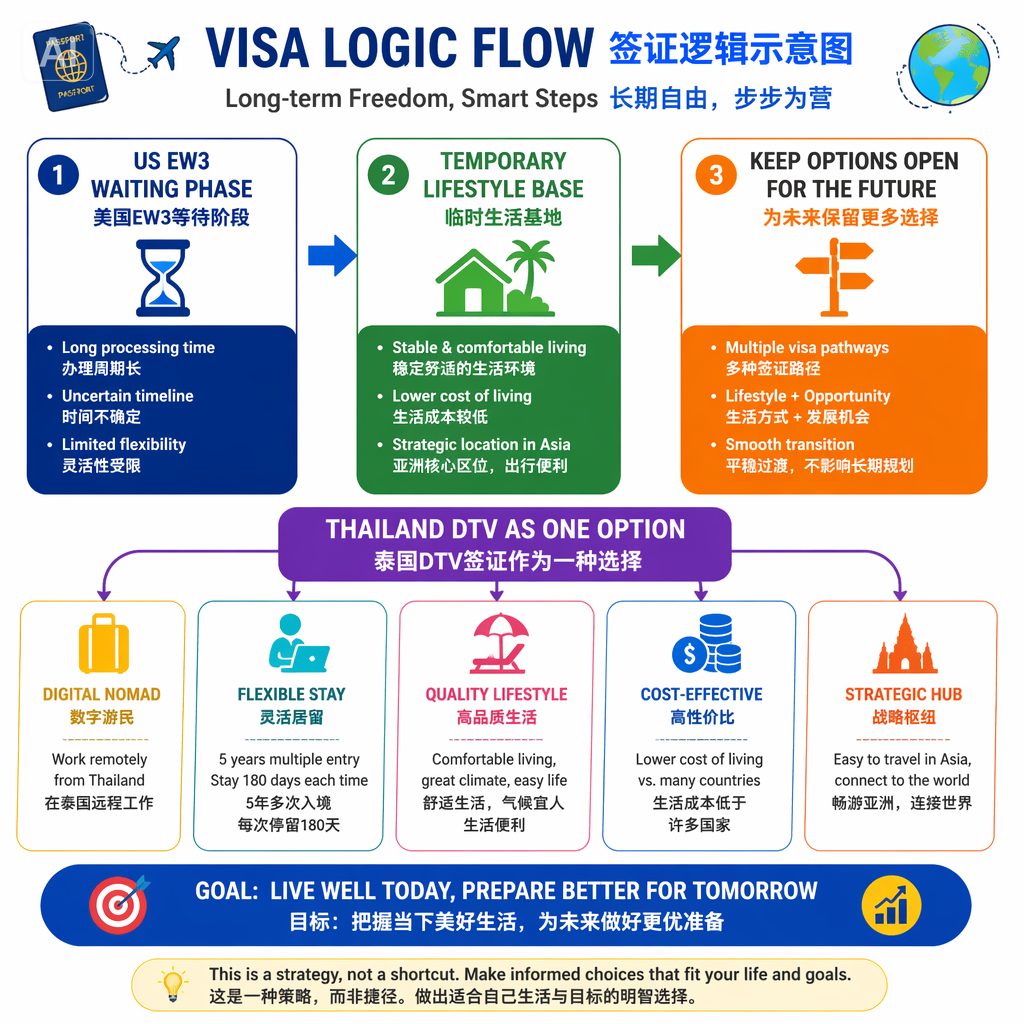
The hardest part of the US EW3 process is not just the delay. It is what the delay does to your life.
When people talk about navigating the US EW3 backlog, they usually focus on one question: how long it takes.
That matters, of course. But after spending years living across different countries and building a location-independent life, I have come to believe that the bigger issue is not the processing time itself. It is what that long, uncertain timeline does to your daily reality.
A long immigration queue can quietly affect everything.
It affects how confidently you make career decisions.
It affects whether you are willing to sign a lease, move cities, or commit to a long-term plan.
It affects your cash flow, your emotional stability, and your ability to imagine the next few years clearly.
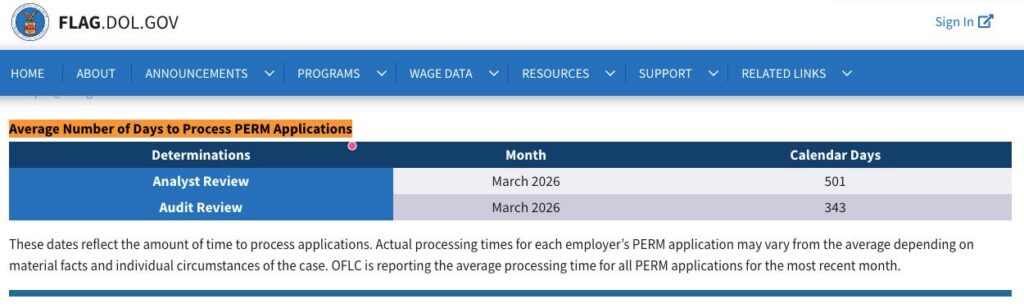
Based on publicly available DOL data as of May 31, 2026, Analyst Review cases were averaging around 501 days, or about 16.48 months. And that is only the first stage.
That number tells me one thing very clearly: if you are on the US EW3 path, waiting is no longer a short pause. It is a real phase of life.
And once you accept that, the question changes.
It is no longer just, “How long will this take?”
It becomes:
How do I want to live while it takes that long?
This is why I do not think people should treat the EW3 waiting period as dead time
One thing I have learned from living abroad for years is that life rarely rewards the people who press pause and wait for certainty.
If the first stage alone can take well over a year, then the smarter move is not to sit in anxiety and count months. The smarter move is to build a lifestyle that can carry you through that period with as little friction as possible.
That does not mean running away from reality.
It means responding to reality like an adult.
If the system is slow, then your personal strategy has to become better.
For some people, that means staying where they are and keeping things simple. For others, especially those with remote income, flexible work, or an international mindset, it may make more sense to spend those waiting years somewhere lighter, calmer, and easier to sustain.
That is the lens I use when I think about Thailand DTV.
Thailand DTV is not the only option in Southeast Asia, but it is the one I would start with
I want to be clear here.
This makes it the perfect temporary buffer while waiting out the EW3 Backlog.
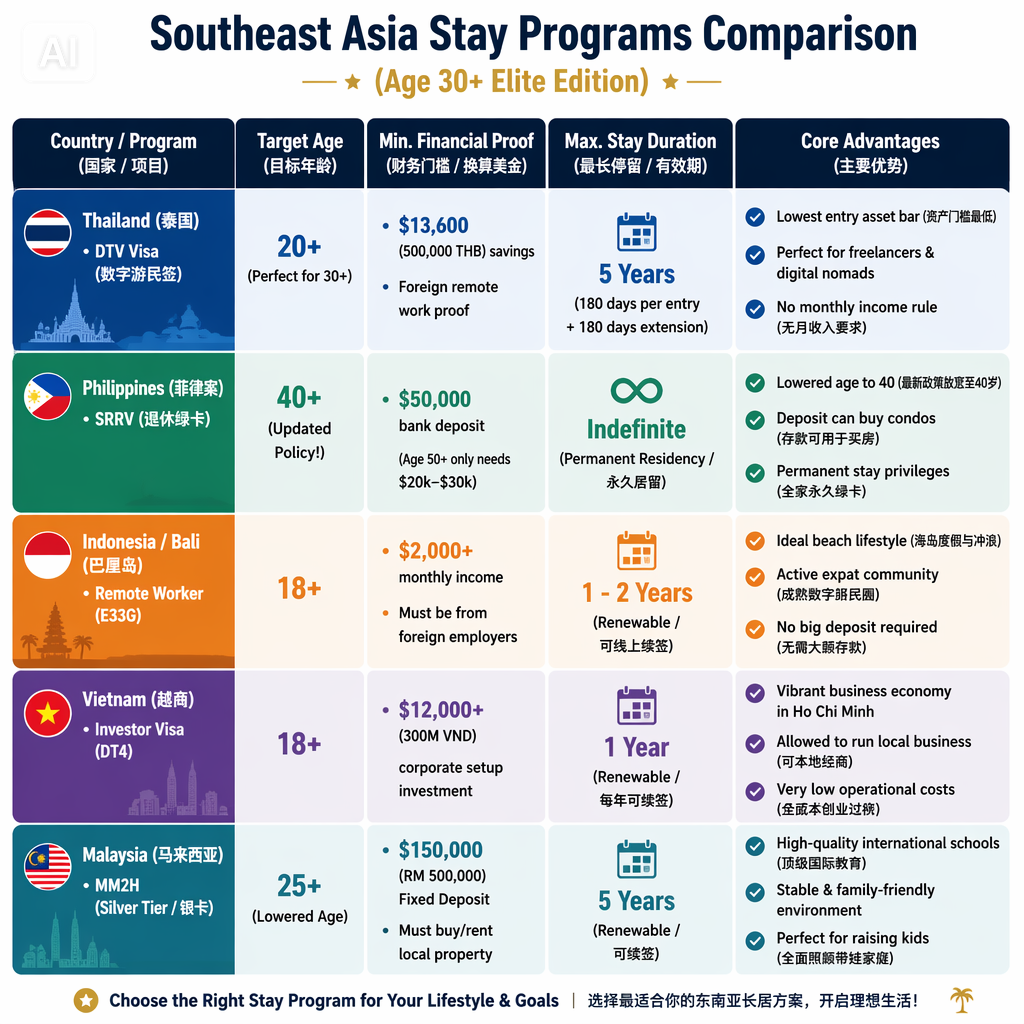
Thailand DTV is not the only possible answer for people waiting out the US EW3 backlog.
If you are looking at Southeast Asia seriously, there are several possible directions. The Philippines has SRRV, which some people consider for longer-term residence planning. Indonesia, especially Bali, continues to attract remote workers who care more about lifestyle and creative energy. Ho Chi Minh City makes sense for people who want a fast-moving city at a lower cost. Malaysia also deserves attention if you value structure, convenience, and a more balanced living environment.
So no, Thailand is not the only choice.
But if someone asked me where I would begin the research, especially as a first serious transition strategy during the US EW3 wait, I would still say Thailand DTV.
Why?
Because right now it feels like one of the easiest options to understand, one of the most practical to imagine living with, and one of the most natural fits for people who are already used to working online, living internationally, or designing their life with more flexibility.
I will write about the Philippines, Bali, Vietnam, and Malaysia separately. They all deserve their own space.
But this is the first one I would recommend exploring.
Why Thailand DTV stands out to me
1. It gives the kind of time flexibility that actually matches real life
A short-stay visa can be useful for a break. It is much less useful when you are trying to build stability during a long immigration wait.
One reason Thailand DTV gets so much attention is that it offers a level of time flexibility that feels more compatible with real life. Based on current public information, it is commonly understood as a 5-year visa with 180-day stays, along with the ability to extend under the current rules.
That matters because people waiting on US EW3 are not usually looking for a two-month escape. They are trying to think in years, not weeks.
When the timeline in the background is uncertain, longer visa flexibility changes the emotional equation. It lets you stop thinking like a tourist and start thinking like someone building a temporary but stable chapter of life.
That shift is bigger than it sounds.
2. It fits people who already earn in a borderless way
I think Thailand makes the most sense for a certain kind of person.
Not everyone, but a specific kind of person.
Someone who already works remotely.
Someone who freelances, runs a small website, operates an online business, creates content, consults, or earns from digital work that is not tied to one country.
Someone who does not need a local office to feel productive.
For that kind of person, Thailand can be very workable.
Bangkok has the pace, convenience, and infrastructure to support a serious routine. Chiang Mai offers a softer rhythm and is still deeply familiar with remote-worker life. Even outside the major hubs, the country is relatively easy to navigate if you want a setup that feels efficient without being emotionally heavy.
That is one of the reasons I keep coming back to it in my own thinking.
You are not just buying time.
You are protecting continuity.
And continuity matters a lot when the immigration process itself offers so little control.
3. It allows waiting to feel like living, not just surviving
This may be the most important point, and it has less to do with immigration mechanics than with quality of life.
A lot of people underestimate how draining it is to stay in a place that no longer fits you, just because you are afraid to make a move before the next stage of your plan is confirmed.
I understand that fear. It sounds rational. But it can become expensive in ways that are hard to measure.
Expensive emotionally.
Expensive creatively.
Expensive in lost momentum.
Thailand appeals to many people because it creates the possibility of a life that still feels open while you wait.
You can work.
You can reset.
You can keep your expenses under control.
You can build better habits.
You can have sunlight, routine, affordability, and movement instead of living in a holding pattern.
To me, that is the real attraction.
Thailand DTV is not just a visa idea. It is a way to stop treating waiting as wasted life.
Why I think so many people still use agencies or consultants
A question that comes up often is whether Thailand DTV should be handled independently or with professional help.
In theory, many people can research a visa process themselves. In practice, a lot of applicants still prefer some form of agency or consultant support.
That does not surprise me.
Most people are not looking for drama. They are looking for clarity.
They want to understand what route makes sense for their background.
They want the process to feel organized.
They want fewer moving parts and less unnecessary stress.
And if they are already living abroad, changing countries, or managing an income stream online, they may simply not want to spend weeks trying to decode every procedural detail alone.
I think that is a very human reaction.
For someone waiting on US EW3, the deeper issue is usually not “How do I file one visa?” It is “How do I create a smoother next few years?”
And once you frame the problem that way, it makes sense that many people want some help.
If I were choosing help, I would care less about hype and more about fit
If someone is considering an agency or consultant, I do not think the right question is, “Who sounds the most confident?”
I think the better question is:
Who seems to understand my real life, not just the visa headline?
The right support should make the process feel clearer, not louder.
For me, the useful signals would be simple.
Do they understand how you actually make money?
Do they understand why Thailand fits your current season of life?
Do they explain the process in a way that reduces confusion instead of creating dependency?
Do they seem focused on helping you build something workable, not just something marketable?
That kind of clarity matters.
Not because everything has to be perfect.
But because the entire point of a waiting strategy is to reduce friction, not add more of it.
Who I think should seriously consider Thailand DTV during the US EW3 wait
Not everyone waiting on US EW3 needs a Thailand plan.
But I do think Thailand DTV becomes especially attractive if you are someone who:
- already has stable remote or online income
- is comfortable living outside your home country
- values flexibility more than fixed location
- wants to reduce pressure during a long immigration queue
- prefers to keep life moving instead of sitting still
- sees the next 1 to 5 years as something to be designed, not merely endured
If that sounds like you, Thailand may not just be interesting. It may actually be useful.
And in a long immigration process, useful beats exciting every time.
The most mature strategy is not to obsess over the queue. It is to build a life that can hold the queue.
This is probably the simplest way I can say it.
A lot of people wait for immigration timelines the same way they wait for a delayed flight. They stay mentally frozen, believing movement will begin only when the system changes.
But the US EW3 process does not always move like a delayed flight. Sometimes it moves like weather. Slowly. Unevenly. Outside your control.
That is why I think the healthier question is not, “When will this finally move?”
It is:
If this takes much longer than I hoped, do I still have a way to live well?
That is the question Thailand DTV helps answer for some people.
Not because it solves immigration.
Not because it replaces a final destination.
But because it gives structure to the in-between.
And if you have lived abroad long enough, you learn that the in-between is not a minor detail.
It is a large part of life.
Final thoughts
If you are already deep enough into the US EW3 process to realize the first stage may take far longer than expected, then this may be the right time to think beyond paperwork and start thinking about lifestyle design.
Thailand DTV is not the only path in Southeast Asia, and I would never frame it that way. The Philippines, Bali, Ho Chi Minh City, and Malaysia all deserve serious attention depending on who you are and how you want to live.
But if you want one option to start with, one place to begin the conversation, one practical route that feels both realistic and livable, I would start with Thailand.
Not because it is trendy.
Not because it is magical.
But because for the right person, it offers something very valuable:
a way to keep living well while waiting for a slow system to catch up.
That, to me, is not avoidance.
It is strategy.
FAQ
Is Thailand DTV the only good option while waiting for US EW3?
No. It is one of several Southeast Asia options worth researching. The right choice depends on your income, preferred lifestyle, long-term plan, and budget.
Why do you recommend Thailand first?
Because it combines practical visa flexibility, digital nomad compatibility, strong day-to-day infrastructure, and a lifestyle many international workers can imagine sustaining.
What about the Philippines SRRV, Bali, Vietnam, or Malaysia?
All of them may work depending on your needs. I see them as parallel options, not inferior ones. Thailand is simply the first one I would explain in detail.
Is this a legal recommendation?
No. This is a personal strategy perspective based on lifestyle fit, public information, and long-term planning logic. Anyone making a visa decision should review current official requirements directly.
Related Reading: Check out my comprehensive guide on the EW3 Visa Timeline to plan your green card stages.