Category: USA

Comprehensive guides on US employment-based immigration, specializing in EB-3 and EW3 visa pathways. Tracking PERM labor certifications, I-140 approvals, visa bulletin priority dates, and NVC timelines.

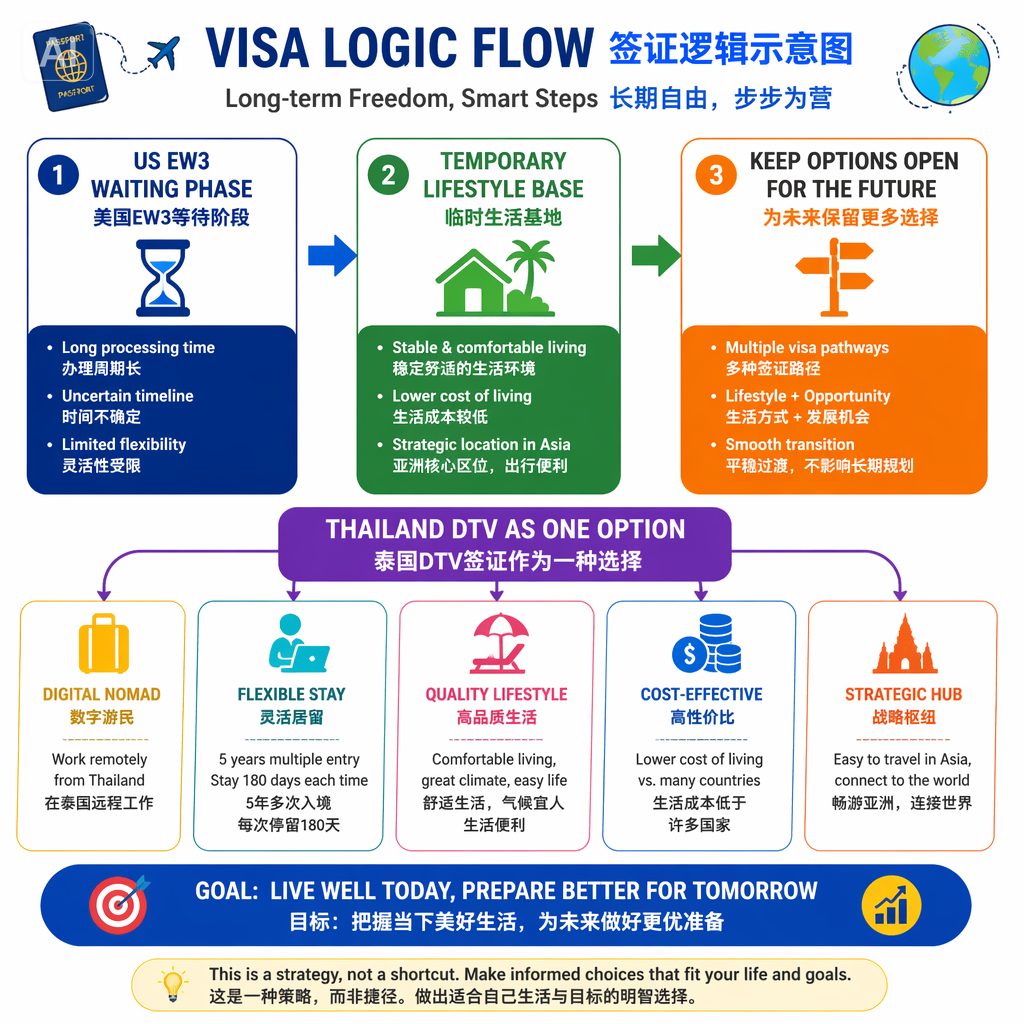
  • Waiting Out the US EW3 Backlog: Why Thailand DTV Is the First Option I’d Recommend

    The hardest part of the US EW3 process is not just the delay. It is what the delay does to your life.

    When people talk about navigating the US EW3 backlog, they usually focus on one question: how long it takes.

    That matters, of course. But after spending years living across different countries and building a location-independent life, I have come to believe that the bigger issue is not the processing time itself. It is what that long, uncertain timeline does to your daily reality.

    A long immigration queue can quietly affect everything.

    It affects how confidently you make career decisions.
    It affects whether you are willing to sign a lease, move cities, or commit to a long-term plan.
    It affects your cash flow, your emotional stability, and your ability to imagine the next few years clearly.
    EW3 Backlog Strategy Guide

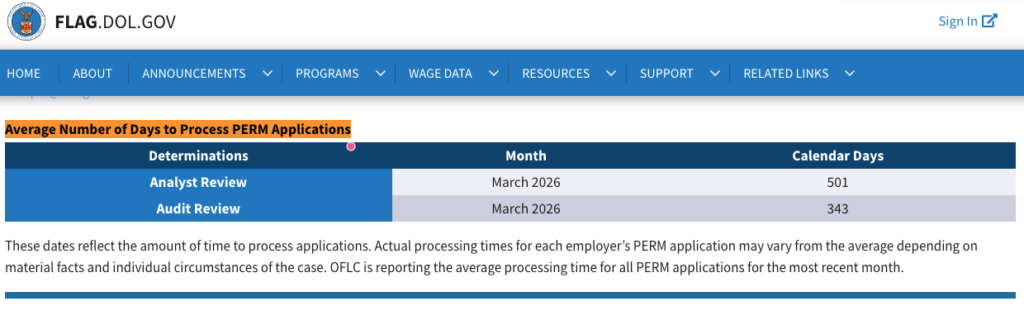
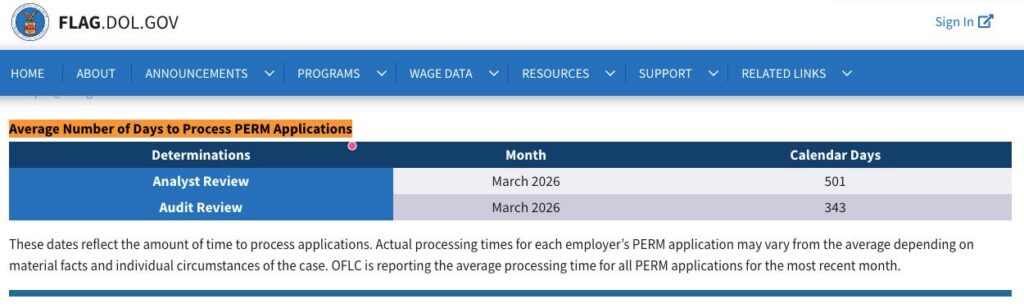
    Based on publicly available DOL data as of May 31, 2026, Analyst Review cases were averaging around 501 days, or about 16.48 months. And that is only the first stage.

    That number tells me one thing very clearly: if you are on the US EW3 path, waiting is no longer a short pause. It is a real phase of life.

    And once you accept that, the question changes.

    It is no longer just, “How long will this take?”

    It becomes:

    How do I want to live while it takes that long?

    This is why I do not think people should treat the EW3 waiting period as dead time

    One thing I have learned from living abroad for years is that life rarely rewards the people who press pause and wait for certainty.

    If the first stage alone can take well over a year, then the smarter move is not to sit in anxiety and count months. The smarter move is to build a lifestyle that can carry you through that period with as little friction as possible.

    That does not mean running away from reality.
    It means responding to reality like an adult.

    If the system is slow, then your personal strategy has to become better.

    For some people, that means staying where they are and keeping things simple. For others, especially those with remote income, flexible work, or an international mindset, it may make more sense to spend those waiting years somewhere lighter, calmer, and easier to sustain.

    That is the lens I use when I think about Thailand DTV.

    Thailand DTV is not the only option in Southeast Asia, but it is the one I would start with
    EW3 Backlog Strategy Guide

    I want to be clear here.

    This makes it the perfect temporary buffer while waiting out the EW3 Backlog.

    Thailand DTV is not the only possible answer for people waiting out the US EW3 backlog.

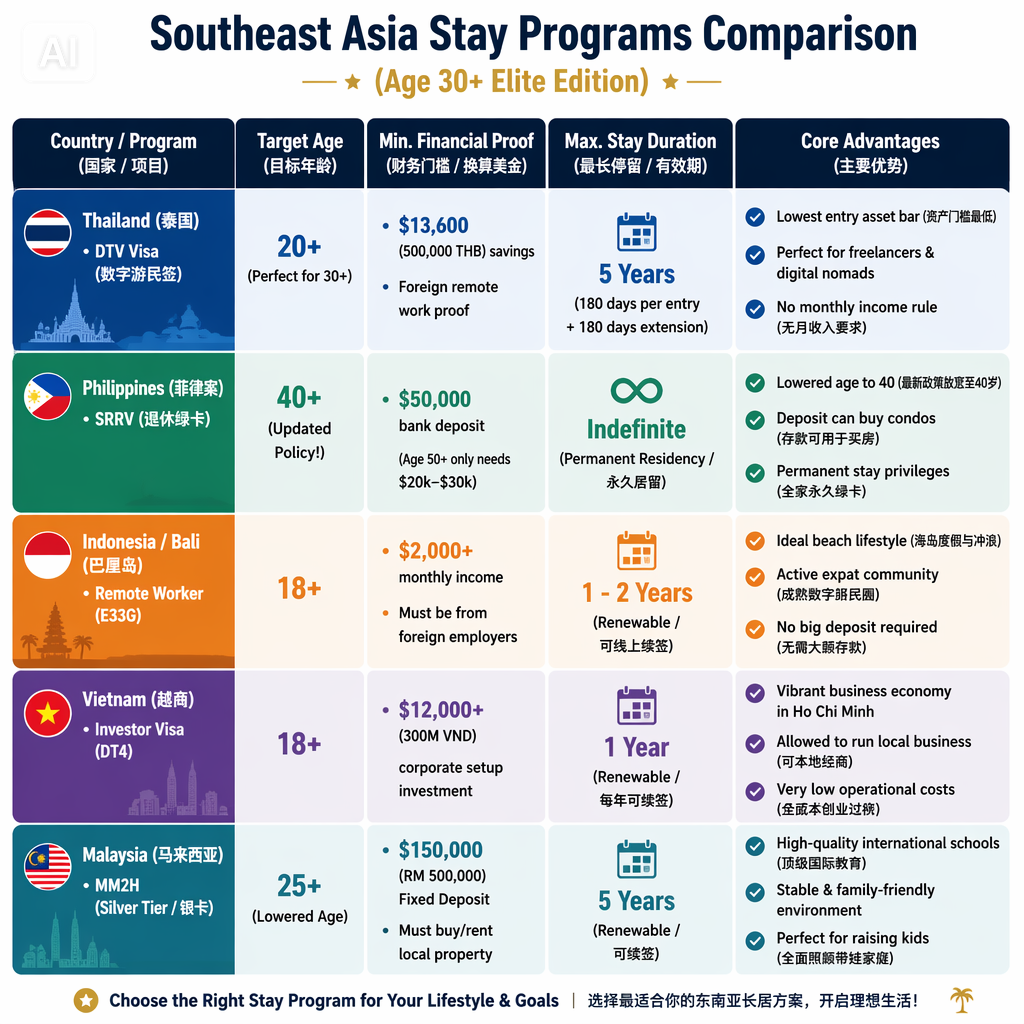
    If you are looking at Southeast Asia seriously, there are several possible directions. The Philippines has SRRV, which some people consider for longer-term residence planning. Indonesia, especially Bali, continues to attract remote workers who care more about lifestyle and creative energy. Ho Chi Minh City makes sense for people who want a fast-moving city at a lower cost. Malaysia also deserves attention if you value structure, convenience, and a more balanced living environment.

    So no, Thailand is not the only choice.

    But if someone asked me where I would begin the research, especially as a first serious transition strategy during the US EW3 wait, I would still say Thailand DTV.
    Why?

    Because right now it feels like one of the easiest options to understand, one of the most practical to imagine living with, and one of the most natural fits for people who are already used to working online, living internationally, or designing their life with more flexibility.

    I will write about the Philippines, Bali, Vietnam, and Malaysia separately. They all deserve their own space.

    But this is the first one I would recommend exploring.

    Why Thailand DTV stands out to me

    1. It gives the kind of time flexibility that actually matches real life

    A short-stay visa can be useful for a break. It is much less useful when you are trying to build stability during a long immigration wait.

    One reason Thailand DTV gets so much attention is that it offers a level of time flexibility that feels more compatible with real life. Based on current public information, it is commonly understood as a 5-year visa with 180-day stays, along with the ability to extend under the current rules.

    That matters because people waiting on US EW3 are not usually looking for a two-month escape. They are trying to think in years, not weeks.

    When the timeline in the background is uncertain, longer visa flexibility changes the emotional equation. It lets you stop thinking like a tourist and start thinking like someone building a temporary but stable chapter of life.

    That shift is bigger than it sounds.

    2. It fits people who already earn in a borderless way

    I think Thailand makes the most sense for a certain kind of person.

    Not everyone, but a specific kind of person.

    Someone who already works remotely.
    Someone who freelances, runs a small website, operates an online business, creates content, consults, or earns from digital work that is not tied to one country.
    Someone who does not need a local office to feel productive.

    For that kind of person, Thailand can be very workable.

    Bangkok has the pace, convenience, and infrastructure to support a serious routine. Chiang Mai offers a softer rhythm and is still deeply familiar with remote-worker life. Even outside the major hubs, the country is relatively easy to navigate if you want a setup that feels efficient without being emotionally heavy.

    That is one of the reasons I keep coming back to it in my own thinking.

    You are not just buying time.
    You are protecting continuity.

    And continuity matters a lot when the immigration process itself offers so little control.

    3. It allows waiting to feel like living, not just surviving

    This may be the most important point, and it has less to do with immigration mechanics than with quality of life.

    A lot of people underestimate how draining it is to stay in a place that no longer fits you, just because you are afraid to make a move before the next stage of your plan is confirmed.

    I understand that fear. It sounds rational. But it can become expensive in ways that are hard to measure.

    Expensive emotionally.
    Expensive creatively.
    Expensive in lost momentum.

    Thailand appeals to many people because it creates the possibility of a life that still feels open while you wait.

    You can work.
    You can reset.
    You can keep your expenses under control.
    You can build better habits.
    You can have sunlight, routine, affordability, and movement instead of living in a holding pattern.

    To me, that is the real attraction.

    Thailand DTV is not just a visa idea. It is a way to stop treating waiting as wasted life.

    Why I think so many people still use agencies or consultants

    A question that comes up often is whether Thailand DTV should be handled independently or with professional help.

    In theory, many people can research a visa process themselves. In practice, a lot of applicants still prefer some form of agency or consultant support.

    That does not surprise me.

    Most people are not looking for drama. They are looking for clarity.

    They want to understand what route makes sense for their background.
    They want the process to feel organized.
    They want fewer moving parts and less unnecessary stress.
    And if they are already living abroad, changing countries, or managing an income stream online, they may simply not want to spend weeks trying to decode every procedural detail alone.

    I think that is a very human reaction.

    For someone waiting on US EW3, the deeper issue is usually not “How do I file one visa?” It is “How do I create a smoother next few years?”

    And once you frame the problem that way, it makes sense that many people want some help.

    If I were choosing help, I would care less about hype and more about fit

    If someone is considering an agency or consultant, I do not think the right question is, “Who sounds the most confident?”

    I think the better question is:

    Who seems to understand my real life, not just the visa headline?

    The right support should make the process feel clearer, not louder.

    For me, the useful signals would be simple.

    Do they understand how you actually make money?
    Do they understand why Thailand fits your current season of life?
    Do they explain the process in a way that reduces confusion instead of creating dependency?
    Do they seem focused on helping you build something workable, not just something marketable?

    That kind of clarity matters.

    Not because everything has to be perfect.
    But because the entire point of a waiting strategy is to reduce friction, not add more of it.

    Who I think should seriously consider Thailand DTV during the US EW3 wait

    Not everyone waiting on US EW3 needs a Thailand plan.

    But I do think Thailand DTV becomes especially attractive if you are someone who:

    • already has stable remote or online income
    • is comfortable living outside your home country
    • values flexibility more than fixed location
    • wants to reduce pressure during a long immigration queue
    • prefers to keep life moving instead of sitting still
    • sees the next 1 to 5 years as something to be designed, not merely endured

    If that sounds like you, Thailand may not just be interesting. It may actually be useful.

    And in a long immigration process, useful beats exciting every time.

    The most mature strategy is not to obsess over the queue. It is to build a life that can hold the queue.

    This is probably the simplest way I can say it.

    A lot of people wait for immigration timelines the same way they wait for a delayed flight. They stay mentally frozen, believing movement will begin only when the system changes.

    But the US EW3 process does not always move like a delayed flight. Sometimes it moves like weather. Slowly. Unevenly. Outside your control.

    That is why I think the healthier question is not, “When will this finally move?”

    It is:

    If this takes much longer than I hoped, do I still have a way to live well?

    That is the question Thailand DTV helps answer for some people.

    Not because it solves immigration.
    Not because it replaces a final destination.
    But because it gives structure to the in-between.

    And if you have lived abroad long enough, you learn that the in-between is not a minor detail.
    It is a large part of life.

    Final thoughts

    If you are already deep enough into the US EW3 process to realize the first stage may take far longer than expected, then this may be the right time to think beyond paperwork and start thinking about lifestyle design.

    Thailand DTV is not the only path in Southeast Asia, and I would never frame it that way. The Philippines, Bali, Ho Chi Minh City, and Malaysia all deserve serious attention depending on who you are and how you want to live.

    But if you want one option to start with, one place to begin the conversation, one practical route that feels both realistic and livable, I would start with Thailand.

    Not because it is trendy.
    Not because it is magical.
    But because for the right person, it offers something very valuable:

    a way to keep living well while waiting for a slow system to catch up.

    That, to me, is not avoidance.
    It is strategy.

    FAQ

    Is Thailand DTV the only good option while waiting for US EW3?

    No. It is one of several Southeast Asia options worth researching. The right choice depends on your income, preferred lifestyle, long-term plan, and budget.

    Why do you recommend Thailand first?

    Because it combines practical visa flexibility, digital nomad compatibility, strong day-to-day infrastructure, and a lifestyle many international workers can imagine sustaining.

    What about the Philippines SRRV, Bali, Vietnam, or Malaysia?

    All of them may work depending on your needs. I see them as parallel options, not inferior ones. Thailand is simply the first one I would explain in detail.

    Is this a legal recommendation?

    No. This is a personal strategy perspective based on lifestyle fit, public information, and long-term planning logic. Anyone making a visa decision should review current official requirements directly.

    Related Reading: Check out my comprehensive guide on the EW3 Visa Timeline to plan your green card stages.

  • My Personal PERM Timeline: 3 Critical Risks to Avoid

    💡 风险控制者的清醒独白: 移民从来不是一场押注运气的豪赌,而是一场精确到月份的风险管理。

    Many agencies will tell you that tracking your PERM timeline and the US EW3 (Unskilled EB-3) visa process is just a game of “pay the fee and wait blindly.” However, as a 36-year-old single woman with 12 years of cross-border living experience, I treat immigration differently.

    I chose the United States after turning 35 because I value its inclusive, diverse environment. More importantly, it offers an escape from the “35-year-old career deadline” and the intense workplace anxiety back home. (摆脱国内“35岁即失业”的年龄天花板与职场焦虑). In a system where hard work and a drive to improve still unlock decent opportunities, time becomes your ally, not your enemy.

    Today, I am sharing my live U.S. Department of Labor (DOL) case status. No marketing fluff, just the cold, hard reality of the first stage (PERM) in 2026.

    My Live Data and Personal PERM Timeline

    📌 实时一手数据(拒绝中介画饼)

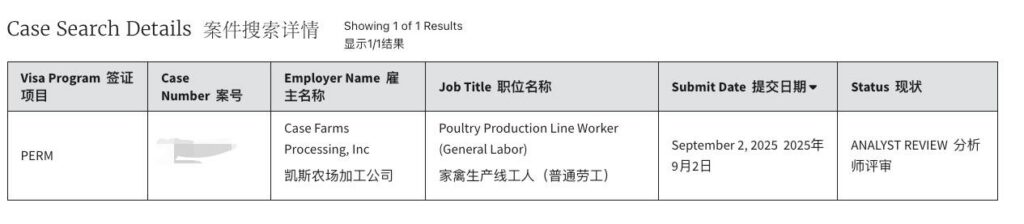
    Below is a verified screenshot from my account on the Department of Labor system (case number redacted for privacy):

    My Personal PERM Timeline Screenshot
    • Visa Program: PERM (EB-3 Unskilled / Other Workers)
    • My Priority Date (PD): September 2, 2025 (2025年9月2日优先日)
    • Verified Employer: Case Farms Processing, Inc. (大名鼎鼎的凯斯农场)
    • Job Title: Poultry Production Line Worker
    • Current Status: ANALYST REVIEW (分析师评审中)

    2. A Risk Controller’s Logic: Why I Chose Case Farms

    🎯 为什么是凯斯农场?因为我拿到了朋友全家在2024年12月顺利拿到绿卡的“通关铁证”。

    With so many EW3 employers on the market—ranging from fast-food chains to cleaning companies—why did I lock in Case Farms? Because I had the strongest risk-control evidence possible: A real, successful closing loop from a close friend.

    This real-life success story validated two critical risk factors for me:

    • Genuine Labor Demand (真实的用工需求): The fact that my friend received their green cards and started working proves that this enterprise has a long-term, real shortage of labor. This directly lowers the legal risk of the DOL questioning the job’s legitimacy.
    • Employer Stability (雇主财务存活率): A massive, financially stable enterprise like Case Farms drastically reduces the risk of the project collapsing halfway through due to employer failure.

    3. Slicing Through the Noise: PERM Times in 2026

    ⚠️ 撕开 2026 年的 PERM 实时真相:周期已毫无悬念拉长到 10 个月以上。

    Standard internet guides and generic AI articles still claim: “The PERM stage usually takes 6 to 10 months.” I am sorry, but that is outdated data.

    Let’s look at the live reality: My Priority Date is September 2, 2025. As I write this in mid-2026, my case is still sitting in ANALYST REVIEW.

    Any promises of a “guaranteed approval within 6 months” shatter when facing real data. When planning our lives and overseas asset allocations, we must build this timeline buffer strictly into our equations.

    4. Navigating a Long Wait at 36: My Personal Risk Management

    🕊️ 36岁,未婚未育,一个人等排期的风控法则。

    At 36, without the immediate ties of a marriage or the anxieties of raising children, this “single and free” status has actually become my strongest fortress during this marathon.

    • Refusing to Put Life on “Pause” (生活拒绝按下暂停键): Many applicants hit a standstill after filing, checking their status daily with severe anxiety. Instead, I continue living, working, and exploring overseas (currently in Southeast Asia) as a digital nomad.
    • Beating the 35-Year-Old Career Ceiling (用时间换空间): While many face immense pressure due to age discrimination in domestic job markets, knowing that the US system rewards ambition at any age provides a certainty that mutes all the waiting anxiety.
    • Building a Financial Firewall (构建资产的防火墙): Throughout the PERM waiting period, maintaining a strong, liquid overseas financial line ensures that no matter how policies shift, I always have the freedom to pivot.

    Conclusion

    My EW3 journey has just opened its first chapter. This tracker page will continuously update as my case progresses—whether it moves smoothly or hits an unexpected Audit.

    In this long marathon, we do not lean on luck. Welcome to watch how I manage these risks to the very end.

    Related Reading: Check out the full EW3 Visa Timeline to plan your next immigration stages.

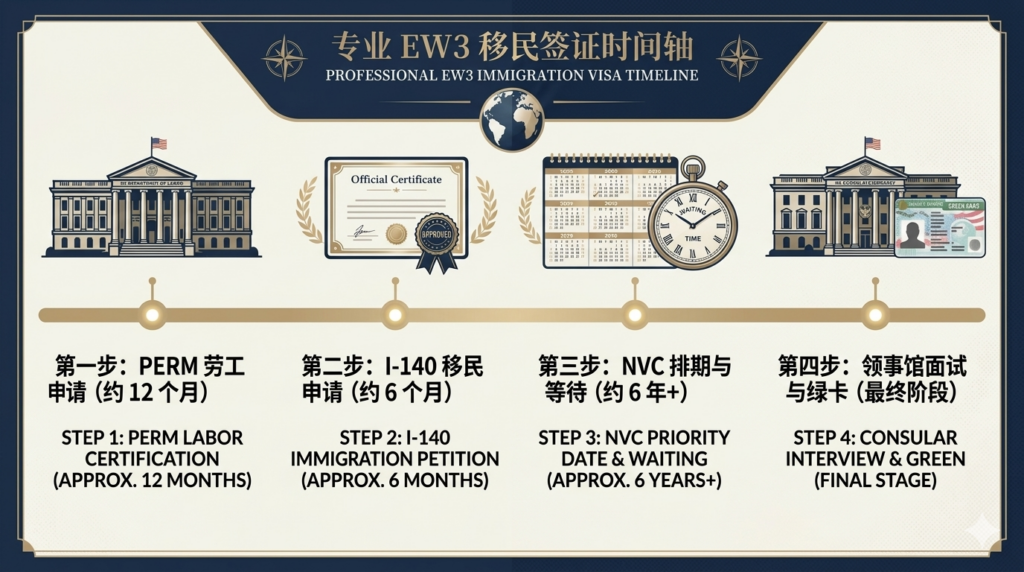
  • EW3 Visa Timeline: What to Expect at Every Stage

    EW3 Visa Timeline Guide

    The EW3 visa, also known as EB-3 Other Workers, offers a path to permanent residency for individuals performing unskilled labor that requires less than two years of training or experience. Understanding the EW3 Visa Timeline—from employer sponsorship through final green card approval—helps applicants set realistic expectations and reduce anxiety during what can be a multi-year journey. This guide breaks down each phase, typical wait times, and critical compliance considerations.

    What Is EW3 / EB-3 Other Workers?

    The EB-3 Other Workers category is a permanent employment-based visa for positions that do not require advanced education or specialized skills. To qualify, the job must be full-time, permanent, and the employer must demonstrate that no qualified U.S. workers are available. This category has historically faced significant backlogs due to high demand and annual numerical limits, making timeline awareness essential for anyone considering this path.

    Step 1: Initiating the EW3 Visa Timeline with PERM

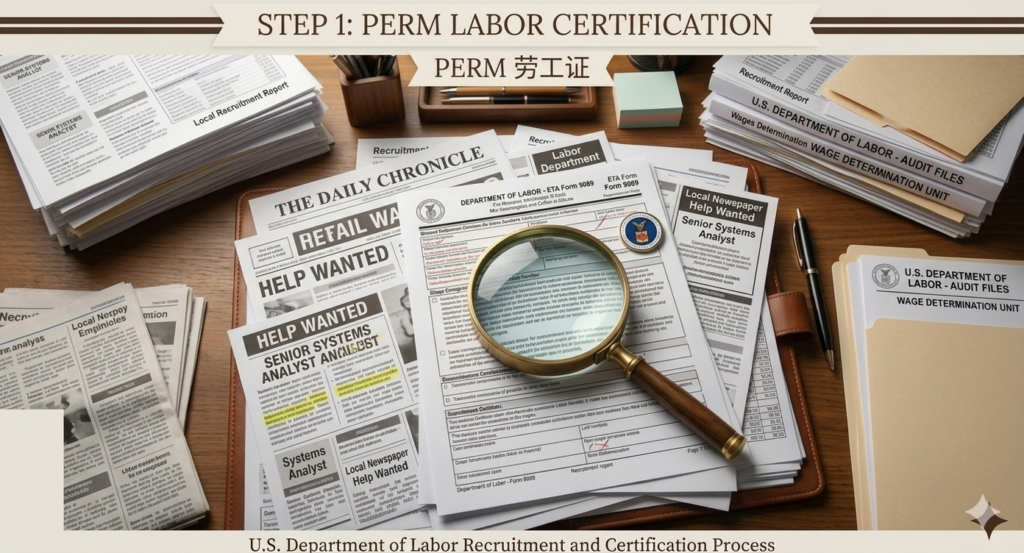
    The PERM (Program Electronic Review Management) labor certification is the foundation of the EW3 process. Your U.S. employer must obtain this certification from the Department of Labor (DOL) to prove that hiring a foreign worker will not adversely affect U.S. workers.

    During this phase, the employer conducts a supervised recruitment campaign, including newspaper advertisements and other required steps, to test the labor market. The DOL then reviews the application for compliance with recruitment and wage requirements.

    Processing times for PERM labor certification have varied considerably. Historically, adjudication has ranged from several months to over a year, depending on DOL workload, whether the case is selected for audit, and the complexity of the employer’s recruitment efforts. Audit requests can add substantial delays. Employers should ensure strict adherence to all recruitment documentation requirements to minimize risk of denial or extended processing.


    🔍 Real-Life Snapshot: Want to see how long the PERM stage actually takes right now? Check out my live data here: My Personal PERM Case Study.

    Step 2: Filing the I-140 Petition

    Once PERM certification is approved, the employer files Form I-140, Immigrant Petition for Alien Worker, with U.S. Citizenship and Immigration Services (USCIS). This petition establishes that the employer has the ability to pay the offered wage and that the beneficiary meets the job requirements.

    USCIS offers optional Premium Processing for certain I-140 categories, though availability for EB-3 Other Workers has been limited or unavailable at various times. Standard processing times have fluctuated based on service center workload and policy changes. Applicants should verify current processing estimates through official USCIS resources, as these figures change periodically.

    Step 3: Priority Dates and the Visa Bulletin

    After I-140 approval, the critical factor becomes the priority date—the date when the PERM labor certification was filed. This date determines the applicant’s place in line for an immigrant visa number.

    The Department of State publishes a monthly Visa Bulletin showing which priority dates are currently eligible for visa issuance. The EB-3 Other Workers category often experiences substantial retrogression and backlogs, particularly for applicants from countries with high demand such as Mexico, the Philippines, and others. Waiting periods in this step can extend from several years to well over a decade in some cases, depending on country of chargeability and overall visa availability.

    Applicants must monitor the Visa Bulletin monthly, as dates can advance, stall, or even move backward (retrogress). The timeline for this stage is unpredictable and varies significantly by individual circumstances.

    Tracking these monthly updates is vital to project your total EW3 Visa Timeline.

    Step 4: Consular Processing or Adjustment of Status

    When a priority date becomes current according to the Visa Bulletin, the applicant may proceed to final green card processing. Those outside the United States typically use consular processing at a U.S. embassy or consulate abroad, while those lawfully present in the U.S. may be eligible to file Form I-485 for adjustment of status.

    Consular processing involves National Visa Center (NVC) document collection, fee payments, medical examination, and a visa interview. Adjustment of status processing includes biometrics, potential interview scheduling, and background checks. Processing times for both pathways vary by location, case volume, and individual circumstances. Applicants should consult current official estimates, as these timeframes shift regularly.

    Common Compliance Risks

    Several compliance issues can derail or delay EW3 applications. Employers must maintain accurate recruitment records and be prepared for potential DOL audits. Job requirements listed in the PERM application must genuinely reflect the position and cannot be tailored to the foreign worker’s qualifications.

    Applicants should avoid unauthorized work, overstaying visas, or other immigration violations that could trigger inadmissibility bars. Material misrepresentation at any stage can result in permanent consequences. Additionally, employer financial instability or failure to demonstrate ability to pay the offered wage can lead to I-140 denials.

    Changes in employment during the process require careful evaluation, as portability rules have limitations. Working with experienced immigration counsel helps identify and mitigate these risks proactively.

    Key Takeaways

    • The EW3 visa process involves multiple stages: PERM labor certification, I-140 petition, priority date waiting, and final green card processing.
    • Total timelines can extend many years, primarily due to visa backlogs in the EB-3 Other Workers category.
    • PERM processing and I-140 adjudication times vary; verify current estimates through official DOL and USCIS sources.
    • Priority date movement is unpredictable and depends on country of chargeability and annual visa limits published in the monthly Visa Bulletin.
    • Strict compliance at every stage protects against denials, delays, and long-term immigration consequences.
    • Always prepare for adjustments along the EW3 Visa Timeline.

    Frequently Asked Questions

    How long does the entire EW3 process typically take?

    Total processing time varies substantially based on priority date backlogs, which can range from a few years to over a decade for certain countries. The PERM and I-140 stages add additional months or years. Individual circumstances significantly affect overall timelines.

    Can I work in the U.S. while waiting for my EW3 priority date to become current?

    The EW3 petition itself does not grant work authorization. Applicants must maintain independent valid nonimmigrant status or obtain separate work authorization through other means. Unauthorized employment can create serious immigration complications.

    What happens if my employer goes out of business during the process?

    A new employer generally cannot substitute for the original petitioner in most PERM-based cases. If the I-140 has been approved for 180 days or more and a visa number is available, you may benefit from job portability provisions under certain conditions. Otherwise, the process typically must restart with a new employer.

    Does Premium Processing shorten the overall EW3 timeline?

    Premium Processing, when available for I-140 petitions, expedites USCIS adjudication to 15 calendar days. However, it does not affect PERM processing times or priority date waiting periods, which constitute the longest portions of the EW3 timeline for most applicants.

    Can my family members immigrate with me through the EW3 category?

    Yes, a principal EW3 beneficiary’s spouse and unmarried children under 21 may be included as derivative beneficiaries. They receive the same priority date and must also wait for visa numbers to become available before completing their own immigration processing.

    Disclaimer

    This article is for general informational purposes only and does not constitute legal advice. Immigration laws, government procedures, visa bulletin dates, and processing times may change. Readers should verify information with official sources or consult a qualified immigration attorney.

  • US EW3 Big Data Tracker: Real-Time Official DOL PERM Insights (2026)

    📊 Official Source: Data live-parsed directly from the U.S. Department of Labor (DOL) Official Platform.

    📅 Last Updated: May 31, 2026

    Many immigration agencies rely on outdated, static brochures to tell you how long the PERM stage takes. As a Risk Controller, I believe only in hard, cold, official data. Below is the real-time processing status of the U.S. Department of Labor, fully cleaned and analyzed for 2026 applicants.

    1. Current Official DOL PERM Metrics (实时官方指标看板)

    Processing Queue (审理队列)Current Filing Month Under Review (当前正在审理)Average Processing Time
    (官方平均周期)
    Risk Status (风控状态)
    Analyst Review (普通件)April 2025 (20254)501 Days (~16.48 Months)⚠️ Severe Backlog (积压拉长)
    Audit Review (审计件)November 2025
    (2025年11月)
    343 Days (~11.28 Months)🛑 Applies only if audited

    Note: While the Audit queue shows November 2025, this timeline ONLY applies if your case is unluckily selected for an audit. It cannot be used to measure regular case progress.

    2. Timeline Predictions for 2025/2026 Applicants (大趋势理性预测)

    Based on linear regression of the current DOL workflow backlog, if your Priority Date (PD) falls in late 2025 or early 2026, here is the scientific expectation:

    • The 16-Month Reality Check: The official regular processing window has undeniably breached the 16-month mark. Any marketing claims promising a “6-to-8 month labor card approval” are statistically false in 2026.
    • My Case Study Alignment: My personal Priority Date is September 2, 2025. With DOL currently reviewing April 2025, there is a 6-month gap remaining. (9th Month – 3rd Month). I mathematically expect my Analyst Review to be initiated around late 2026.

    3. Risk Controller’s Insight: How to Handle the Wait

    💡 风险控制者的理性思考:焦虑不可怕,可怕的是只有焦虑,没有解法。

    Entering mid-life often brings a compounding stack of anxieties—career ceilings, family stability, and future planning. Facing a 16+ month wait for just the first stage of a US immigration journey can drive many into a spiral of panic.

    My risk management playbook for this waiting period is simple: Never put your life on pause.

    Use this extended timeline to build asset firewalls, explore borderless income, and live actively (as I do now, nomading through Southeast Asia). In a system that eventually rewards upward mobility and hard work regardless of your age, time is a tool to be managed, not an enemy to fear.

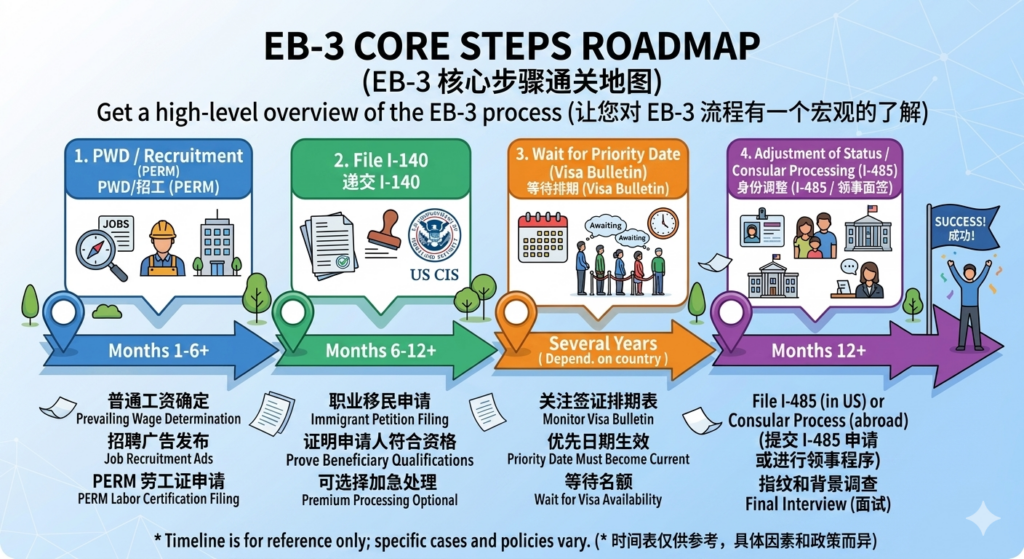
  • EB-3 Employer Immigration Process Guide 2026

    The EB-3 employment-based immigrant visa remains one of the most widely used pathways for foreign nationals seeking lawful permanent residence in the United States through employer sponsorship. Covering skilled workers, professionals, and other workers, the EB-3 category offers opportunities across a broad range of industries and skill levels. However, the process involves multiple government agencies—the Department of Labor, USCIS, the National Visa Center, and U.S. consulates abroad—each with its own compliance requirements. Because immigration policies, visa bulletin dates, and processing timelines are subject to frequent change, applicants and employers must stay informed and plan carefully. This guide walks through the essential stages of the EB-3 process, outlines key qualifications, highlights common risks, and explains what to expect in 2026. Readers should always verify current procedures with official government sources or consult a qualified immigration attorney before taking action.

    What Is EW3 / EB-3 Other Workers?

    The EB-3 visa is the third preference category for employment-based immigration to the United States. It is designed for foreign workers who have a valid, permanent, full-time job offer from a U.S. employer. Unlike the EB-1 or EB-2 categories, which target individuals with extraordinary ability or advanced degrees, EB-3 casts a wider net. It is divided into three distinct subcategories, each with its own educational and experiential threshold.

    The first subcategory is Skilled Workers. These are positions that require at least two years of job experience, specialized training, or post-secondary education that is relevant to the offered role. The training or experience cannot be of a seasonal or temporary nature, and the foreign worker must meet all job requirements at the time the petition is filed. Common examples include technical support specialists, electricians, and certain manufacturing supervisors.

    The second subcategory is Professionals. This group is limited to occupations that require a U.S. baccalaureate degree or its foreign equivalent as a minimum entry requirement. The beneficiary must possess the degree, and in most cases, experience cannot be substituted for the educational requirement. Typical roles include accountants, engineers, teachers, and registered nurses, provided that a bachelor’s degree is the normal minimum requirement for the position.

    The third subcategory is Other Workers, often referred to as EW3. This classification covers positions that require less than two years of training or experience. It is generally associated with unskilled or semi-skilled labor, such as certain positions in hospitality, agriculture, landscaping, or food processing. While the eligibility bar for the worker is lower, the demand for visas in this category often exceeds the annual supply, which can result in longer waits due to per-country visa limits.

    For applicants, the baseline requirements are straightforward but strict. There is no formal age limit or English-language test for EB-3, but the beneficiary must meet the specific qualifications of the offered job. Skilled workers need documented proof of their experience or training. Professionals need an academic credential evaluation if their degree was earned outside the United States. All applicants must be admissible to the United States, meaning they must pass background checks and medical examinations and cannot be subject to grounds of inadmissibility.

    The sponsoring employer also faces significant obligations. The company must be a legitimate, tax-paying U.S. entity with a valid Federal Employer Identification Number. It must demonstrate that the job offer is for a permanent, full-time position that is bona fide and not created solely for immigration purposes. Crucially, the employer must prove its financial ability to pay the offered wage from the date the labor certification is filed and continuing through the beneficiary’s acquisition of permanent residence. This is typically shown through federal tax returns, audited financial statements, or payroll records. Employers must also remain in compliance with all Department of Labor recruitment and prevailing wage regulations, which are examined closely during the PERM process.

    It is important to understand that the EB-3 category is intended for permanent positions only. The employer must demonstrate that the job is not temporary or seasonal in nature. This distinguishes EB-3 from nonimmigrant visa programs such as the H-2B, which covers temporary labor needs. A permanent job offer means the employer expects to employ the worker indefinitely, without a predetermined end date, although the worker may leave or the position may be eliminated under standard business conditions.

    Step 1: PERM Labor Certification

    Before USCIS will consider an EB-3 petition, the U.S. employer must obtain a permanent labor certification from the U.S. Department of Labor. This process, commonly known as PERM, is intended to ensure that hiring a foreign worker will not adversely affect the wages and working conditions of similarly employed U.S. workers. The PERM process is often the longest and most document-intensive phase of the EB-3 journey.

    Prevailing Wage Determination

    The first substantive action is obtaining a Prevailing Wage Determination from the DOL’s National Prevailing Wage Center. The employer submits details about the job, including its title, duties, requirements, and worksite location. The DOL then issues a prevailing wage that reflects the average wage paid to similarly employed workers in the specific geographic area. The employer must agree to pay the foreign worker at least this wage from the moment the individual begins work under the green card. Processing times for prevailing wage requests vary and can change based on DOL workload; employers should consult the official DOL processing times webpage for the most current estimates.

    Recruitment and Labor Market Testing

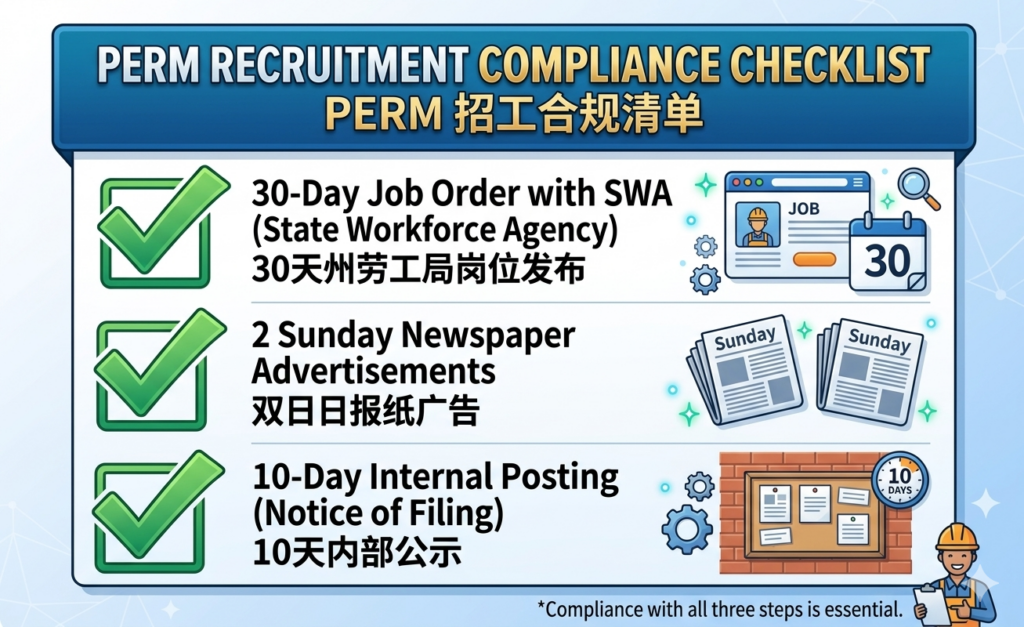
    Once the wage is confirmed, the employer must conduct a good-faith recruitment campaign to test the U.S. labor market. For non-professional positions, this generally includes placing a job order with the State Workforce Agency for thirty days, running two print advertisements on separate Sundays in a newspaper of general circulation in the area of intended employment, and posting an internal notice of the job opening for ten consecutive business days. Professional positions require three additional recruitment steps, which may include employer website postings, job search website advertisements, on-campus recruiting, or trade journal ads.

    The employer must interview any applicants who appear minimally qualified and must document lawful, job-related reasons for rejecting them. Recruitment records, including resumes and interview notes, must be retained for five years because they may be reviewed in the event of a DOL audit. It is critical that the job requirements listed in the recruitment phase match exactly with those later stated on the ETA-9089 application. Tailoring requirements to fit the foreign worker’s unique background is a common reason for denial.

    Filing ETA-9089 and DOL Review

    After the recruitment period concludes and no willing and qualified U.S. worker has been found, the employer files ETA Form 9089 electronically with the DOL. This form details the job duties, minimum requirements, offered wage, and beneficiary information. The DOL may certify the application, deny it, or select it for audit. There is no premium processing for PERM. Regular processing times fluctuate and depend heavily on DOL staffing and caseloads. If an audit is issued, the employer has a limited timeframe to respond with additional documentation, and the review timeline extends significantly. Employers and applicants should verify current PERM processing statistics through official DOL channels.

    Step 2: Filing the I-140 Petition

    With an approved labor certification in hand, the employer moves to the second major phase by filing Form I-140, Immigrant Petition for Alien Worker, with U.S. Citizenship and Immigration Services. The I-140 establishes that the beneficiary meets the job requirements and that the employer has the ability to pay the offered wage.

    USCIS requires substantial evidence. The petition must include the certified PERM, proof of the beneficiary’s qualifications such as diplomas or experience letters, and detailed documentation of the employer’s financial health. To satisfy the ability-to-pay requirement, the employer typically must submit one or more of the following core documents:

    • Federal corporate tax returns (企业联邦税表)
    • Audited financial statements (审计财务报表)
    • Payroll records (工资单记录)

    These documents must show that the company’s net income, net current assets, or the actual wage paid to the beneficiary meets or exceeds the proffered wage from the date the PERM was filed.

    USCIS adjudicators look at the totality of the circumstances when assessing ability to pay. A company that shows a net loss on its tax return may still qualify if it has substantial net current assets or if the beneficiary is already on payroll and earning the proffered wage. Conversely, a profitable company that pays its owners excessive distributions might face scrutiny if the remaining assets appear insufficient to cover the new wage. Clear, organized financial documentation presented at the I-140 stage prevents costly requests for evidence.

    USCIS processing times for I-140 petitions vary by service center and are updated periodically on the USCIS website. In some instances, premium processing may be available for an additional fee, offering a faster adjudication timeframe for certain petitions. However, availability and eligible categories can change, so petitioners should confirm current premium processing rules directly with USCIS. If the I-140 is approved, the beneficiary’s priority date is locked in, and the case moves to the visa availability stage.

    Step 3: Priority Dates and the Visa Bulletin

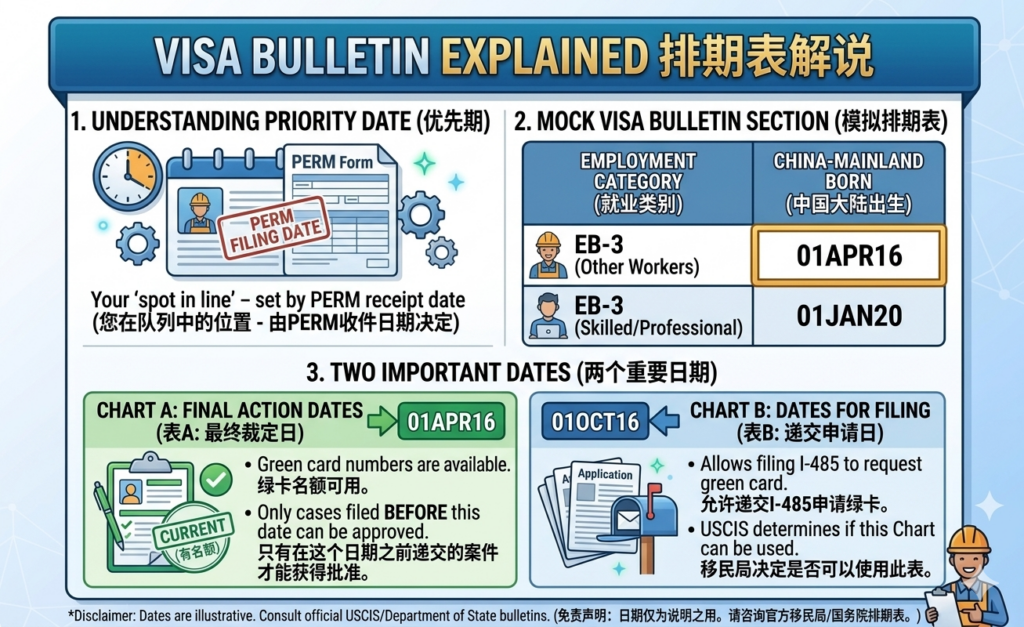
    In employment-based immigration, the priority date is typically the date the PERM labor certification was filed with the Department of Labor. This date determines the beneficiary’s place in line for an immigrant visa number. Because Congress sets annual limits on employment-based green cards and imposes per-country caps, demand from high-volume countries often exceeds supply, creating backlogs.

    Every month, the U.S. Department of State publishes the Visa Bulletin, which lists cutoff dates for each preference category and country of chargeability. For EB-3 applicants, it is essential to monitor both the employment-based third preference columns and, for EW3, the separate “Other Workers” column, which often moves more slowly. When a beneficiary’s priority date is earlier than the cutoff date listed in the Visa Bulletin, a visa number becomes available, and the case can proceed to final processing.

    Visa bulletin dates can advance steadily, stall for months, or retrogress backward if demand spikes. Because these movements are unpredictable and tied to global visa demand, applicants should avoid making irreversible life decisions based on assumed forward progress. Checking the official Visa Bulletin each month and consulting with legal counsel when a date becomes current is the safest approach.

    Applicants should also understand the concept of cross-chargeability. In some cases, a beneficiary may use their spouse’s country of birth for visa bulletin purposes if that country has a more favorable cutoff date.

    👉 Chart A vs. Chart B (Understanding the Visa Bulletin Charts)

    Additionally, the Visa Bulletin publishes two charts each month:

    • Final Action Dates (Chart A): Determines when an immigrant visa or adjustment of status may receive final approval.
    • Dates for Filing (Chart B): Indicates when applicants can begin submitting documents to the National Visa Center or file an Form I-485.

    Knowing which chart USCIS will honor for I-485 filing each month is critical, and USCIS typically announces this on its website around the time the Visa Bulletin is released.

    Step 4: Consular Processing or Adjustment of Status

    Once the priority date is current, the final stage of the EB-3 process begins. The path forward depends entirely on whether the beneficiary is inside the United States or abroad.

    📍 Path A: Consular Processing (海外领事面签)

    For beneficiaries residing overseas, the case is transferred to the National Visa Center (NVC).

    • The NVC Process: The NVC collects immigrant visa fees, civil documents, and the DS-260 immigrant visa application.
    • The Interview: After processing, the NVC schedules an interview at the U.S. consulate in the beneficiary’s home country (or a designated third-country post if eligible).
    • Requirements: The beneficiary must complete a medical examination with an authorized panel physician and bring original documents to the interview. Consular officers will assess admissibility, verify the job offer, and confirm that the beneficiary is not likely to become a public charge. Interview wait times vary significantly by post and should be verified through the State Department’s official resources.

    📍 Path B: Adjustment of Status (美国境内转身份)

    For beneficiaries already in the United States in a valid nonimmigrant status, Adjustment of Status through Form I-485 may be an option if the priority date is current.

    • Filing: In some cases, when the Visa Bulletin shows a current date, the I-485 can be filed concurrently with the I-140, though retrogression often prevents this for many EB-3 categories.
    • The AOS Process: This involves biometrics collection, background checks, and potentially an interview at a local USCIS field office. Applicants may also apply for employment authorization and advance parole while the I-485 is pending. Processing times for I-485 cases differ by jurisdiction and are posted on the USCIS website.

    Crucial Admissibility Considerations

    During consular processing, employment-based immigrant visa applicants must demonstrate that they are not likely to become a public charge. Although the I-140 petition and the employer’s ability to pay normally satisfy this concern, consular officers retain discretion to request additional evidence of financial support. Applicants with significant health issues or criminal histories should address these matters before the interview.

    For adjustment of status applicants, maintaining lawful nonimmigrant status up to the time of filing is highly advantageous, although certain provisions may protect those who fall out of status briefly depending on their circumstances. Unauthorized employment or status violations can create serious complications, so applicants should seek legal guidance before any status changes.


    ⚠️Common Compliance Risks

    The EB-3 pathway is fraught with procedural traps that can delay or derail a case. Awareness of these risks allows both employers and employees to plan defensively.

    PERM Audits (劳工证审计风险)

    The Department of Labor can audit a PERM application randomly or for cause. A supervised recruitment audit requires the employer to conduct all recruitment under DOL oversight, which is time-consuming and expensive. More commonly, a request for evidence asks the employer to produce recruitment reports, business necessity justifications for job requirements, or proof of the company’s existence. Inconsistent information between the job posting and the ETA-9089 is a leading trigger for denial. Employers should treat every recruitment step with documentary precision.

    Employer Instability (雇主稳定性风险)

    If the sponsoring employer goes out of business, is sold in an asset purchase, or withdraws the I-140 before it is approved, the petition is generally abandoned. After the I-140 has been approved and the I-485 has been pending for at least one hundred eighty days, AC21 portability may allow the beneficiary to move to a new employer in a same or similar occupation. However, before that milestone, the employee is largely bound to the original sponsor. Due diligence on the employer’s financial stability is therefore not just advisable—it is essential.

    Priority Date Retrogression (排期倒退风险)

    Even after I-140 approval, a beneficiary’s priority date can retrogress, pushing the final green card interview months or years into the future. This is especially common in oversubscribed categories like EW3. During prolonged waits, dependent children may age out of derivative status. While the Child Status Protection Act can preserve a child’s age in certain circumstances, the calculations are complex and should be reviewed by an attorney.

    Job Requirement Inflation (职位要求过高风险)

    Employers sometimes inadvertently list requirements that are more stringent than normal for the occupation, inviting scrutiny. Conversely, requirements that appear tailored to the foreign worker’s exact resume raise red flags. The job description must reflect the actual, minimum requirements for the position in the standard labor market.

    Illegal Financial Arrangements (非法资金往来风险)

    Finally, both parties must avoid any arrangement in which the employee pays the employer for the labor certification or otherwise compensates the company for sponsorship. Such payments violate DOL regulations and can result in permanent denial of the labor certification and potential fraud findings. The entire process must be conducted in good faith, with the employer genuinely seeking a worker for a real job and the employee honestly intending to accept the position upon approval.

    Key Takeaways

    • EB-3 immigration requires a legitimate, permanent job offer from a U.S. employer that is financially capable of paying the prevailing wage throughout the process.
    • The PERM labor certification is a high-stakes phase where strict adherence to recruitment rules, prevailing wage standards, and documentation retention can make or break the case.
    • Approval of the I-140 petition does not guarantee immediate permanent residence; visa bulletin priority dates and per-country limits often dictate the real timeline.
    • Employer continuity is critical until the I-140 is approved and, ideally, until the I-485 has been pending for one hundred eighty days to preserve portability options.
    • Immigration procedures, government fees, and processing timelines change frequently; always verify the latest information through official DOL, USCIS, and State Department channels.

    Frequently Asked Questions

    What are the basic applicant requirements for EB-3 in 2026?

    EB-3 applicants must have a permanent, full-time job offer from a U.S. employer. Skilled workers need at least two years of relevant experience or training. Professionals must hold a U.S. bachelor’s degree or foreign equivalent. Other workers must perform unskilled labor requiring less than two years of training. All applicants must be admissible to the United States and meet the specific qualifications of the offered position.

    Can any U.S. employer sponsor an EB-3 worker?

    No. The employer must be a real, operating business with a valid Federal Employer Identification Number and the financial capacity to pay the offered wage. The job must be bona fide, permanent, and full-time. Startups and small businesses can qualify, but they must provide convincing evidence of their ability to pay and their operational legitimacy.

    How long does the entire EB-3 process take?

    Total processing time varies widely based on DOL prevailing wage and PERM processing, USCIS I-140 adjudication, and visa bulletin availability. Some cases move in a few years, while others—particularly in the EW3 category or for nationals of high-demand countries—can take considerably longer. Government processing times and visa bulletin dates change regularly, so applicants should check official sources for current estimates.

    What happens if my employer receives a PERM audit?

    If the Department of Labor audits a PERM application, the employer must submit additional evidence, such as detailed recruitment reports, resumes of applicants, and business necessity documentation. The employer has a strict deadline to respond. An audit extends the overall timeline significantly and increases the risk of denial if recruitment was not conducted properly or if inconsistencies exist in the application.

    Can I change jobs while my EB-3 case is pending?

    If your I-140 is approved and your I-485 has been pending with USCIS for at least one hundred eighty days, you may be able to change employers under AC21 portability rules, provided the new job is in the same or a similar occupational classification. Before reaching that point, changing employers usually requires the new employer to start the PERM and I-140 process from the beginning. Always consult an attorney before making any employment changes.

    Disclaimer

    This article is for general informational purposes only and does not constitute legal advice. Immigration laws, government procedures, visa bulletin dates, and processing times may change. Readers should verify information with official sources or consult a qualified immigration attorney.