The EB-3 employment-based immigrant visa remains one of the most widely used pathways for foreign nationals seeking lawful permanent residence in the United States through employer sponsorship. Covering skilled workers, professionals, and other workers, the EB-3 category offers opportunities across a broad range of industries and skill levels. However, the process involves multiple government agencies—the Department of Labor, USCIS, the National Visa Center, and U.S. consulates abroad—each with its own compliance requirements. Because immigration policies, visa bulletin dates, and processing timelines are subject to frequent change, applicants and employers must stay informed and plan carefully. This guide walks through the essential stages of the EB-3 process, outlines key qualifications, highlights common risks, and explains what to expect in 2026. Readers should always verify current procedures with official government sources or consult a qualified immigration attorney before taking action.
What Is EW3 / EB-3 Other Workers?
The EB-3 visa is the third preference category for employment-based immigration to the United States. It is designed for foreign workers who have a valid, permanent, full-time job offer from a U.S. employer. Unlike the EB-1 or EB-2 categories, which target individuals with extraordinary ability or advanced degrees, EB-3 casts a wider net. It is divided into three distinct subcategories, each with its own educational and experiential threshold.
The first subcategory is Skilled Workers. These are positions that require at least two years of job experience, specialized training, or post-secondary education that is relevant to the offered role. The training or experience cannot be of a seasonal or temporary nature, and the foreign worker must meet all job requirements at the time the petition is filed. Common examples include technical support specialists, electricians, and certain manufacturing supervisors.
The second subcategory is Professionals. This group is limited to occupations that require a U.S. baccalaureate degree or its foreign equivalent as a minimum entry requirement. The beneficiary must possess the degree, and in most cases, experience cannot be substituted for the educational requirement. Typical roles include accountants, engineers, teachers, and registered nurses, provided that a bachelor’s degree is the normal minimum requirement for the position.
The third subcategory is Other Workers, often referred to as EW3. This classification covers positions that require less than two years of training or experience. It is generally associated with unskilled or semi-skilled labor, such as certain positions in hospitality, agriculture, landscaping, or food processing. While the eligibility bar for the worker is lower, the demand for visas in this category often exceeds the annual supply, which can result in longer waits due to per-country visa limits.
For applicants, the baseline requirements are straightforward but strict. There is no formal age limit or English-language test for EB-3, but the beneficiary must meet the specific qualifications of the offered job. Skilled workers need documented proof of their experience or training. Professionals need an academic credential evaluation if their degree was earned outside the United States. All applicants must be admissible to the United States, meaning they must pass background checks and medical examinations and cannot be subject to grounds of inadmissibility.
The sponsoring employer also faces significant obligations. The company must be a legitimate, tax-paying U.S. entity with a valid Federal Employer Identification Number. It must demonstrate that the job offer is for a permanent, full-time position that is bona fide and not created solely for immigration purposes. Crucially, the employer must prove its financial ability to pay the offered wage from the date the labor certification is filed and continuing through the beneficiary’s acquisition of permanent residence. This is typically shown through federal tax returns, audited financial statements, or payroll records. Employers must also remain in compliance with all Department of Labor recruitment and prevailing wage regulations, which are examined closely during the PERM process.
It is important to understand that the EB-3 category is intended for permanent positions only. The employer must demonstrate that the job is not temporary or seasonal in nature. This distinguishes EB-3 from nonimmigrant visa programs such as the H-2B, which covers temporary labor needs. A permanent job offer means the employer expects to employ the worker indefinitely, without a predetermined end date, although the worker may leave or the position may be eliminated under standard business conditions.
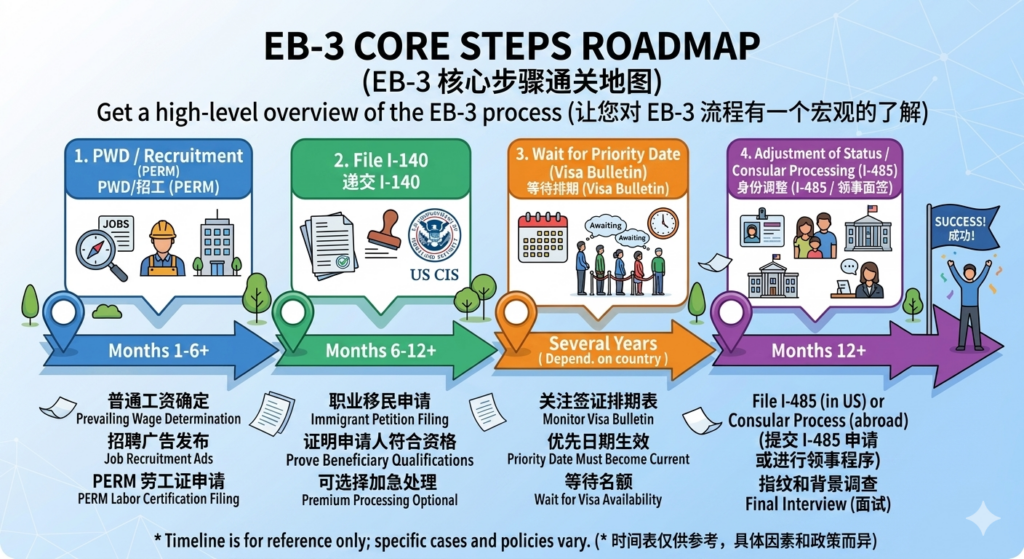
Step 1: PERM Labor Certification
Before USCIS will consider an EB-3 petition, the U.S. employer must obtain a permanent labor certification from the U.S. Department of Labor. This process, commonly known as PERM, is intended to ensure that hiring a foreign worker will not adversely affect the wages and working conditions of similarly employed U.S. workers. The PERM process is often the longest and most document-intensive phase of the EB-3 journey.
Prevailing Wage Determination
The first substantive action is obtaining a Prevailing Wage Determination from the DOL’s National Prevailing Wage Center. The employer submits details about the job, including its title, duties, requirements, and worksite location. The DOL then issues a prevailing wage that reflects the average wage paid to similarly employed workers in the specific geographic area. The employer must agree to pay the foreign worker at least this wage from the moment the individual begins work under the green card. Processing times for prevailing wage requests vary and can change based on DOL workload; employers should consult the official DOL processing times webpage for the most current estimates.
Recruitment and Labor Market Testing
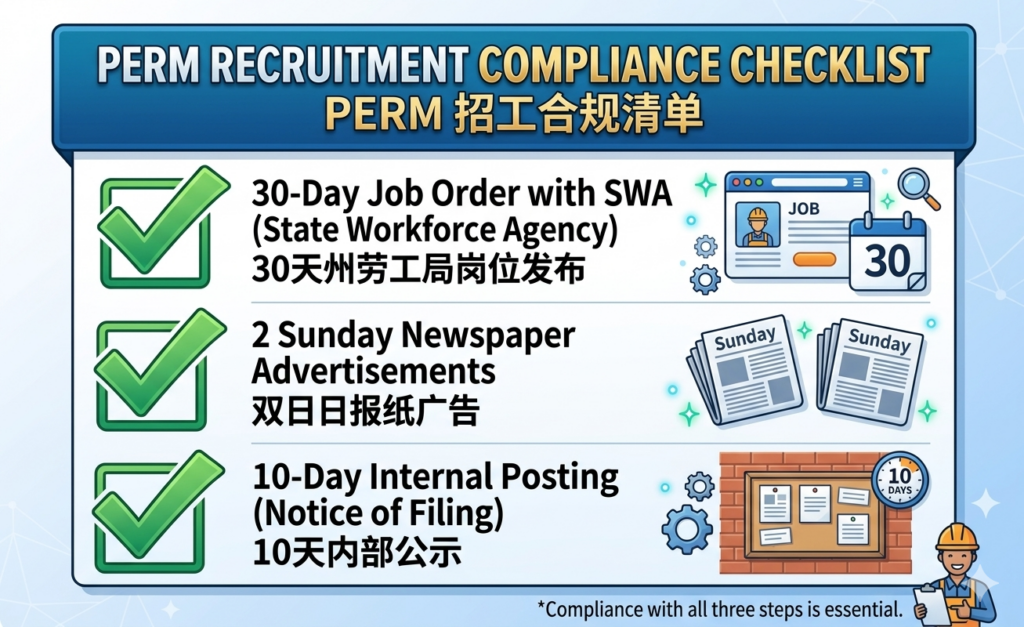
Once the wage is confirmed, the employer must conduct a good-faith recruitment campaign to test the U.S. labor market. For non-professional positions, this generally includes placing a job order with the State Workforce Agency for thirty days, running two print advertisements on separate Sundays in a newspaper of general circulation in the area of intended employment, and posting an internal notice of the job opening for ten consecutive business days. Professional positions require three additional recruitment steps, which may include employer website postings, job search website advertisements, on-campus recruiting, or trade journal ads.
The employer must interview any applicants who appear minimally qualified and must document lawful, job-related reasons for rejecting them. Recruitment records, including resumes and interview notes, must be retained for five years because they may be reviewed in the event of a DOL audit. It is critical that the job requirements listed in the recruitment phase match exactly with those later stated on the ETA-9089 application. Tailoring requirements to fit the foreign worker’s unique background is a common reason for denial.
Filing ETA-9089 and DOL Review
After the recruitment period concludes and no willing and qualified U.S. worker has been found, the employer files ETA Form 9089 electronically with the DOL. This form details the job duties, minimum requirements, offered wage, and beneficiary information. The DOL may certify the application, deny it, or select it for audit. There is no premium processing for PERM. Regular processing times fluctuate and depend heavily on DOL staffing and caseloads. If an audit is issued, the employer has a limited timeframe to respond with additional documentation, and the review timeline extends significantly. Employers and applicants should verify current PERM processing statistics through official DOL channels.
Step 2: Filing the I-140 Petition
With an approved labor certification in hand, the employer moves to the second major phase by filing Form I-140, Immigrant Petition for Alien Worker, with U.S. Citizenship and Immigration Services. The I-140 establishes that the beneficiary meets the job requirements and that the employer has the ability to pay the offered wage.
USCIS requires substantial evidence. The petition must include the certified PERM, proof of the beneficiary’s qualifications such as diplomas or experience letters, and detailed documentation of the employer’s financial health. To satisfy the ability-to-pay requirement, the employer typically must submit one or more of the following core documents:
- Federal corporate tax returns (企业联邦税表)
- Audited financial statements (审计财务报表)
- Payroll records (工资单记录)
These documents must show that the company’s net income, net current assets, or the actual wage paid to the beneficiary meets or exceeds the proffered wage from the date the PERM was filed.
USCIS adjudicators look at the totality of the circumstances when assessing ability to pay. A company that shows a net loss on its tax return may still qualify if it has substantial net current assets or if the beneficiary is already on payroll and earning the proffered wage. Conversely, a profitable company that pays its owners excessive distributions might face scrutiny if the remaining assets appear insufficient to cover the new wage. Clear, organized financial documentation presented at the I-140 stage prevents costly requests for evidence.
USCIS processing times for I-140 petitions vary by service center and are updated periodically on the USCIS website. In some instances, premium processing may be available for an additional fee, offering a faster adjudication timeframe for certain petitions. However, availability and eligible categories can change, so petitioners should confirm current premium processing rules directly with USCIS. If the I-140 is approved, the beneficiary’s priority date is locked in, and the case moves to the visa availability stage.
Step 3: Priority Dates and the Visa Bulletin
In employment-based immigration, the priority date is typically the date the PERM labor certification was filed with the Department of Labor. This date determines the beneficiary’s place in line for an immigrant visa number. Because Congress sets annual limits on employment-based green cards and imposes per-country caps, demand from high-volume countries often exceeds supply, creating backlogs.
Every month, the U.S. Department of State publishes the Visa Bulletin, which lists cutoff dates for each preference category and country of chargeability. For EB-3 applicants, it is essential to monitor both the employment-based third preference columns and, for EW3, the separate “Other Workers” column, which often moves more slowly. When a beneficiary’s priority date is earlier than the cutoff date listed in the Visa Bulletin, a visa number becomes available, and the case can proceed to final processing.
Visa bulletin dates can advance steadily, stall for months, or retrogress backward if demand spikes. Because these movements are unpredictable and tied to global visa demand, applicants should avoid making irreversible life decisions based on assumed forward progress. Checking the official Visa Bulletin each month and consulting with legal counsel when a date becomes current is the safest approach.
Applicants should also understand the concept of cross-chargeability. In some cases, a beneficiary may use their spouse’s country of birth for visa bulletin purposes if that country has a more favorable cutoff date.
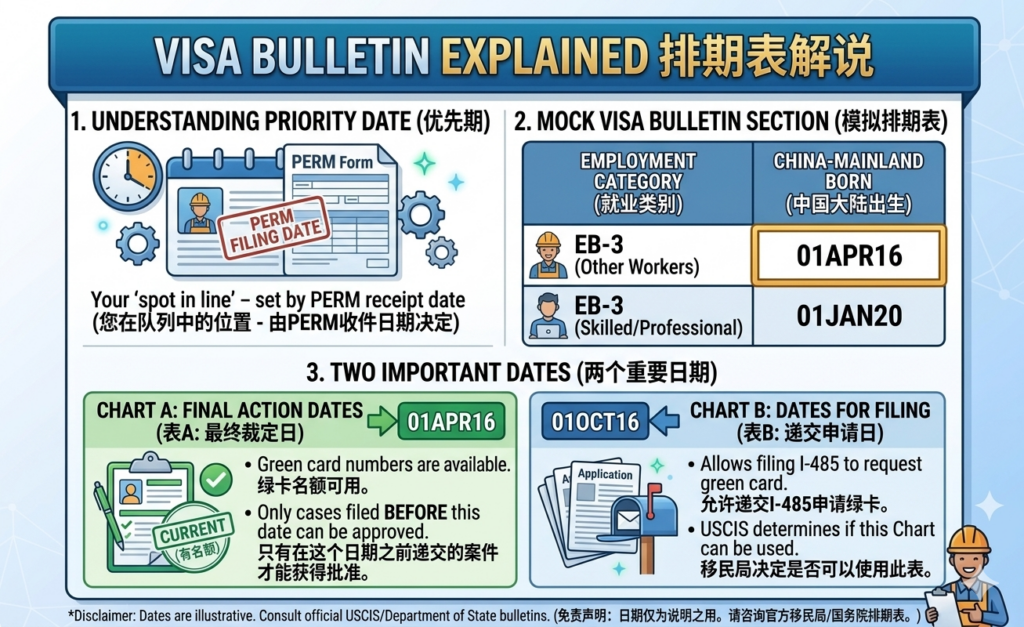
👉 Chart A vs. Chart B (Understanding the Visa Bulletin Charts)
Additionally, the Visa Bulletin publishes two charts each month:
- Final Action Dates (Chart A): Determines when an immigrant visa or adjustment of status may receive final approval.
- Dates for Filing (Chart B): Indicates when applicants can begin submitting documents to the National Visa Center or file an Form I-485.
Knowing which chart USCIS will honor for I-485 filing each month is critical, and USCIS typically announces this on its website around the time the Visa Bulletin is released.
Step 4: Consular Processing or Adjustment of Status
Once the priority date is current, the final stage of the EB-3 process begins. The path forward depends entirely on whether the beneficiary is inside the United States or abroad.
📍 Path A: Consular Processing (海外领事面签)
For beneficiaries residing overseas, the case is transferred to the National Visa Center (NVC).
- The NVC Process: The NVC collects immigrant visa fees, civil documents, and the DS-260 immigrant visa application.
- The Interview: After processing, the NVC schedules an interview at the U.S. consulate in the beneficiary’s home country (or a designated third-country post if eligible).
- Requirements: The beneficiary must complete a medical examination with an authorized panel physician and bring original documents to the interview. Consular officers will assess admissibility, verify the job offer, and confirm that the beneficiary is not likely to become a public charge. Interview wait times vary significantly by post and should be verified through the State Department’s official resources.
📍 Path B: Adjustment of Status (美国境内转身份)
For beneficiaries already in the United States in a valid nonimmigrant status, Adjustment of Status through Form I-485 may be an option if the priority date is current.
- Filing: In some cases, when the Visa Bulletin shows a current date, the I-485 can be filed concurrently with the I-140, though retrogression often prevents this for many EB-3 categories.
- The AOS Process: This involves biometrics collection, background checks, and potentially an interview at a local USCIS field office. Applicants may also apply for employment authorization and advance parole while the I-485 is pending. Processing times for I-485 cases differ by jurisdiction and are posted on the USCIS website.
Crucial Admissibility Considerations
During consular processing, employment-based immigrant visa applicants must demonstrate that they are not likely to become a public charge. Although the I-140 petition and the employer’s ability to pay normally satisfy this concern, consular officers retain discretion to request additional evidence of financial support. Applicants with significant health issues or criminal histories should address these matters before the interview.
For adjustment of status applicants, maintaining lawful nonimmigrant status up to the time of filing is highly advantageous, although certain provisions may protect those who fall out of status briefly depending on their circumstances. Unauthorized employment or status violations can create serious complications, so applicants should seek legal guidance before any status changes.
⚠️Common Compliance Risks
The EB-3 pathway is fraught with procedural traps that can delay or derail a case. Awareness of these risks allows both employers and employees to plan defensively.
PERM Audits (劳工证审计风险)
The Department of Labor can audit a PERM application randomly or for cause. A supervised recruitment audit requires the employer to conduct all recruitment under DOL oversight, which is time-consuming and expensive. More commonly, a request for evidence asks the employer to produce recruitment reports, business necessity justifications for job requirements, or proof of the company’s existence. Inconsistent information between the job posting and the ETA-9089 is a leading trigger for denial. Employers should treat every recruitment step with documentary precision.
Employer Instability (雇主稳定性风险)
If the sponsoring employer goes out of business, is sold in an asset purchase, or withdraws the I-140 before it is approved, the petition is generally abandoned. After the I-140 has been approved and the I-485 has been pending for at least one hundred eighty days, AC21 portability may allow the beneficiary to move to a new employer in a same or similar occupation. However, before that milestone, the employee is largely bound to the original sponsor. Due diligence on the employer’s financial stability is therefore not just advisable—it is essential.
Priority Date Retrogression (排期倒退风险)
Even after I-140 approval, a beneficiary’s priority date can retrogress, pushing the final green card interview months or years into the future. This is especially common in oversubscribed categories like EW3. During prolonged waits, dependent children may age out of derivative status. While the Child Status Protection Act can preserve a child’s age in certain circumstances, the calculations are complex and should be reviewed by an attorney.
Job Requirement Inflation (职位要求过高风险)
Employers sometimes inadvertently list requirements that are more stringent than normal for the occupation, inviting scrutiny. Conversely, requirements that appear tailored to the foreign worker’s exact resume raise red flags. The job description must reflect the actual, minimum requirements for the position in the standard labor market.
Illegal Financial Arrangements (非法资金往来风险)
Finally, both parties must avoid any arrangement in which the employee pays the employer for the labor certification or otherwise compensates the company for sponsorship. Such payments violate DOL regulations and can result in permanent denial of the labor certification and potential fraud findings. The entire process must be conducted in good faith, with the employer genuinely seeking a worker for a real job and the employee honestly intending to accept the position upon approval.
Key Takeaways
- EB-3 immigration requires a legitimate, permanent job offer from a U.S. employer that is financially capable of paying the prevailing wage throughout the process.
- The PERM labor certification is a high-stakes phase where strict adherence to recruitment rules, prevailing wage standards, and documentation retention can make or break the case.
- Approval of the I-140 petition does not guarantee immediate permanent residence; visa bulletin priority dates and per-country limits often dictate the real timeline.
- Employer continuity is critical until the I-140 is approved and, ideally, until the I-485 has been pending for one hundred eighty days to preserve portability options.
- Immigration procedures, government fees, and processing timelines change frequently; always verify the latest information through official DOL, USCIS, and State Department channels.
Frequently Asked Questions
What are the basic applicant requirements for EB-3 in 2026?
EB-3 applicants must have a permanent, full-time job offer from a U.S. employer. Skilled workers need at least two years of relevant experience or training. Professionals must hold a U.S. bachelor’s degree or foreign equivalent. Other workers must perform unskilled labor requiring less than two years of training. All applicants must be admissible to the United States and meet the specific qualifications of the offered position.
Can any U.S. employer sponsor an EB-3 worker?
No. The employer must be a real, operating business with a valid Federal Employer Identification Number and the financial capacity to pay the offered wage. The job must be bona fide, permanent, and full-time. Startups and small businesses can qualify, but they must provide convincing evidence of their ability to pay and their operational legitimacy.
How long does the entire EB-3 process take?
Total processing time varies widely based on DOL prevailing wage and PERM processing, USCIS I-140 adjudication, and visa bulletin availability. Some cases move in a few years, while others—particularly in the EW3 category or for nationals of high-demand countries—can take considerably longer. Government processing times and visa bulletin dates change regularly, so applicants should check official sources for current estimates.
What happens if my employer receives a PERM audit?
If the Department of Labor audits a PERM application, the employer must submit additional evidence, such as detailed recruitment reports, resumes of applicants, and business necessity documentation. The employer has a strict deadline to respond. An audit extends the overall timeline significantly and increases the risk of denial if recruitment was not conducted properly or if inconsistencies exist in the application.
Can I change jobs while my EB-3 case is pending?
If your I-140 is approved and your I-485 has been pending with USCIS for at least one hundred eighty days, you may be able to change employers under AC21 portability rules, provided the new job is in the same or a similar occupational classification. Before reaching that point, changing employers usually requires the new employer to start the PERM and I-140 process from the beginning. Always consult an attorney before making any employment changes.
Disclaimer
This article is for general informational purposes only and does not constitute legal advice. Immigration laws, government procedures, visa bulletin dates, and processing times may change. Readers should verify information with official sources or consult a qualified immigration attorney.